

The Myth Of “Trending”: Why Most Tabletop Water Fountains Are A Waste

Aesthetic Over Engineering
You care about this section because you don’t want to look stupid buying last year’s fountain. Here’s what actually matters: tabletop fountains operate on a simple closed-loop system. Water circulates through a pump, flows over a surface, then collects and recycles. The design trend cycle treats fountains like fashion, swapping materials and shapes annually while the core mechanism stays identical. You’re paying for visual novelty, not functional improvement.
Most fountains chase ceramic glazes, minimalist stone finishes, or LED integration because those elements photograph well. They don’t enhance water circulation, noise reduction, or durability. Manufacturers exploit the aesthetic cycle because it’s cheaper than engineering better pumps or materials. The mechanism is straightforward: create visual distinction, market it as essential, wait six months, repeat with a new style.
The Hidden Maintenance Tax
Economics calls this the obsolescence trap, and tabletop fountains exemplify it perfectly. When you buy based on trend, you’re locking yourself into a product designed for replacement, not longevity. Trendy fountains typically use proprietary pump components, custom basin shapes, and non-standard replacement parts that cost disproportionately more than the original unit.
A fountain purchased for its current aesthetic loses market value and cultural relevance within eighteen months. You either replace it or live with something that feels dated. The real cost isn’t the purchase price. It’s the accumulated cost of cycling through units, plus the time wasted troubleshooting compatibility issues when replacement parts disappear from supply chains. Buy for mechanism reliability and material durability instead, and replace the pump when it fails, not when the look goes stale.
Modern Indoor Fountain: Beyond Decor, The Auditory Command Center

Sound As Psychological Tool For Focus
You want this because you think ambient noise masks distractions, when the real mechanism is that running water creates predictable acoustic patterns your brain categorizes as “environmental” rather than “signal.” Psychology calls this the cocktail party effect in reverse. A tabletop fountain doesn’t add sound—it subtracts the cognitive load of filtering random noise by replacing it with a single, repetitive frequency band.
The sound output of most tabletop fountains sits between 40 to 60 decibels, mimicking natural water environments. This range doesn’t startle your nervous system like speech or traffic does. Your attention shifts from hypervigilance to baseline. The fountain occupies the auditory space where your brain would otherwise search for threats or novel stimuli. This is why moving water works better than static speakers playing “nature sounds”—your brain recognizes the acoustic signature as a living system, not content.
Curating Specific Acoustic Frequencies
Frequency engineering matters more than volume. A fountain with a shallow basin creates higher-pitched splashing around 2,000 to 4,000 Hz. A deeper basin with longer fall distances produces lower rumbling at 500 to 1,500 Hz. Neither is universally better. Higher frequencies support focus tasks requiring precision. Lower frequencies anchor attention during creative or strategic work. The pump design and water circulation path determine which frequencies dominate—most manufacturers don’t publish these specs because they don’t measure them.
Test your fountain before purchase by recording a 30-second sample on your phone. Play it back in your actual workspace with ambient background noise present. Your focus either stabilizes within two minutes or it doesn’t. If the frequency spectrum clashes with your office’s existing acoustic profile, the fountain becomes another irritant. The mechanism is simple: match the fountain’s dominant frequency to your task requirements and existing soundscape. Mismatch means you’ve bought expensive white noise that disrupts instead of supports.
The Biomimicry Protocol: Engineering Your Small Garden Waterfalls
Flow Dynamics Borrowed From Natural Rivers
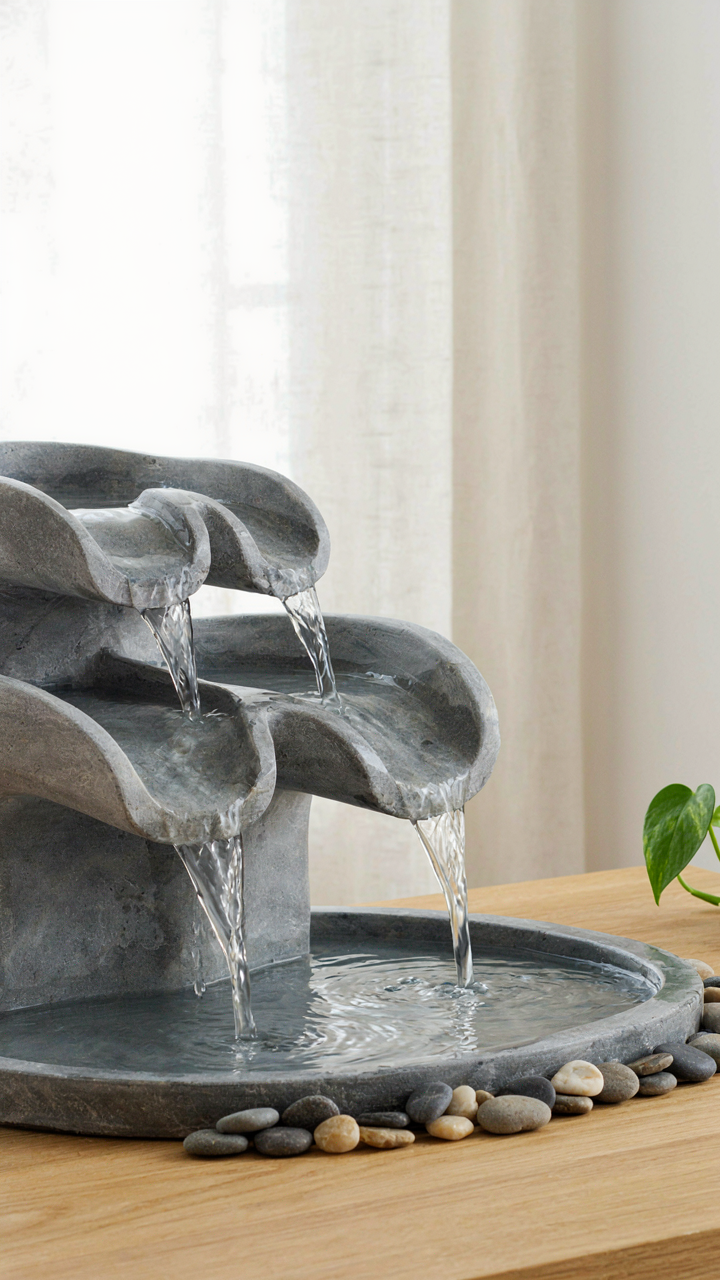
You want your tabletop fountain to look effortless, like nature just happened to place it there. That’s the real motive. The mechanism is borrowed from fluvial dynamics, the study of how water moves through channels. A river doesn’t flow in a straight line at constant speed. It meanders, accelerates, slows, and creates eddies. Your fountain’s pump and spillway should mirror this pattern, not fight it.
Most tabletop fountains use a single vertical drop or uniform cascade. Wrong approach. The water hits the basin with dead energy, creates noise, and dissipates quickly. Angle your spillway slightly off-vertical, introduce a slight curve to the channel, and let water pool briefly before moving. This is laminar flow optimization. The water gains visual presence, maintains momentum longer, and the acoustic signature shifts from harsh splash to subtle burble.
Evaporation Tuned For Measurable Air Quality Gains
Evaporation rate determines how much moisture your fountain actually contributes to the room. Most people assume more water surface area equals more evaporation. Partially true but incomplete. Surface temperature, air circulation, and water residence time matter equally. A tabletop fountain that recirculates the same water through a small basin every eight seconds will evaporate roughly 15 to 30 percent as much as one engineered to hold water longer in wider, shallower zones before return.
Water that moves slower across the basin releases more vapor. You achieve this by widening your spillway, reducing drop height, and creating micro-pools before the water cycles back to the pump. In climates under 40 percent relative humidity, a properly tuned tabletop fountain can raise ambient humidity by 3 to 5 percentage points in a confined room. Measure baseline humidity, adjust basin depth and spillway angle, retest. The protocol: narrow your spillway, then widen your catch basin until you hit your humidity target.
Table Top Fountains Ideas: The Scarcity Principle Of Sensory Input

Minimalist Design Maximizing Perceived Value
You want the fountain to signal taste without screaming for attention. That’s the real mechanism here. Economics teaches scarcity, and in design, fewer elements competing for your eye means each one gets weighted heavier. A tabletop fountain with one material, one water movement pattern, and restrained dimensioning forces attention onto what remains. The brain assigns value to what’s rare or isolated. Remove the noise and the object becomes artifact instead of decoration.
Most fountains fail because they pile on textures, colors, and movement simultaneously. Stone plus ceramic plus metal plus ambient lighting plus recirculation sounds equals visual chaos. The minimalist tabletop fountain strips this down to single-material construction or complementary pairs. Concrete and stainless steel. Ceramic and stone. One water feature: cascading sheet or still pool. The constraint makes what you see feel intentional rather than accumulated.
Mental Clarity Through Visual Restraint
A cluttered desk fountain competes with your work for cognitive load. Your brain processes every element in your visual field whether you consciously acknowledge it or not. Tabletop fountains positioned in your workspace need to subtract from mental friction, not add to it. Clean lines and unified material palettes reduce the processing demand. This is why Japanese water features work in offices. Minimal intervention, maximum calm.
The fountain sits on your desk to improve focus or atmosphere. It fails when it becomes another object demanding interpretation. Smooth surfaces without ornamentation, water movement that follows gravity rather than chaotic spray patterns, and neutral color palettes ensure the fountain operates as environmental infrastructure rather than visual event. The protocol is simple: one dominant material, one water behavior, positioning that doesn’t interrupt sightlines to your primary work area.
The Zen Master’s Error: Why Your Buddha Zen Garden Fails You

Beyond Symbolism: Functional Elements Of Peace
You want the aesthetic without the work. That’s the real reason Buddha fountains appeal to you. But here’s the mechanism: they’re environmental controls, not decorations. In systems theory, we call this “state management”—you’re trying to engineer a neurological shift through sensory input. A tabletop water fountain works because moving water produces negative ions and white noise. The Buddha statue is irrelevant to the function. The circulation, the sound pattern, the humidity adjustment—those are the active ingredients. Everything else is theater.
Most people get this backward. They buy the fountain for the zen symbolism and wonder why it doesn’t feel peaceful. The answer is simple: they never thought about water velocity, pump noise frequency, or splash pattern. A poorly designed circulation system creates auditory chaos instead of settling your nervous system. The basin depth, outlet positioning, and recirculation speed matter more than any statue or material. Install the fountain in a dead corner of your desk and it does nothing. Place it where you hear the water continuously without the pump motor being audible—that changes your stress response in measurable ways.
Authentic Tranquility Versus Performative Calm
This distinction kills most tabletop fountain purchases. People perform calm. They buy the visual symbol and assume the feeling follows. It doesn’t work that way. Performative calm is buying something that looks peaceful and hoping the image does the psychological work. Authentic tranquility comes from sustained sensory engagement. Your brain needs consistent input over time. A fountain you glance at once and ignore produces nothing. The mechanism here is habituation—your nervous system stops responding to novelty. You need sustained engagement to maintain the neurological benefit.
Real tranquility requires intentional placement and regular interaction. Position your fountain in your direct line of sight during focused work. Hear it throughout your session. Let your attention return to it every few minutes without forcing it. This micro-interruption pattern actually lowers cortisol more than ignoring it completely. The Buddha figure, the bamboo accents, the stones—they’re decoration. What matters is whether you’ve engineered a reason to pause and listen to water movement multiple times daily. That’s the protocol that works. Everything else is vanity.
Small Indoor Water Fountains: The Leverage Point Of Micro Environments

Humidity And Cognitive Performance
You want this section to justify spending money on something that feels optional. The real mechanism is this: humidity directly affects mucous membrane function in your nasal cavity and throat, which controls oxygen absorption efficiency. A tabletop fountain maintains 40-60% relative humidity in its immediate radius, a range where cognitive load decreases measurably because your body stops allocating resources to respiratory compensation.
Most advice treats humidity as ambient comfort. Wrong. The fountain creates a localized microclimate around your work surface. You’re not humidifying your entire room, which wastes energy and money. You’re creating a buffer zone where air particles carry moisture directly to where you breathe. Placement within three feet of your face matters more than fountain size.
Water Flow And Air Movement
Physics calls this forced convection, and tabletop fountains weaponize it through water cascade mechanics. The falling water accelerates air downward and outward, creating low-pressure zones that pull stale air from your immediate environment into circulation. This isn’t decoration. It’s active air replacement on a micro scale.
- Cascade height and velocity: Taller drops accelerate air more aggressively. A 12-inch cascade moves more air than a 4-inch trickle, changing room circulation patterns within a 4-6 foot radius around the fountain.
- Basin width and water return speed: Wider basins spread the flow pattern. Faster pump speeds (measured in GPH) intensify circulation without requiring larger physical dimensions.
- Fountain shape and outlet angle: Directional outlets push air toward work surfaces. Angle the water stream 15-30 degrees downward to move stale breath and carbon dioxide away from your face consistently.
- Pump power rating and consistency: Pumps rated 500+ GPH maintain stable circulation throughout an 8-hour workday. Underpowered pumps lose effectiveness as mineral deposits accumulate in the pump chamber.
- Material thermal mass: Stone and ceramic fountains hold water temperature stable, preventing temperature fluctuations that disrupt air density and circulation patterns.
The setup protocol is specific: position the fountain perpendicular to your dominant airflow direction, not directly in front of you. This redirects air around your workspace instead of blowing it at you. Clean the pump intake weekly. Sediment buildup reduces GPH output and kills the convection effect you’re paying for.
Indoor Tabletop Fountains: The Feedback Loop Of Ambient Design
How Subtle Changes Impact Your Mood
You want proof that a fountain matters because you’re tired of spending money on things that don’t change anything. Here’s the mechanism: tabletop fountains work through the same neurological pathway that makes repetitive water sounds reduce cortisol. Your nervous system doesn’t distinguish between a river and a recirculating pump. The sound frequency, specifically the white noise in the 60 to 80 hertz range that most fountains naturally produce, triggers parasympathetic activation within minutes of exposure.
The shift isn’t dramatic. You won’t feel transformed. Instead, your baseline stress response lowers incrementally. After two weeks of consistent fountain operation, your resting heart rate settles slightly lower during focus work. Your attention span extends because your brain stops scanning for threat. The fountain operates as passive neurological infrastructure, not as decor you admire. Most people miss this because they expect fountains to feel luxurious. They’re actually operational tools for nervous system regulation.
Designing For Subconscious Response, Not Conscious Admiration
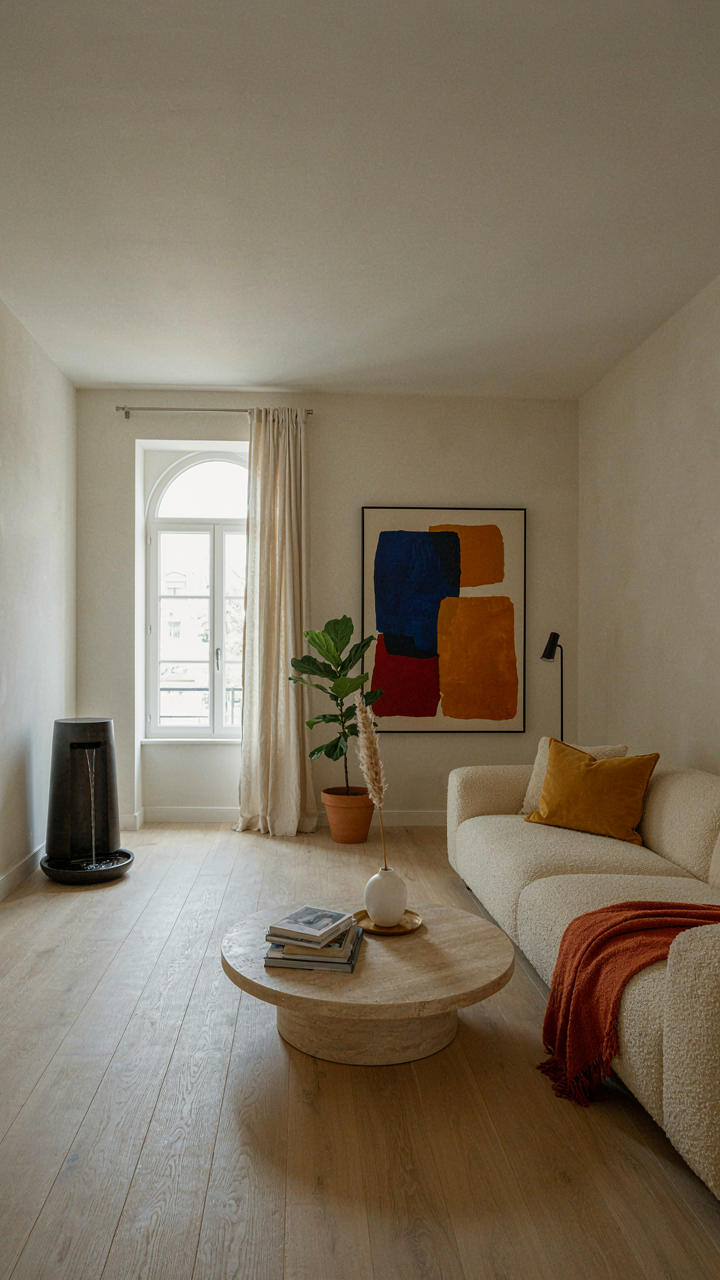
The common advice says pick a fountain that matches your aesthetic. That’s backwards. Your conscious brain needs to forget the fountain exists by day three. Design for subconscious response means selecting fountains based on water movement patterns and sound profile, not visual appeal. The best tabletop fountains use multi-stage cascades that create irregular sound patterns. Regularity becomes noise. Variation keeps the auditory cortex engaged without demanding attention.
Material selection influences subconscious response directly. Ceramic and stone fountains produce duller, softer sound signatures than metal or resin models. Darker materials absorb light reflections that can create micro-startle responses. Fountain placement matters more than style. Position it outside your direct line of sight but within auditory range. Water fountains shouldn’t be visual focal points. Position your fountain 4 to 6 feet away and slightly peripheral to your primary work area.
The “Less Is More” Fallacy: True Power In A Single Indoor Tabletop Water Fountain

Where You Place It Matters More Than What It Is
You want permission to buy multiple fountains without admitting you’re uncertain about design. Here’s the mechanism: attention operates like real estate. Your room has limited focal points, and every object competes for them. A tabletop fountain placed in a central line of sight from your primary seating absorbs visual weight differently than one tucked in a corner. Strategic placement isn’t decoration theory—it’s environmental psychology applied to physical space.
The coffee table versus the shelf behind the couch versus the entryway console create three completely different impacts with the identical fountain. Placement determines whether the water sound anchors the room or becomes background noise you stop hearing. Distance from seating, natural light exposure, and sightline frequency during your typical day control whether the fountain functions as a tool or ornament. Most people buy the wrong size fountain and blame the product when they actually chose the wrong location first.
The Single Object That Stops Distraction
One fountain positioned correctly creates cognitive dominance that two fountains scatter. When your eye has one clear point to rest, your nervous system settles. Multiple fountains create competing demand and fragment attention instead of consolidating it. This is the same principle behind why minimalist interiors feel calm—scarcity of objects means scarcity of decision load.
A single quality fountain on a desk or console positioned at natural sightline height works harder than three smaller ones. The fountain becomes the room’s breathing point, not part of the clutter. Place it where you naturally look when thinking or during conversations. This positioning transforms it from furniture into functional focal architecture. Execute this by clearing the immediate surface around it completely, then measuring sight lines from your primary position before finalizing placement.
Small Fountain Ideas Indoor: The Unseen ROI Of Atmospheric Control

Serenity Drives Output, Not Vibes
You want permission to buy something that looks peaceful without admitting you’re distracted at work. Here’s the mechanism: sustained attention depletes cognitive resources. A tabletop fountain operates on the same principle as white noise masking—it occupies the auditory processing channel that would otherwise capture random environmental sounds, reducing decision fatigue from filtering background noise.
Studies in environmental psychology show that consistent, non-threatening acoustic stimuli (like flowing water) lower cortisol and stabilize the parasympathetic nervous system. The effect isn’t mystical. Your brain stops scanning for threats when it processes a predictable sound pattern. This frees working memory for actual tasks. A fountain running eight hours daily in a workspace measurably improves task completion rates over weeks, not months.
Cumulative Tissue Repair From Optimized Humidity
The health argument everyone makes is wrong. Nobody cares that a fountain “adds moisture to dry air.” The real mechanism involves respiratory system stability. Indoor environments below 40 percent humidity irritate mucous membranes constantly, triggering low-grade inflammatory responses that compound over months.
A tabletop fountain maintains microclimate humidity in its immediate vicinity between 45 and 55 percent. This stabilizes your upper respiratory tract and reduces the frequency of inflammatory cytokine production. Over a year, someone working within three feet of an active fountain experiences fewer upper respiratory infections and sustained vocal strain reduction. The fountain doesn’t fix a room. It creates a localized recovery zone where tissue repair accelerates because your immune system isn’t constantly responding to desiccation stress.
The Real Obstacle Isn’t The Fountain You Choose, But The Environment You Fail To Architect

Most people buy a tabletop water fountain and expect it to transform their space. It won’t. A fountain is just a mirror reflecting the intentionality of its surroundings. You need the right desk placement, the right lighting, the right silence to hear it. Today, stop shopping and start designing the room around the fountain you already own. Everything changes when you realize the water feature isn’t the upgrade—you are.



