
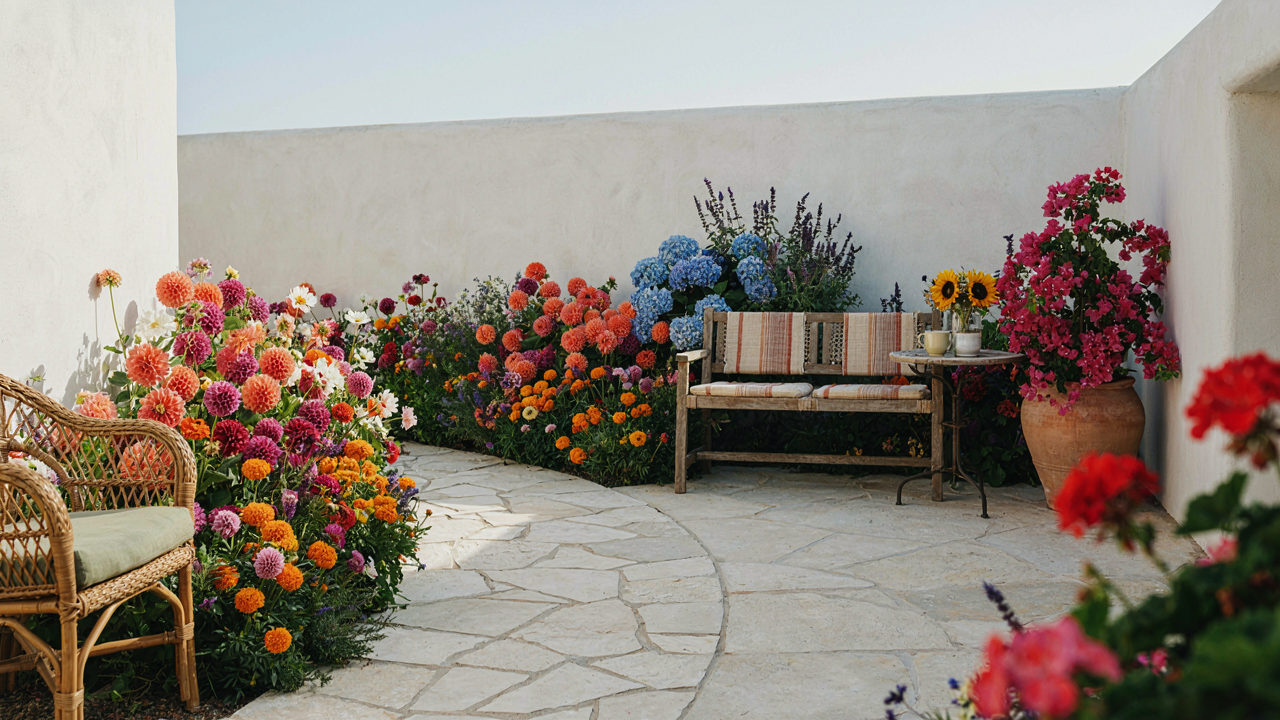
The Illusion Of Low Maintenance: Why Most Patio Flowers Fail

Popular Plants That Demand More Than They Deliver
You want to believe a patio garden is passive income for your outdoor space. It isn’t. The standard recommendations—impatiens, begonias, petunias—work against your actual constraints, not with them.
Impatiens need consistent moisture and fail in direct sun, requiring daily watering in heat and careful shade placement. Begonias demand humidity most patios can’t provide, leading to powdery mildew and spider mites by mid-summer. Petunias seem hardy until deadheading becomes a weekly chore or they stop blooming entirely. You end up with plants that need babysitting, not decoration.
The mechanism is simple: nurseries sell what’s cheap to propagate, not what actually performs on patios. They move volume. You’re stuck maintaining something that was never designed for your conditions. The better move is selecting plants that thrive with neglect—sedums, ornamental grasses, and calibrachoa actually reward you for ignoring them.
Microclimates Are Where Your Plants Go To Die
Patio flower gardens fail because most gardeners treat their space like it’s one uniform environment. It isn’t. Microclimate design is a concept from ecological systems: small pockets of distinct conditions create their own rules independent of the larger area.
Your patio’s north side stays 8-12 degrees cooler and holds moisture longer than the south. East-facing areas get morning sun but afternoon shade. Corners against walls radiate heat back onto plants, creating stress zones. Wind tunnels form between structures, drying soil twice as fast. Reflective surfaces bounce light and heat unpredictably. Plant a sun-lover in a wind tunnel or a shade plant against a heat-radiating wall, and it doesn’t matter how perfect the species is—it fails because the microclimate is hostile.
Map your patio’s light patterns across three days at different times. Identify wind direction and intensity. Touch the soil moisture at different spots 24 hours after rain. The plants you choose must match these actual conditions, not generic “full sun” or “partial shade” labels. This isn’t optional refinement—it’s the entire foundation.
The ‘Perennial Power’ Protocol: Year Round Garden Patio Impact

Build Bloom Sequences That Never Quit
You want your patio to look intentional without effort, which means you need perennials doing the work instead of annuals dying on you every season. Here’s the mechanism: perennials store energy underground, so they return reliably year after year. Annuals burn out. This isn’t preference. It’s biology. Select species that bloom in overlapping windows across spring, summer, and fall so something flowers when something else fades.
Stagger bloom times by choosing early bloomers like Hellebores and Peonies, mid-season performers like Coreopsis and Salvia, and late bloomers like Asters and Sedum. Don’t plant them randomly. Map bloom calendars before digging. Group plants by their peak months so you get continuous color without gaps. This requires front-end planning, not guesswork.
Hardscape Creates The Frame That Lasts
Stone, gravel, and built structures are the skeleton perennials hang on. Most people think hardscape is decoration. Wrong. Hardscape controls water drainage, defines planting zones, prevents soil erosion, and makes your patio look finished even when plants rest in winter. The real work is placement. Hard features that frame beds create the visual anchor. Perennials become the texture that changes within a stable structure.
Use pavers or gravel pathways to separate planting areas and create zones. Install raised beds or borders in stone or metal to contain soil and prevent spreading. Position structures to guide eye movement and create depth. Hard materials don’t fade, rot, or require replanting. They hold value and structure while perennials do the seasonal labor. Build the frame first. Fill it with flowers second.
Cultivating Cohesion: Beyond Random Colorful Flower Beds

Color Theory In Action
You want your patio to look intentional because a scattered mess signals you don’t know what you’re doing. The mechanism is contrast. Color theory borrowed from painting and graphic design maps directly onto planting: value (light versus dark) controls visual hierarchy, not hue alone.
Most designers default to the tired “complementary colors” rule without understanding why it works. Complementary pairs (blue and orange, purple and yellow) create maximum contrast by sitting opposite on the color wheel. In a patio bed, this contrast stops the eye and creates perceived depth. A single salmon-colored flower against deep purple foliage reads as intentional. A random mix of reds, pinks, and purples reads as accident.
Start with a dominant color that covers 60 percent of your planting area. Choose something tied to your patio’s hardscape or your home’s exterior. Then add a secondary color at 30 percent for transition. The remaining 10 percent goes to an accent color that creates the contrast point. This isn’t arbitrary. Stick to this ratio and your beds cohere.
Texture And Form As Structure
Plant architecture matters more than flower count because form creates visual weight that holds a design together when blooms fade. Think in terms of engineering: you’re building layers of height, silhouette, and surface density, not arranging colors.
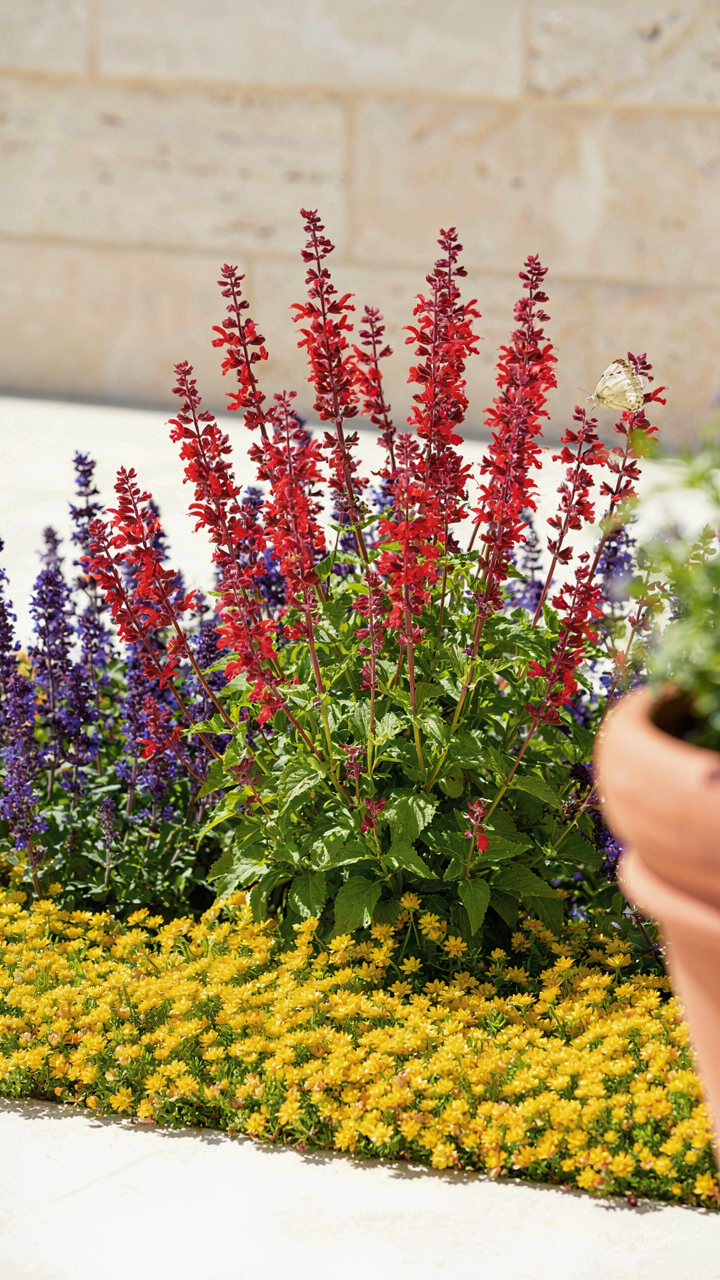
Vertical plants anchor the back of beds and provide visual lift. Spiky plants like salvias or delphiniums create line and movement. Mounding plants like catmint or sedums fill space and soften edges. Prostrate or trailing plants like creeping thyme soften hardscape boundaries. These categories aren’t decorative labels. They’re structural roles. A bed without vertical anchors collapses into visual flatness even with peak blooms.
The interplay of fine-textured foliage against bold-leaved plants creates rhythm without relying on flower color. Feathery artemisia next to broad hosta leaves makes both more visible and interesting. Combine three distinct forms per bed to avoid monotony: one vertical, one mounding, one trailing. Plant the vertical element first, then scale the mounding plants to two-thirds the height of your vertical anchor. Fill remaining space with the trailer. This is the protocol.
The Unseen Architecture: Designing Your Flower Bed Around Patio For Flow

Zoning And Pathways
You want people to notice your garden and assume you have taste. The real mechanism is friction. Landscape architecture borrows from urban planning the concept of desire paths—the routes people naturally walk. Your patio flower beds either guide movement or create dead zones. Place focal beds at decision points: where the patio meets the yard, where sight lines break, where foot traffic naturally pauses. This isn’t decoration. This is choreography.
The mistake most people make is treating the patio as the endpoint. It’s not. Your flower beds should create a visual argument that pulls the eye and body forward in sequence. Use low plantings near seating to keep sightlines open. Use taller specimens at 6 to 10 feet away to create depth and anchor the space. Hard edges—pavers, stone borders, low steel—define zones. Soft edges—spilling perennials, gravel transitions—invite exploration. The patio itself becomes a node in a system, not a isolated platform.
Vertical Gardening
Patio space is finite. Height is free. Most people respond to this fact by buying a trellis and bolting it to a fence. That’s not vertical gardening, that’s decoration on a wall. Real vertical gardening uses the third dimension as structural design. Your bed doesn’t just sit flat. It uses tiered plantings, espalier forms, and stacked containers to multiply usable square footage and create the visual impression of abundance without suffocation.
Trellises, arbors, and wall-mounted systems serve two functions. First, they solve the math: you fit 40 percent more plant material into the same ground footprint. Second, they break up sightlines and create micro-zones within the patio garden. A 3-foot wide patio feels smaller when you add 6 feet of vertical structure. The human eye reads depth as spaciousness. Stack your plantings. Use climbers on hardscape edges. Hang specimen containers at eye level on existing walls or fence lines. This compounds your design impact without requiring land you don’t own.
The Biome Blueprint: Engineering A Self Sustaining Patio Flower Garden
Plant Communities That Actually Thrive Together
You want a patio garden that runs itself so you stop obsessing over it. Here’s the mechanism: ecosystems work because plants fill different vertical and nutritional niches simultaneously, which means less competition and more efficiency. Borrow from ecology—think of your patio as a “community assembly” problem, not a collection of individual specimens. Plants that evolved together in the same climate zones outperform random combinations because their root depths, water needs, and nutrient demands don’t collide.
Native plant communities demonstrate this most clearly. A meadow doesn’t survive by chance. Tall plants anchor nitrogen-fixing species near their roots. Mid-story flowers attract specific pollinators that then service low-growing ground covers. The system self-regulates because each layer feeds the layer below it. Your patio works the same way when you stack plants by height and function rather than aesthetic preference alone.
Soil As The Engine Of Everything
Most patio gardeners treat soil like a cosmetic detail and obsess over the plants. Wrong. Soil is the operating system. Nutrient cycling—the breakdown of organic matter into available plant food—depends entirely on soil structure, microbial life, and water retention capacity. You cannot engineer a self-sustaining garden in depleted, compacted, or inert substrate. That’s not pessimism; that’s physics applied to containers.
Build your soil with a 40 percent compost base mixed into existing patio bed soil or potting medium. This single ratio creates the water-holding capacity that prevents feast-famine cycles while preserving drainage. The compost feeds microorganisms that then convert locked nutrients into plant-available forms continuously. Check soil moisture at four inches depth before watering rather than guessing by surface appearance. This discipline prevents the most common patio mistake: overwatering soil that has poor structure and cannot actually hold moisture where roots need it.
Discipline In Design: Eliminating Overwhelm In Patio Flowers

Less Choice, More Impact
You want options because options feel like control, but options in a small patio space create visual noise that cancels itself out. The real mechanism here is constraint: limitation forces clarity. When you plant five species instead of fifteen, each one registers. When you plant fifteen, your brain stops processing and sees clutter.
Minimalist planting means choosing one primary flower type per zone, then one supporting accent, then stopping. A patio with six zoned clusters of two plants each beats a patio with thirty scattered specimens fighting for attention. The dopamine hit comes from coherence, not quantity. Plant accordingly.
The Repeating Unit Principle
Design borrowed from landscape architecture uses the repeating unit: a single grouped composition deployed across space to build rhythm and coherence. In patio flowers, this translates directly. The rule of three means one primary plant, one secondary, one filler or foliage. Repeat this exact trio in three separate patio zones minimum.
- Primary plant: The visual anchor, typically tallest, blooms longest. Examples include zinnias, coneflowers, or roses depending on your sun exposure and hardiness zone.
- Secondary plant: Contrasts in texture or color, fills gaps, blooms at different intervals. Dusty miller, salvia, or ornamental grasses work here.
- Filler or foliage: Provides mass without competing. Sweet potato vine, alyssum, or artemisia creates continuity across repeating groupings.
- Spacing consistency: Plant each trio at identical distances apart. This repetition trains the eye to move smoothly through your patio instead of jumping randomly.
- Seasonal overlap: Stagger bloom times between your three plants so one is always performing while others recover or transition.
Repeat this trio three times minimum across your patio. The pattern itself becomes the design. Your brain recognizes it, the repetition feels intentional, and the space reads as curated instead of random. Stop overthinking and plant the same grouping again.
The “Adaptive Strategy” For Outdoor Garden Ideas

Allocate Resources Where They Compound
You want your patio to look effortless. That’s the real reason you’re reading this. Military strategy calls this “force concentration”—deploying your assets where they create the most leverage. In patio gardening, this means spending your money, space, and maintenance effort on the plants that actually perform in your specific conditions, not on trending varieties that look good in someone else’s yard.
Most gardeners spread resources evenly. They buy six different plant types, give each equal square footage, and then wonder why half die while one thrives. The mechanism is simple: plants have different water needs, light requirements, and survival rates in your microclimate. Identify which species actually want to grow where you are, then load that area with abundance. Skip everything else.
Prepare For The Plants That Will Die
Failure isn’t optional in patio gardening. It happens. The lazy advice says “just pick hardy plants and you’ll be fine.” That’s incomplete because even hardy plants fail under specific stress—unexpected frost, soil compaction, pest pressure, or simple neglect. Real contingency planning means designing your patio with built-in redundancy and knowing which plants to sacrifice first.
Map your patio into zones. High-performance zone gets your premium specimens in optimal positions. Buffer zone surrounds it with plants that tolerate stress better and cost less to replace. When something fails in the buffer, you replace it without losing your entire design. When something fails in the high-performance zone, you have adjacent plants positioned to visually compensate while you address the problem. This prevents one dead plant from looking like total failure.
Beyond Blooms: Integrating Function Into Your Cozy Garden Inspiration
When Herbs Become Hardscape
You want your patio to justify itself beyond Instagram photos. That’s the real reason you’re reading this. The mechanism is simple: edible plants function as both ornament and utility, which means your garden produces tangible value instead of just existing.
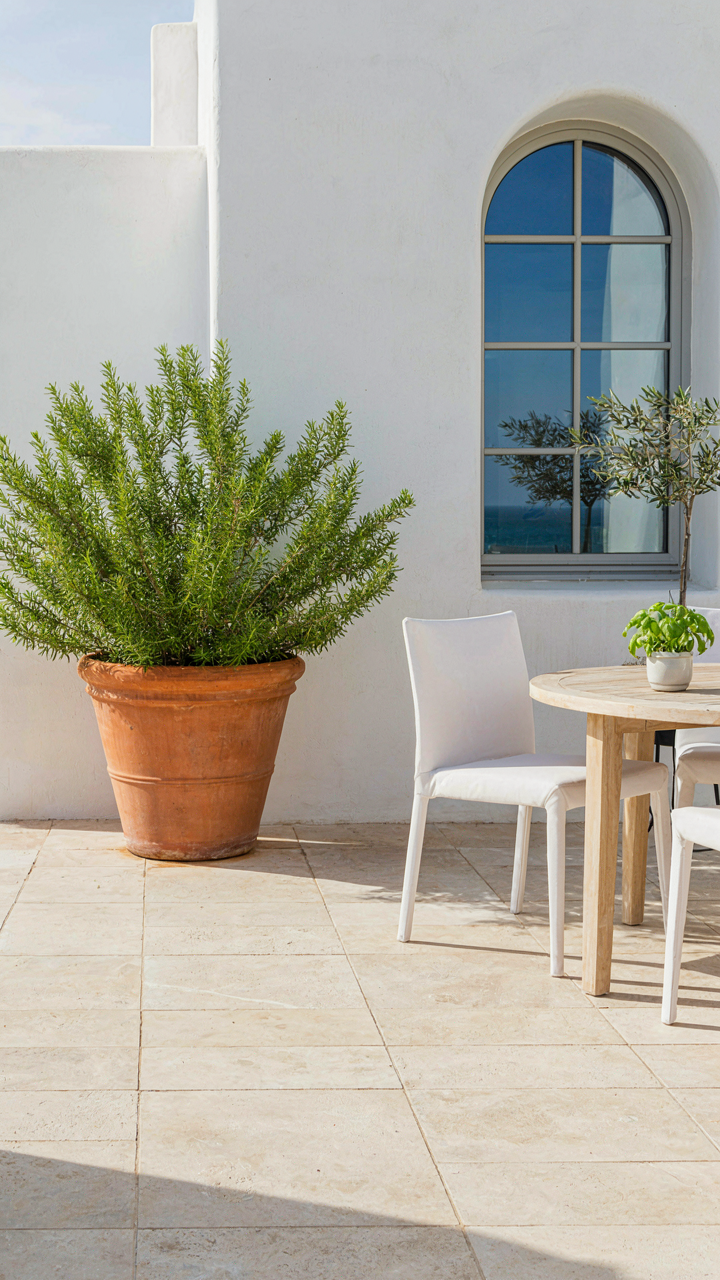
Herbs like basil, rosemary, and thyme deliver visual interest while serving your kitchen. Plant them in containers or integrated beds at the patio’s edge, not hidden in corners. They need 6-8 hours of direct sun, well-draining soil, and regular harvesting to stay compact. The act of cutting them shapes their growth and triggers bushier development. Leafy greens like lettuce and chard work in shallow containers and tolerate partial shade better than most herbs.
The real leverage comes from placement strategy. Put high-use herbs like basil within arm’s reach of your seating area or kitchen door. This removes friction from the decision to cook with them. Position slower-growth perennials like rosemary toward the patio’s back, where they establish without competing for attention. Edibles and ornamentals solve the same spatial problem simultaneously, which means you stop choosing between beauty and purpose.
Light And Seating Create Extension
Lighting and seating determine whether your patio functions after sunset or becomes unused. Most people treat these as decorative afterthoughts, which is why their patios sit empty once the sun dips. Both elements control whether the space functions as an extension of your home or just a daytime pass-through.
Task lighting serves a specific purpose: it makes the space usable. String lights mounted overhead or warm-toned uplighting on plants extends your patio’s operating hours without creating harsh shadows. Path lighting along garden edges prevents stumbling and defines the garden’s boundaries. Seating placement matters equally. Position chairs to face your best plant displays or garden views, not toward the house wall. This shifts your focus outward and makes the garden feel intentional rather than incidental.
Seating density determines traffic flow. One isolated chair suggests the space is supplemental. A small bench or pair of chairs positioned to encourage conversation signals that the patio matters. Include side tables or ledges for drinks and plants at seated height, which removes the need to stand up repeatedly. When lighting and seating converge on creating a functional gathering point, your patio stops being decoration and becomes territory you actually inhabit.
The Master Gardener’s Mindset: Evolution, Not Perfection

Watch Your Space, Not The Magazine
You want the garden to validate your taste before you’ve earned it. That’s the trap. Here’s the mechanism: biology doesn’t care about your aesthetic theory. Your patio has light patterns, wind exposure, soil drainage, and microclimate zones that shift throughout the season. Most gardeners skip this step because it feels like work instead of design. The real leverage is observation. Spend two weeks watching how sun moves across your space, where water pools after rain, which corners stay perpetually damp, and which dry out in hours.
This isn’t optional groundwork. It’s the foundation for every choice that follows. You’ll notice that a shade-loving plant thrives on the east side but struggles on the west. You’ll see that afternoon heat burns certain flowers in July but not June. You’ll watch wind patterns flatten tall stems in one corner while another stays sheltered. Document this through photos or notes. The patterns you identify become your design constraints. These constraints are not restrictions. They’re the actual rules your garden operates under, and working against them wastes money and time.
Refine Through Real Feedback, Not Revision Fantasy
Most people treat their garden like a first draft that needs editing. They’re wrong. A garden is a living system that provides constant feedback, but only if you’re reading it correctly. The difference between this and random trial-and-error is simple: you change one variable at a time and observe the result over a full growing season. Don’t replant the entire bed because three flowers underperformed. Move one struggling species, adjust watering for one section, or add structure to one area. Watch what happens. This is how you build actual knowledge instead of just rearranging deck chairs.
The master gardener doesn’t chase Pinterest photos from different climates. They evolve their garden based on what their specific patio teaches them each year. The garden tells you what works here. Flowers that thrive become the anchors. Plants that struggle either need repositioning or replacement. Spacing that looked right in spring might reveal overcrowding by August. Container sizes that held up last year might need adjusting this year based on growth patterns. Your protocol: document what bloomed well, when it peaked, and what conditions supported it. Next season, you replicate those conditions intentionally. This builds a garden that actually works instead of one that just looks like it should.
The Real Obstacle Isn’t Your Patio Size; It’s Your Willingness To Break Free From Suburban Conformity

Most people sabotage their patio flower garden design before they even start. They copy what their neighbors planted. They follow magazine layouts. They play it safe. But your patio reflects your taste, not theirs. Spend thirty minutes today sketching one unexpected flower combination that makes you slightly uncomfortable. That discomfort is where your actual design begins. Your patio doesn’t need to look like everyone else’s to look good.



