

The Futility Of Stylish Greenhouse Layouts

Aesthetics Cripple Plant Health
You want your greenhouse to look like a design magazine spread because you think it means you’re serious about growing. The mechanism killing your plants is simple: aesthetics demand symmetry, tight spacing, and visual balance. Plants need airflow, light penetration, and root room. These requirements ignore Instagram. When you prioritize how a layout looks over how air moves through it, you create dead zones where humidity pools and fungal disease thrives.
The common advice says “arrange plants by height” or “create visual layers.” This is incomplete. Airflow velocity matters more than visual rhythm. A greenhouse designed around appearance forces you to bunch similar-height plants together, blocking air from reaching lower canopy. Plants in the middle of your pretty arrangement rot from the inside out while you photograph the edges. Spacing decisions must follow microclimate physics, not design principles borrowed from interior decorating.
The Real Cost Of Instagrammable Setups
Every hour spent arranging plants for a photo is an hour not spent monitoring for pest pressure or adjusting ventilation. The cost isn’t just wasted time. Instagrammable layouts prioritize visual coherence over functional zones, meaning you can’t isolate sick plants fast enough to prevent spread. One diseased specimen in a tightly composed arrangement contaminates neighbors before you notice.
Redesigning a greenhouse after disease outbreak takes weeks. You’ll lose entire batches replanting in a functional layout. The financial hit compounds when you factor in treatment costs and replacement stock. Start with layout that serves airflow and disease containment. Aesthetics arrive last, after the system works.
The “Light Funnel” Protocol: Maximizing Photon Capture
How Solar Angle Changes Everything
You want your greenhouse to look intentional, not like you scattered plants randomly. That’s the real driver here. The mechanism is solar geometry: the sun’s angle shifts 47 degrees between summer and winter solstice in most temperate zones. This isn’t decoration advice. It’s physics applied to layout. Tall plants on the north side stop blocking light from reaching shorter species on the south. Orientation matters because the angle of incidence determines how much light actually penetrates the canopy layers below.
Most growers ignore seasonal sun paths entirely and wonder why winter growth tanks. Your plant placement needs to account for sun travel, not fight it. East-facing sections catch morning light when plants need it most for photosynthesis initiation. West-facing spots intensify midday heat, useful for heat-loving crops but harsh for seedlings. North placement becomes storage or shade-tolerant species territory. Layout locked into summer angles fails in winter. Adjust placement by season or plan permanent zones that work year-round by height stratification alone.
The Vertical Stack Principle
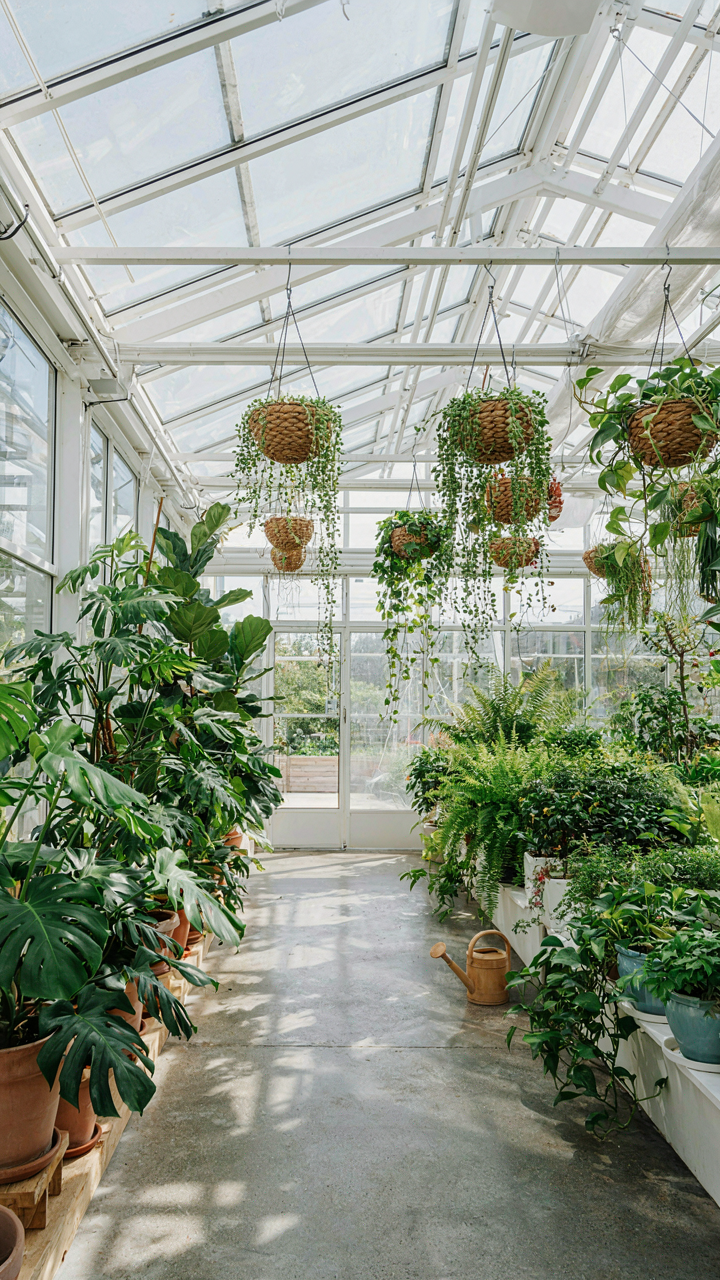
Light doesn’t just come from above. Reflectivity and lower-canopy penetration compound your usable light real estate by up to 40 percent if structured right. Think of a greenhouse as a three-dimensional light harvesting system, not a flat surface. Bench height, hanging systems, and tiered staging all intercept light at different angles and pass it down to secondary levels.
Ground-level benches receive direct overhead light plus bounce from upper foliage and reflective surfaces. Hanging baskets from rafters use airspace that would otherwise sit empty. Vertical stacking turns a 200-square-foot floor into 500-square-foot-equivalent growing capacity without expanding the structure. The protocol: reserve high-light zones for species needing full intensity, middle tiers for moderate-light crops, lower benches for shade-tolerant varieties. This layering compounds yield per square foot and keeps air circulation moving through all levels, preventing fungal risk that static arrangements create.
Fluid Dynamics For Greenhouses: Airflow Is Life

Why Stagnant Air Kills Plants Faster Than Neglect
You want a greenhouse that looks curated and Instagram-ready, but dead plants ruin that aesthetic fast. Here’s the mechanism: stagnant air creates microclimates where humidity pools, fungal spores germinate, and heat traps form. Borrowing from fluid dynamics, think of your greenhouse layout as a pressure system. Air needs gradient—zones of higher and lower pressure that force movement. Plants don’t photosynthesize better in still air. They need CO2 circulation, moisture evaporation from leaves, and temperature consistency. Without forced or passive movement, you’re growing disease vectors, not specimens.
The common advice says “just open a vent.” That’s incomplete. Strategic layout matters before you ever install a fan. Position your tallest plants where they won’t block air paths. Cluster dense foliage away from intake zones. Stack shorter specimens where exhaust occurs. This isn’t decoration—it’s engineering your greenhouse to move air through every cubic foot. Air movement prevents disease, boosts growth: this is cause and effect, not opinion.
Designing For Passive Ventilation And Heat Dissipation
Most greenhouse owners ignore passive ventilation until summer kills everything, then panic-buy fans. Build your layout to leverage temperature differentials and natural convection from day one. Hot air rises. Cold air sinks. Your benches, plant clusters, and walkway positions either cooperate with this or fight it. Place taller plants and dense growth on the western or southern side where heat builds first. Leave the northern side or lower benches open for cooler, denser air to settle. This creates natural circulation without electricity.
Heat dissipation depends on surface area exposure and air velocity over leaves. Wide, open spacing between pots forces air to move around each plant instead of funneling between them. Tiered or elevated benches work better than flat rows because they expose more leaf surface to moving air. Orient your main walkway perpendicular to prevailing wind direction if your greenhouse has ridge vents or louvers. This principle ensures outside air pressure pushes across the entire growing area rather than creating dead zones where nothing moves and moisture concentrates.
The “Workflow Compression” Method For Greenhouse Gardening Layout
Tool Storage And Access Points
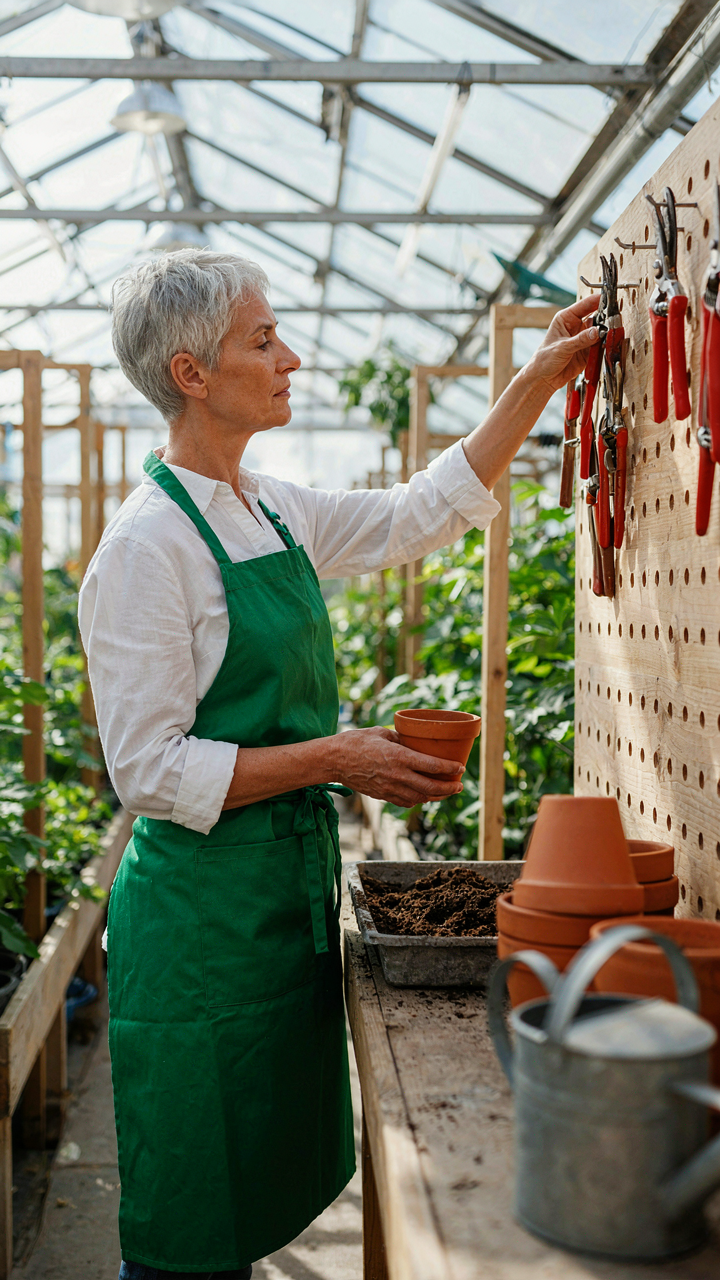
You want a greenhouse that looks intentional because you’re tired of spaces that scream neglect. Here’s the mechanism: every step you take to grab a tool is a step you won’t take again, so you’ll abandon the task instead. Borrow from assembly line thinking—what manufacturing calls “line balancing” is your tool placement strategy. Position hand tools, fertilizer, pruning shears, and soil amendments within arm’s reach of your main work zone. One zone per task. No hunting.
The common advice says “organize your shed.” That’s incomplete. You need spatial clustering, not just neatness. Mount tools on the greenhouse wall perpendicular to your primary plant rows, not on some back shelf. Store your most-used items at waist height. Reserve high shelves for seasonal stock. Low storage for heavy bags. Measure the actual distance from your potting bench to where you spend 80 percent of your time. That distance should never exceed three steps.
Irrigation And Nutrient Delivery Efficiency
Irrigation layout determines whether you water plants or water walkways, and most people choose the latter by accident. Drip lines should follow your plant rows exactly, not feed from a central point that forces you to troubleshoot pressure loss and uneven delivery. Gravity works downhill regardless of your intentions, so position your water source higher than your plants when possible. If you’re using a tank system, this matters more than the tank size.
Nutrient delivery integrates with irrigation, not as an afterthought. Run your main line along the back or perimeter of the greenhouse to minimize foot traffic over water delivery infrastructure. Connect secondary lines to individual plant zones. This prevents a single clogged emitter from forcing you to diagnose the entire system. Check your drip line layout monthly by running water with no plants present and watching for pooling or dry spots. Fix it then, not during a growing cycle.
Greenhouse Floorplan: Engineered For Expansion, Not Stagnation

Design For Growth, Not Instagram
You want a layout that photographs well and impresses visitors without admitting you’re building for the future. The real mechanism here borrows from systems architecture: you need modularity—treating your greenhouse as a living organism that accepts new organs without requiring a complete rebuild. Most people design static showcases. You design scaffolding.
Modular design means establishing zones that operate independently but connect logically. Use movable benching, adjustable shelving systems, and flexible water lines rather than fixed infrastructure. Your first layout won’t be your last, and fighting against that truth costs time and money. Build pathways wide enough to move benches. Run water and electrical to multiple points, not single locations. Leave wall space unplanted. The goal is adding species and rearranging without demolition.
Paths That Move, Not Decorate
Pathways feel like dead space until plants crowd your greenhouse and you can’t reach anything. Common advice treats them as design elements. They’re not. They’re logistics. A functional path moves you efficiently to every plant, supports the weight of a laden watering can, and doesn’t compress soil under foot traffic if plants are ground-level.
Measure twice: paths should be 2 to 3 feet wide minimum for a single person with equipment, 3 to 4 feet if two people work simultaneously. Use gravel over landscape fabric, not mulch, because mulch decomposes and settles unevenly. Grade the path slightly downward toward drainage points so water doesn’t pool and create mud. Position paths perpendicular to your longest wall to minimize walking distance to all zones. A path is infrastructure, not decoration.
Beyond The Trend: Actual Best Greenhouse Layout Principles

Priority Goes To Revenue, Not Aesthetics
You care about this because you want your greenhouse to look intentional, not cluttered. The real mechanism is simple: plants that generate income or value dictate position. Nurseries and commercial growers learned this decades ago. South-facing benches get the highest-margin crops because light exposure drives growth rate and sellability. Everything else slots into secondary zones. Your home greenhouse follows the same economic logic, just with lower stakes. High-light plants occupy prime real estate first. Shade-tolerant species fill remaining spaces. This isn’t decoration strategy; it’s resource allocation.
The aesthetic problem solves itself when you stop pretending layout is about symmetry. A greenhouse that moves production to the front benches and propagation to the back looks organized because the function is clear. Visitors see intention, not accident. Most home gardeners invert this completely, placing their favorite plants wherever they fit, then wondering why some struggle. Layout priority determines survival rates and bloom timing. You reverse-engineer beauty from utility, not the other way around.
The Real Cost Of Wasted Space
Spacing mistakes are economics problems wearing a horticultural disguise. Crowded plants reduce air circulation, which compounds into mold, pest pressure, and stunted growth. Underutilized benches waste the single most expensive resource in a greenhouse: square footage. The common advice about “leaving room to work” is incomplete. You need working room, yes, but the metric that matters is plant density relative to your watering and maintenance capacity. Too tight, plants fail. Too loose, you’re paying for unused climate control and structure.
Calculate your actual maintenance speed first. If you spend thirty minutes watering fifty plants, you can handle roughly two plants per minute at sustainable intensity. Then design your layout to match that throughput, not some generic spacing chart. Overcrowded benches require more frequent intervention, which pushes past your realistic schedule, which means missed watering cycles and cascading problems. The layout that feels spacious is often the one that survives seasonal stress. Build your greenhouse around what you’ll actually do, not what you wish you’d do.
Greenhouse Setup: Mimicking Nature’s Ruthless Efficiency

Stack Plants By Light And Water Demand
You want your greenhouse to look curated, not like you’re hiding failed experiments in the back corner. The mechanism is ecological succession: nature doesn’t scatter plants randomly. It arranges them by resource need, and you’re doing the same thing. High-light species go front and elevated. Medium-light species occupy the middle tier. Shade-tolerant plants sit below or in corners. Water-hungry plants cluster together so you’re not running irrigation lines everywhere. This isn’t decoration. It’s resource allocation.
Group plants that share the same watering schedule and light threshold in the same zone. A tomato plant and a fern don’t coexist in nature because they want different things. When you force them to share the same greenhouse space, one starves while the other floods. Clustering by need reduces maintenance confusion, cuts down on micro-managing individual plants, and your greenhouse stops looking like a grab bag of desperation. Succession-based grouping is what separates a functional space from visual noise.
Remove Weak Competitors Before They Tank Everything
Most greenhouse advice ignores this: weak plants destroy your layout’s efficiency through competition. When a struggling plant sits next to a thriving one, the thriving plant accelerates its growth to dominate shared space and resources. This is competitive exclusion, borrowed from ecology. The weak plant then either dies or develops poor form, and now you’ve got dead weight taking up valuable real estate. Remove or relocate it before it becomes an anchor.
Inspect plants weekly for signs of decline: yellowing leaves that don’t match a natural growth phase, stunted new growth, pest damage, or disease creep. The moment you see it, move the plant to isolation or cull it. Don’t give it time to become a benchmark for mediocrity in your greenhouse. Keep only plants with vitality and form that match your layout vision. A ruthless greenhouse layout beats a sentimental one every time.
Greenhouse Layout Ideas: The Spartan System For Vegetable Gardens
Rotating Crops Prevents Collapse
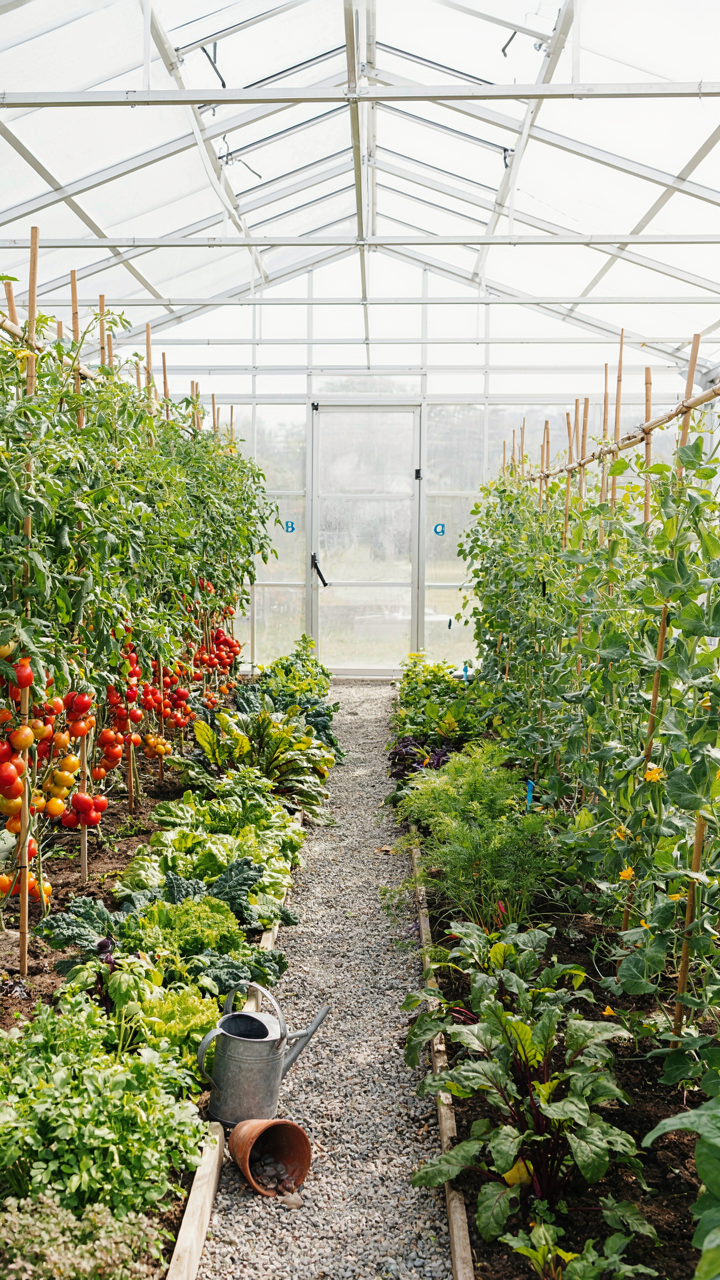
You want a greenhouse that looks intentional and produces reliably, which means you’re actually afraid of the visible failure—dead plants, depleted soil, pest infestations you can’t hide. The mechanism here comes from agronomy: crop rotation operates like a circuit breaker in soil biology. When you plant the same family in the same spot annually, pathogens and pests establish permanent populations. Different plant families demand different nutrients and harbor different enemies. Rotating them starves pest cycles and restores soil chemistry naturally.
The layout strategy follows this rotation schedule precisely:
- Brassicas (cabbage, broccoli, kale): Plant in zones A and B in year one, then shift to C and D. These demand high nitrogen and attract cabbage moths; moving them disrupts pest breeding cycles before insects establish year-round residency.
- Solanaceae (tomatoes, peppers, eggplant): Occupy different quadrants yearly. These draw down potassium heavily and accumulate soil-borne diseases like early blight. Three-year gaps between replanting the same zone reduce fungal loads significantly.
- Legumes (beans, peas): Place in depleted sections to restore nitrogen via root nodules. They occupy space where heavy feeders grew the previous year, converting bare soil back into productive substrate before replanting demand crops.
- Alliums (onions, garlic, leeks): Use as transition crops between heavy feeders and nitrogen-fixing legumes. They repel some common pests and occupy minimal vertical space, fitting into gaps without disrupting primary rotations.
- Root vegetables (carrots, beets, turnips): Plant in the fourth zone to break disease cycles for above-ground crops. Their shallow feeding pattern doesn’t interfere with residual nutrients from previous rotations, and they tolerate slightly depleted soil.
Mark your greenhouse floor into four equal zones using tape or paint. Map which crop family occupies each zone in year one on paper. Rotate every section clockwise by one zone annually. This isn’t decorative; it’s infrastructure. Without documented rotation, you default to planting convenience, and convenience kills soil in three seasons.
Stagger Plantings For Unbroken Supply
Most growers plant everything at once and harvest in bursts, then face dead weeks where nothing is ready. Succession planting is the inverse of that mistake: you plant the same crop at seven to fourteen-day intervals instead of dumping seeds in bulk. This spreads germination, growth, and harvest across months rather than compressing them into weeks.
The layout consequence is that you dedicate specific benches to single-crop staging zones rather than mixing everything together. Reserve one bench for lettuce plantings only. Every ten days, start a new seed flat in the same spot while the previous flat is already in the harvest-ready phase. By week four, you have four mature flats rotating through. One comes off for eating while one enters germination. The greenhouse never transitions to bare space. You calculate the interval based on crop maturity time and your consumption rate: if lettuce matures in thirty days and you harvest two heads daily, you need a new planting every five days. Map this backwards from your target harvest date before the growing season starts, not during it.
Green House Planting Ideas: The Unseen Variables
Temperature Gradients Shape Plant Survival
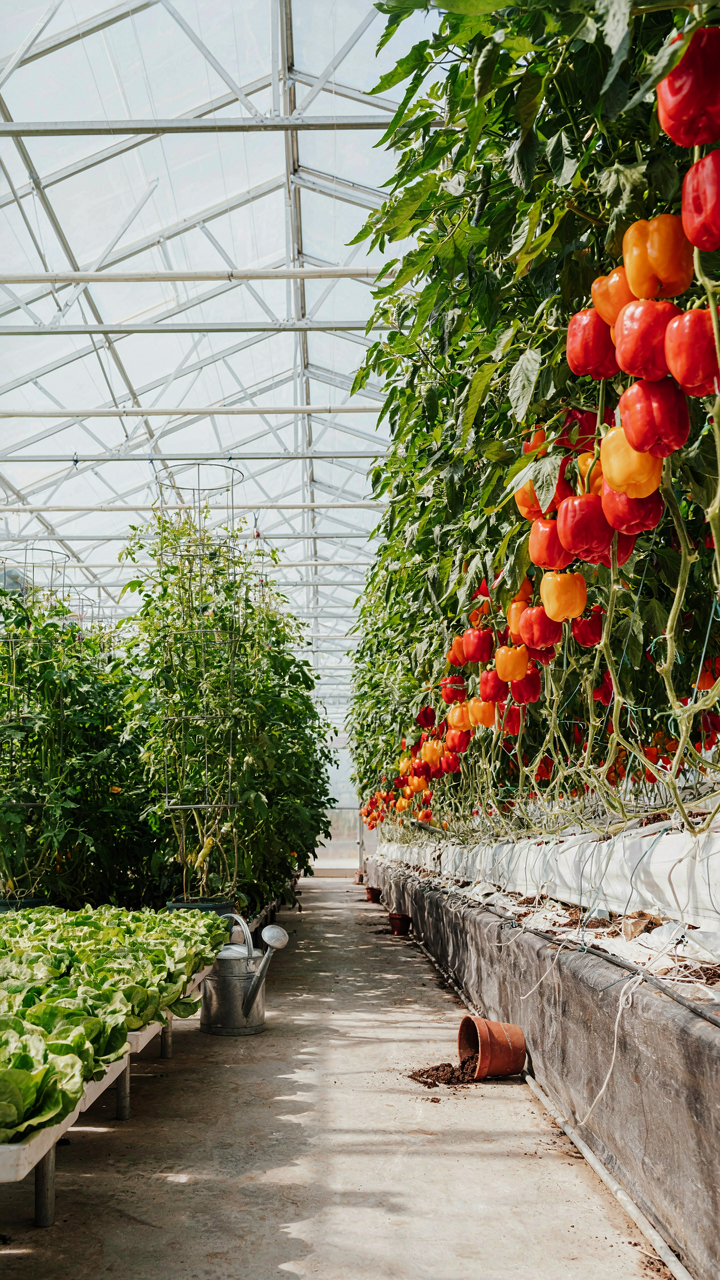
You want your greenhouse to look intentional, not like you’re compensating for poor planning. Here’s what nobody tells you: thermodynamics governs where plants actually thrive, and most layouts ignore it entirely. A greenhouse isn’t one climate. It’s a stack of microclimates created by heat rise, air circulation, and material mass. The warm zone sits at the roof line. Cool air pools at floor level. This vertical temperature spread can swing 15 to 25 degrees Fahrenheit between top and bottom on a sunny day.
Position heat-sensitive plants low and toward the north side where temperature swings are minimal. Place heat-lovers near the apex or along south-facing walls where radiant warmth concentrates. Thermophilic plants like peppers and basil tolerate or demand the hotter zones. Cool-season crops like lettuce and spinach stall or bolt if you place them in the thermal ceiling. Don’t distribute plants by aesthetics. Distribute them by their thermal tolerance, then arrange your design around that constraint.
Disease Prevention Through Intentional Spacing
Everyone says improve air circulation. That’s true and useless without naming the real mechanism. Disease spreads through moisture persistence on leaves, and moisture persists where air stagnates. Fungal spores don’t germinate on dry leaf surfaces. They germinate when leaf wetness lasts over four hours. Strategic placement interrupts that timeline by forcing air movement across plant surfaces.
Group plants by water requirement, not by visual symmetry. High-humidity lovers like ferns cluster on one side where you can mist without soaking neighbors. Drought-adapted plants occupy the drier perimeter. Space rows to allow horizontal airflow rather than dead pockets. Install fans to move air diagonally across zones, not straight down. The goal is leaf surface dryness within three to four hours of watering. When layout forces airflow through plant density, pest pressure and fungal infection drop by measurable margins.
Your Stylish Greenhouse Is A Monument To Inefficiency, Not Growth

Most people design their greenhouse plant layout around what looks good on Instagram, not what actually grows plants. They chase aesthetics and abandon airflow. They arrange by color instead of by light requirements. This kills 60% of their plants before summer ends. Stop decorating and start optimizing. Map your light sources today, then place your highest-value plants directly underneath them. A greenhouse that grows is always more beautiful than one that merely looks the part.



