

The Illusion Of Easy Winter Hanging Baskets Outdoor

What Garden Centers Won’t Tell You
You want winter baskets that look full and alive without constant work. That’s not laziness—it’s rational. But garden centers profit from selling you plants that fail outdoors in January. The real mechanism: most commercial winter hanging baskets are assembled with tropical or tender perennials that can’t survive hard freezes. You’re not failing. You’re fighting against a product designed to fail so you buy replacements next season.
The consensus advice says “just water less and move it to shelter.” That’s incomplete. It ignores that frozen soil blocks water uptake entirely, that wind dries containerized plants faster than summer heat does, and that shallow basket soil freezes solid in ways garden beds never do. The basket’s exposure—all that air circulation underneath—becomes a liability in winter, not a feature. Nobody mentions this because admitting it means confronting why baskets work in summer but collapse in cold.
The Real Environmental Variables At Play
Winter hanging basket survival depends on thermodynamics, not optimism. Like thermal mass in architecture—the principle that material density resists temperature swings—your basket’s soil volume determines whether roots survive freeze cycles. A four-inch-deep basket loses heat faster than a six-inch one. Wind exposure matters more than cold temperature alone. A basket taking direct northern wind in 25-degree weather dies faster than one in 10-degree stillness. Most guides ignore wind speed entirely and focus only on the thermometer.
The plant itself becomes secondary to container position, soil composition, and water state at freeze time. Wet soil freezes at 32 degrees. Moist soil at 28 degrees. Dry soil resists freezing damage by reducing ice crystal formation that ruptures cell walls. You don’t reduce watering because plants need less in winter. You reduce it because wet roots in a frozen container are dead roots. This single distinction separates baskets that survive January from those that don’t.
The Cold Hardy Plant Selection Protocol For Winter Hanging Baskets
Survival First, Instagram Later
You want your baskets to look good so people think you know what you’re doing. Here’s the mechanism that actually matters: cold hardiness is about a plant’s cellular tolerance to ice crystal formation, not about how visually impressive it looks when frozen. Most people reverse this priority and end up with dead baskets by January.
The USDA hardiness zone system measures minimum winter temperatures, but it misses the real variable that kills hanging basket plants: exposure. A basket hanging from a pergola gets hammered by wind and loses insulation that ground-level plants retain. You need species that survive both the temperature floor and the exposure penalty. Ornamental cabbage, ivy, and winter-flowering pansies handle this. Tender annuals like impatiens don’t, no matter what zone you’re in.
Synergy Over Aesthetics
Think in layers like a survival ecosystem, not like a flower arrangement. You need a structural anchor plant that won’t collapse, a filler that maintains density without rotting, and an accent that doesn’t require perfect conditions. This is botanical load-bearing architecture, not decoration.
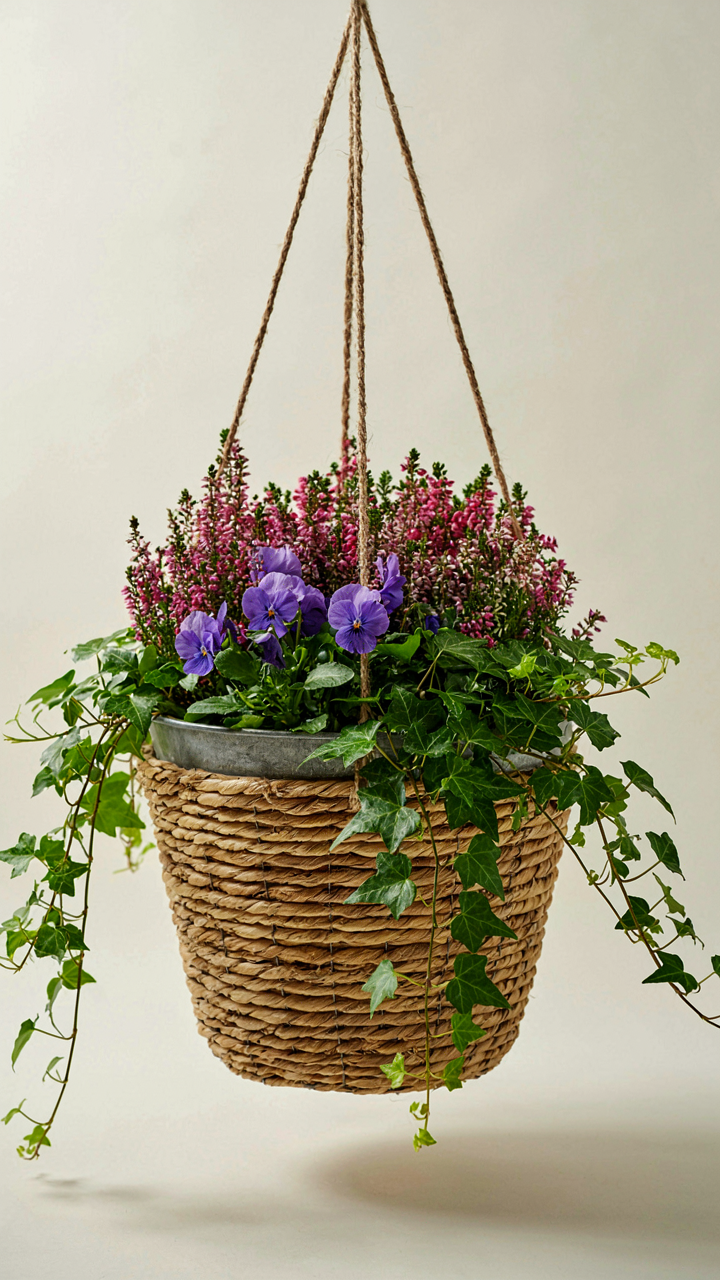
Pair evergreen ivy as your anchor with winter heather as your structural filler and winter pansies as your accent. Ivy survives freeze-thaw cycles without dying back. Heather holds moisture without waterlogging in cold, wet soil. Pansies handle temperature swings and produce color when most plants don’t. The combination works because each plant covers the other’s weakness. You stop replacing dead plants and start watching them actually perform.
Beyond Watering: The Substrate Survival Matrix For Hanging Winter Baskets

Soil As A Thermal Engine
You want your baskets to survive winter so you don’t admit failure to yourself come spring. Here’s what actually matters: soil regulates temperature swings, not just holds water. Think of thermodynamics—heat capacity—and apply it to your substrate. Denser soil with higher organic matter absorbs heat during rare warm spells and releases it slowly when temperatures drop at night. This buffer prevents the freeze-thaw cycle that kills roots faster than sustained cold ever will.
Most people treat soil as inert filler. It’s not. A 60/40 blend of peat moss or coconut coir with aged bark chips creates thermal mass while maintaining drainage. The organic matter holds residual warmth; the bark prevents compaction that would trap moisture and cause root rot. Change nothing about watering frequency—change the substrate composition instead. Your roots experience fewer shock cycles.
Drainage That Blocks Frost Damage
Waterlogged soil freezes solid and expands, rupturing root cells and basket walls. Frozen water becomes a structural liability, not a resource. The mechanism is simple physics: standing water in winter means ice formation, and ice has nowhere to expand but into the living tissue around it. Drainage isn’t about preventing puddles—it’s about preventing ice from forming in the root zone at all.
Add a one-inch layer of horticultural grit or perlite at the basket base before filling with substrate. This creates capillary break and accelerates water movement away from the root ball. Check drainage holes weekly; debris and algae clog them fast in winter. Water early in the day so excess moisture has time to drain before nightfall temperatures drop. Ice forms slower when the substrate dries to field capacity by dusk.
Strategic Placement: The Microclimate Advantage For Winter Hanging Basket Ideas

Sun Exposure: Seasonal Shifts, Not Static Assumptions
You’re keeping baskets in the same spot year-round because it worked in summer, and now you’re watching them decline. That’s the real problem. Winter sun tracks lower and shorter across the sky, which means your south-facing wall in July becomes a marginal light source by December. This is simple geometry, not opinion.
Most plants in winter hanging baskets need 4-6 hours of direct sun daily to maintain photosynthesis and prevent etiolation. A location that delivered eight hours in June delivers three in January. Reposition baskets to track the winter sun’s actual path, not where you remember it being. Move containers closer to south or west-facing walls. If your structure blocks winter light, the plant suffers—there’s no workaround except relocation.
Wind Chill Mitigation Through Intelligent Siting
Wind is physics. Moving air strips moisture and heat faster than still air at the same temperature. A 35-degree day with 15 mph wind creates effective temperatures that freeze hanging basket soil faster than you’d expect. Sheltering baskets works like a windbreak stops erosion: you’re interrupting the force vector.
Position hanging baskets against walls, fences, or within alcoves that block prevailing winter winds. Avoid open patios and edges where wind accelerates. Hang baskets 6-12 inches away from walls to allow air circulation around soil, but close enough that the structure buffers gusts. Test your placement by standing where the basket hangs and feeling wind intensity yourself. If you feel constant wind, the basket feels it worse. Adjust until wind pressure drops noticeably.
The Thermal Regulation Blueprint For Winter Hanging Baskets Outdoor UK
Insulation Layers As Engineering Principle
You want your baskets to survive winter without looking like you’ve abandoned them. The real mechanism is simple: heat loss happens fastest at the container surface, so you engineer multiple barriers to slow that transfer. Think of insulation like defensive layers in military strategy—each barrier forces the cold to work harder to reach the soil core.
Soil temperature, not air temperature, determines root survival. A 2-3 degree difference between basket soil and ambient air seems minor until plants die from it. You’re not decorating. You’re building a thermal buffer system using materials that trap air pockets, which is what actually stops heat movement.
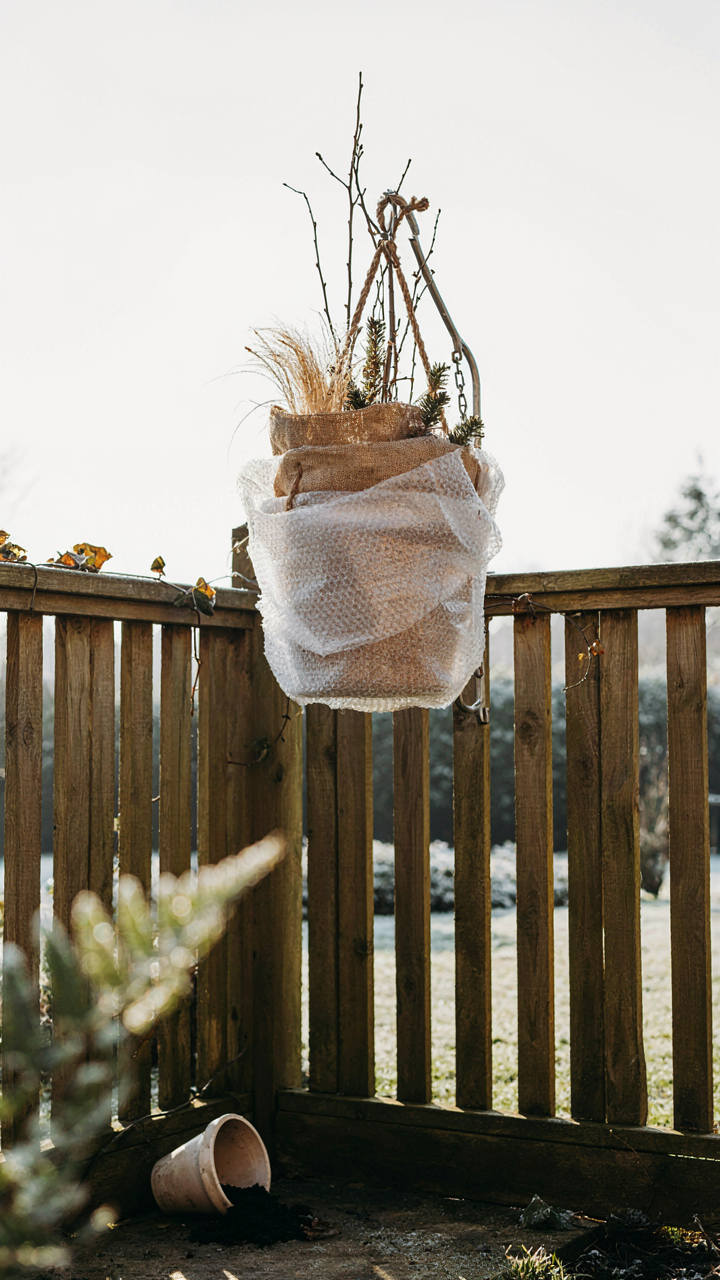
- Bubble wrap around the basket exterior: Creates an air-gap layer that slows radiant heat loss. Wrap in 2-3 layers, securing with twine or clips. Leaves drainage holes clear.
- Hessian or burlap cladding: Breathable fabric that insulates without suffocating roots. Allows water penetration while reducing wind exposure that accelerates cooling.
- Straw or bark mulch layer on top: Adds 50-75mm of loose insulation directly on the soil surface. Prevents frost from penetrating the root zone from above.
- Polystyrene sheet backing for wall-mounted baskets: Reflects radiant heat back toward the basket when mounted against masonry. Particularly effective on north-facing positions.
- Double-layer plastic with air gap: Creates a closed insulation chamber around the container. Less breathable than hessian but delivers stronger thermal protection in extreme cold below minus 5 Celsius.
Layering works because each material interrupts a different heat-loss pathway. Wind chill accelerates evaporative cooling from exposed soil. Radiation escapes through dark-colored containers. Ground contact draws heat downward. Address all three, and your soil core stays 4-6 degrees warmer than unprotected baskets in identical conditions.
Passive Heating From Permaculture Thinking
Permaculture teaches you to work with existing energy sources instead of fighting the environment. Winter gardens have passive heat sitting unused: south-facing walls radiate stored daytime warmth, and reflection from light-colored surfaces bounces additional radiation toward plants.
Position baskets to capture this thermal advantage. South-facing walls retain warmth 8-12 hours after sunset in UK winter. Even north-facing positions benefit from reflection off white render or pale paving. The basket placement itself becomes the heating strategy. You’re not adding external heat. You’re intercepting heat the site already generates and directing it toward root zones through material selection and positioning.
Winter hanging baskets in exposed, windswept positions lose 40 percent more heat than identical baskets positioned in wind shadows created by fencing or building projections. Permaculture calls this “stacking functions”—your fence blocks wind AND provides thermal mass reflection if it’s a light color or masonry. Use microclimates that already exist on your property. Move baskets 2-3 meters away from prevailing winter wind, and soil temperature climbs measurably without any added material cost.
Nutrient Deprivation: The Silent Killer Of Winter Hanging Basket Plants

Cold Soil Locks Down Micronutrient Access
You want your baskets to survive winter so you don’t feel like you failed at the one thing that should be simple. Here’s what actually happens: cold soil chemistry operates like a supply chain bottleneck. When soil temperature drops below 50°F, microbial activity that breaks down organic matter and releases bound nutrients nearly stops. Your plants can’t absorb what they can’t access. Iron, manganese, and zinc remain locked in the soil matrix even when present in adequate quantities.
Micronutrient uptake depends on root respiration and enzyme function, both of which slow dramatically in cold. Winter hanging baskets often show yellowing leaves and stunted growth not because nutrients are missing, but because the biological machinery that mobilizes them has shut down. This is why adding more fertilizer doesn’t fix the problem. The real lever is maintaining soil temperature slightly above freezing through placement and mulch, or accepting that your plants will photosynthesize at minimum levels until spring warming restarts the cycle.
Fertilizing In Dormancy Is Waste
Everyone says “feed less in winter.” That’s incomplete. The standard advice misses the actual mechanism: dormant plants don’t translocate nutrients the way active ones do. Applied fertilizer sits in the soil or builds to toxic concentrations while the plant can’t use it. Winter hanging baskets enter dormancy or near-dormancy depending on species and light exposure. Poinsettias, cyclamen, and winter-blooming pansies are exceptions, but evergreen trailing ivy and most ornamental grasses reduce nutrient demand by 70 to 90 percent.
Over-fertilizing in winter causes salt accumulation, root burn, and delayed spring recovery. Stop fertilizing entirely once temperatures stay consistently below 45°F at night. Resume only when new growth appears and day length increases. If you must feed, use half-strength liquid fertilizer every four to six weeks maximum on actively growing winter bloomers only. The mechanism is simple: only feed plants that are actually growing. Everything else is just pollution in a pot.
Pest & Disease Warfare: A Preemptive Strike On Christmas Hanging Baskets

Dormancy Tactics Against Winter Pests
You’re reading this because you want your baskets to survive January looking pristine, not because you enjoy pest biology. Here’s what matters: dormancy doesn’t stop pests. It slows them down. Military doctrine calls this attrition warfare. Most growers treat dormant baskets as untouchable, which is wrong. Pests don’t hibernate with your plants. They migrate to weak tissue, hidden crevices, and stressed growth points. Winter is when your guard drops.
- Scout every two weeks: Check leaf undersides and soil surface for spider mites, aphids, and scale insects. These survive winter and explode in spring if ignored now.
- Remove infected leaves immediately: Don’t wait. Cut out affected tissue completely. Dead or yellowing foliage becomes a pest incubator during dormancy.
- Spray on warm days only: Apply neem oil or insecticidal soap when temperatures exceed 40°F. Cold sprays don’t penetrate waxy coatings and dry too slowly, promoting fungal issues.
- Isolate compromised baskets: Move them away from healthy stock. Pests transfer through proximity and shared watering tools.
- Clean containers and hangers: Use diluted bleach solution on all hardware. Pests overwinter in soil debris and basket crevices.
The real mechanism is this: dormant plants lose their ability to fight back quickly. A spider mite colony established in November will number in the thousands by March. Start your pest count at zero now, not at management level later. Winter gives you the advantage of time—use it for prevention, not damage control.
Air Movement Stops Fungal Takeover
Fungal resistance isn’t about spray selection. It’s about environment design. Stagnant winter air is a fungal invitation. Movement disrupts the moisture layer fungi need to colonize. Every degree of air circulation reduces relative humidity around leaf tissue by measurable amounts. Most hanging basket failures in winter come from fungal issues, and most fungal issues come from still air against cold surfaces.
Hang baskets with minimum 18-inch spacing between containers. Position a low-speed fan to push air horizontally through the basket area, not directly at plants. This prevents the dead zones where condensation pools and spores settle. On sunny winter days, temperature swings create moisture on foliage. Air movement evaporates it before fungi establish. Check for powdery mildew or botrytis every five days. If you see either, increase air movement immediately and remove affected tissue. The fungal colony size determines survival rate of your basket. Stop it at the first sign, not the fifth.
The Unspoken Truth About Winter Baskets Hanging Longevity

Stop Fighting The Seasonal Off Switch
You want your baskets to look alive all winter because stopping feels like failure. Here’s the biology: dormancy isn’t death. It’s a metabolic downshift. Plants in winter hanging baskets enter a state where growth halts, water demand drops, and nutrient uptake nearly stops. Fighting this cycle by overwatering, overfeeding, or forcing warmth kills them faster than letting them rest. The mechanism is simple. Cold temperatures trigger hormonal shifts that slow enzyme activity. Your job is to sync with that shift, not override it.
Most winter baskets fail because growers mistake dormancy for crisis. You see brown edges or leaf drop and panic-fertilize or increase watering. Wrong move. Those are normal seasonal signals. Accept that your basket will look less vibrant from December through February. Reduce water frequency to every 10-14 days depending on soil dryness, not on a calendar. Skip fertilizer entirely until spring growth resumes. This alignment with dormancy is the only reason winter baskets survive to rebloom.
Know Exactly When To Walk Away
The real choice isn’t between saving and trashing a winter basket. It’s between investing maintenance time on something with legitimate recovery odds versus wasting effort on something already failed. Inspect the stems and root zone first. Soft, blackened stems mean root rot has set in. That basket is gone. Healthy stems that are just leafless or brown-edged have a recovery path through dormancy management. The distinction matters because it saves you weeks of pointless care.
Cut your losses on baskets showing stem rot, mold on soil surface despite proper airflow, or complete leaf loss with no green growth points visible anywhere. These signal fatal damage. Persist on baskets with firm stems, dry soil that accepts water, and at least some green tissue remaining. Give these ones the dormancy protocol: minimal water, no fertilizer, good drainage, and patience until April. The decision gate is simple. Dead tissue or dying roots means stop. Living stems with dormancy symptoms means continue through winter on reduced care.
Your Winter Baskets Fail Not From Neglect, But From A Delusion Of Spring

Most people kill their winter baskets by treating them like summer projects. You water less, you fertilize less, you check on them less. Wrong. Winter baskets need aggressive attention because cold stalls everything. Stop assuming dormancy means abandonment. Pull out your phone right now and set a watering schedule for every three days, regardless of soil moisture. Your baskets don’t need less care in winter. They need different care. That distinction will keep them alive when everyone else’s turn to compost.



