
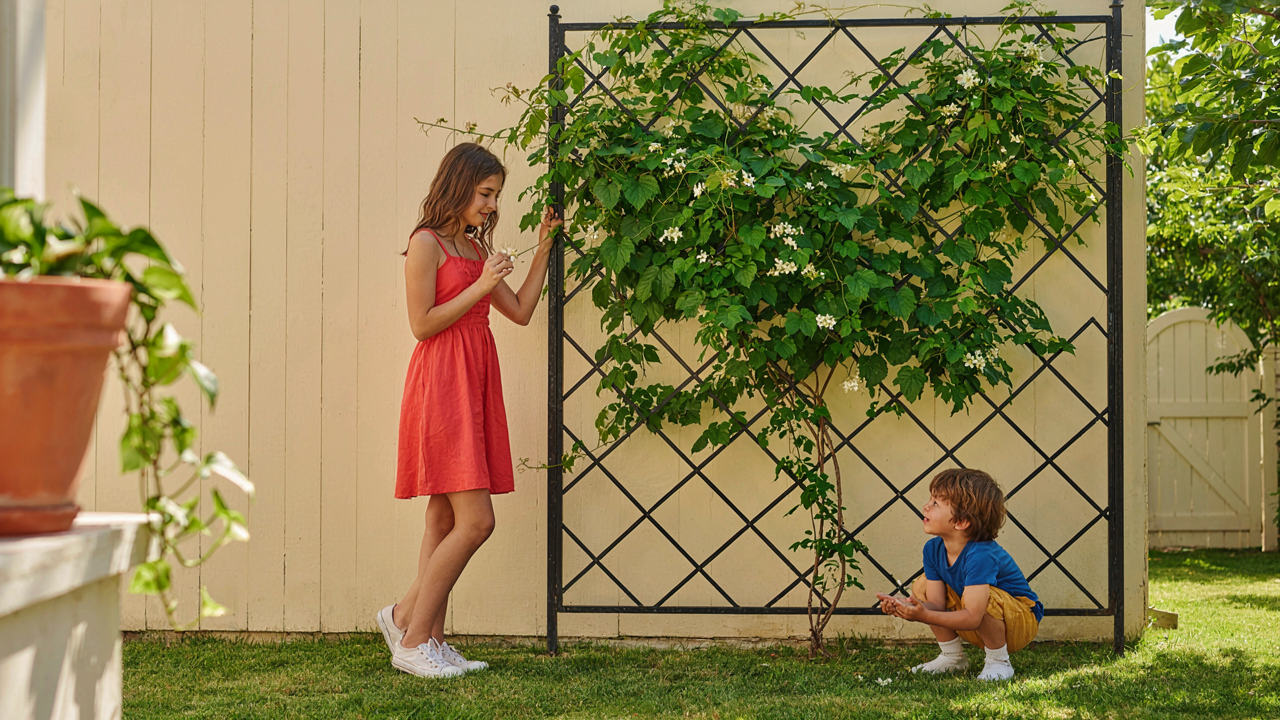
The Unseen Cost Of “Trendy” Climbing Plant Support

When Labor Becomes Your Real Enemy
You want the Instagram version because it looks effortless. Here’s the mechanism: poor support design creates friction points that demand constant intervention. Every weak joint, every misaligned fastener, every undersized material forces you into repetitive maintenance cycles that compound over months. The trellis that looks clean at purchase becomes a time tax you didn’t budget for.
Most trellis designs fail because they treat vines as passive objects rather than active forces. Clematis and climbing hydrangea exert lateral pressure as they grow. Conventional wooden lattice bends under weight. Tie points fail because they weren’t spaced for the plant’s actual growth pattern. You end up retying, reinforcing, and replacing sections while the vine continues its indifferent expansion.
Materials That Fail Silently Until They Don’t
The economics of support structures mirror infrastructure degradation theory: initial cost matters far less than maintenance burden over the lifecycle. A cheap steel trellis rusts from inside out. You can’t see the failure until structural collapse happens mid-season. Galvanized coatings chip where fasteners penetrate. Wood softens at hidden joints where moisture pools. Wire becomes brittle as UV exposure compounds oxidation stress.
Design that cuts corners in year one creates exponential costs in years two through five. Metal that weathers poorly requires replacement faster than the vine reaches maturity. Wood that wasn’t pressure-treated decays at the base where it matters most. The real question isn’t what it costs to buy, but what you’ll spend fixing it after the initial trend cycle passes.
The Biomimicry Principle: Engineered Support, Not Decoration

What Vines Actually Need From Structure
You want to look smart buying the right trellis. That’s not the real problem. The real problem is you’re treating vine support as decoration when it’s load engineering. Plant biology has a clear demand: vines climb through one of three mechanisms—twining, adhesion, or tendrils—and each one requires structural geometry that matches that climbing pattern, not your aesthetic preference. The support structure is the load path. Get it wrong and the vine fails to establish or collapses under its own biomass within two seasons.
Twining vines like clematis wrap around vertical elements in a helical pattern. They need something between 1 and 2 inches in diameter to grip effectively. Adhesive climbers like ivy create suction cups that work on flat surfaces. Tendriled varieties like grape vines need horizontal rungs spaced 8 to 12 inches apart to wrap around. The support structure isn’t decoration bolted to the wall. It’s the substrate that determines whether the vine reaches maturity or stalls at year one.
Structural Load Versus Assumed Load
Most people design vine supports based on how the bare structure looks, not how much weight mature vine biomass actually exerts. This is backwards. A mature climbing vine in full leaf can add 40 to 80 pounds per 100 square feet depending on species and water availability. Your trellis doesn’t fail because it looks weak. It fails because you calculated load capacity from thin air instead of from the vine’s actual growth trajectory and your regional climate’s wind load on that foliage mass.
The mechanism is simple: support structure must account for mature wet biomass plus wind shear, not just the thin green shoots you plant in spring. Metal expands and contracts. Wood rots if it stays moist where vines cluster. The anchor points—where the support attaches to your wall or post—will bear three to four times the stress of the support’s midspan. Engineer the connection first. Everything else follows from that decision.
DIY Trellis Ideas: Beyond The Pinterest Aesthetic

Reclaimed Materials That Actually Last
You want the aesthetic of a handmade trellis without replacing it in three years. The mechanism is simple: material decay follows predictable patterns based on exposure and composition, not romance. Reclaimed wood from barns or industrial sites contains density and age that new lumber doesn’t. Metal salvage—old bedframes, gate hinges, rebar—outlasts treated wood by decades because it oxidizes into a stable state instead of rotting from the inside out.
The duribility difference matters tactically. Reclaimed hardwoods like chestnut and oak resist vine pressure and weather cycles better than contemporary softwoods. Metal salvage requires zero chemical treatment and weathers into a stable patina. Both categories cost less than new pressure-treated lumber when sourced locally. The tradeoff is time spent sourcing and prep work, not material expense or final performance.
Structures That Evolve With Your Garden
Modular design in architecture means systems connect and disconnect without compromising structural integrity. Apply that principle to vine supports: build components that fasten together with bolts or brackets instead of permanent joinery. Your trellis expands when new vines arrive. It reconfigures when a corner gets too shaded. It moves sites without destruction.
The practical protocol is straightforward. Use corner brackets and lag bolts instead of welds or nailing. Space vertical and horizontal elements at intervals that accept standard fasteners. Design the base to accept additional frames stacked on top. This approach trades upfront assembly time for years of modification without replacement. Your support structure adapts as your garden actually grows, not as a garden magazine suggests it should.
The Load Bearing Protocol For Wall Trellis Systems

How Much Weight Your Trellis Actually Holds
You want to know this because a failed trellis is humiliation—a sagging, collapsing mess visible to everyone. But most people skip the math entirely. Physics governs this: load capacity follows the principle of distributed force. A mature climbing vine isn’t static decoration. It’s a dynamic mass that catches wind, holds water, and grows heavier each season. A mature clematis or climbing rose easily weighs 50 to 150 pounds when fully leafed and wet. A wisteria can exceed 200 pounds. Your trellis doesn’t hold the vine. It distributes the vine’s weight across multiple contact points so no single connection fails.
The actual constraint is material and fastening, not design hope. Steel handles distributed weight differently than wood. A half-inch steel rod rated for horizontal load carries far more than a two-by-two timber of the same span. Wood compresses and splits under sustained tension. Steel bends elastically and returns. Calculate backwards: know your vine species’ mature weight, divide by the number of anchor points on your trellis, then verify each fastener can handle that individual load plus a safety margin. Most residential trellises fail because people install them for a young vine, then never upgrade hardware as the plant ages.
Anchor Points And Force Distribution
Spacing anchor points close solves nothing if each point fastens weakly. The mechanism here is load path: you’re creating redundancy so one failure doesn’t cascade into total collapse. A trellis with anchor points every six feet along a wall distributes force more evenly than one with points at eight feet. But those points must penetrate solid structure—not mortar joints, not drywall cavities. Brick and stone can handle tensile force. Mortar cannot. Hit a stud or install a lag bolt into solid masonry at four-inch depth minimum. Cheap anchors pretending to handle lateral wind load will pull free within two seasons.
The distribution math favors a triangle over a line. Three anchor points forming a triangle hold better than four in a row because they resist twisting and lateral sway. Install anchors at the base, middle, and top of your trellis, offset horizontally if wall space allows. Each anchor should use hardware rated for at least 300 pounds sustained load. Stainless steel hardware won’t corrode and undermine the joint. Galvanized or painted hardware fails silently as rust spreads inside the masonry, weakening grip. Once you’ve installed hardware, test it before planting by pulling horizontally with force. If it shifts, your vine’s weight will finish the job.
Wooden Trellis Vs. Metal: Material Science For Durability
How Weather Breaks Down Your Support
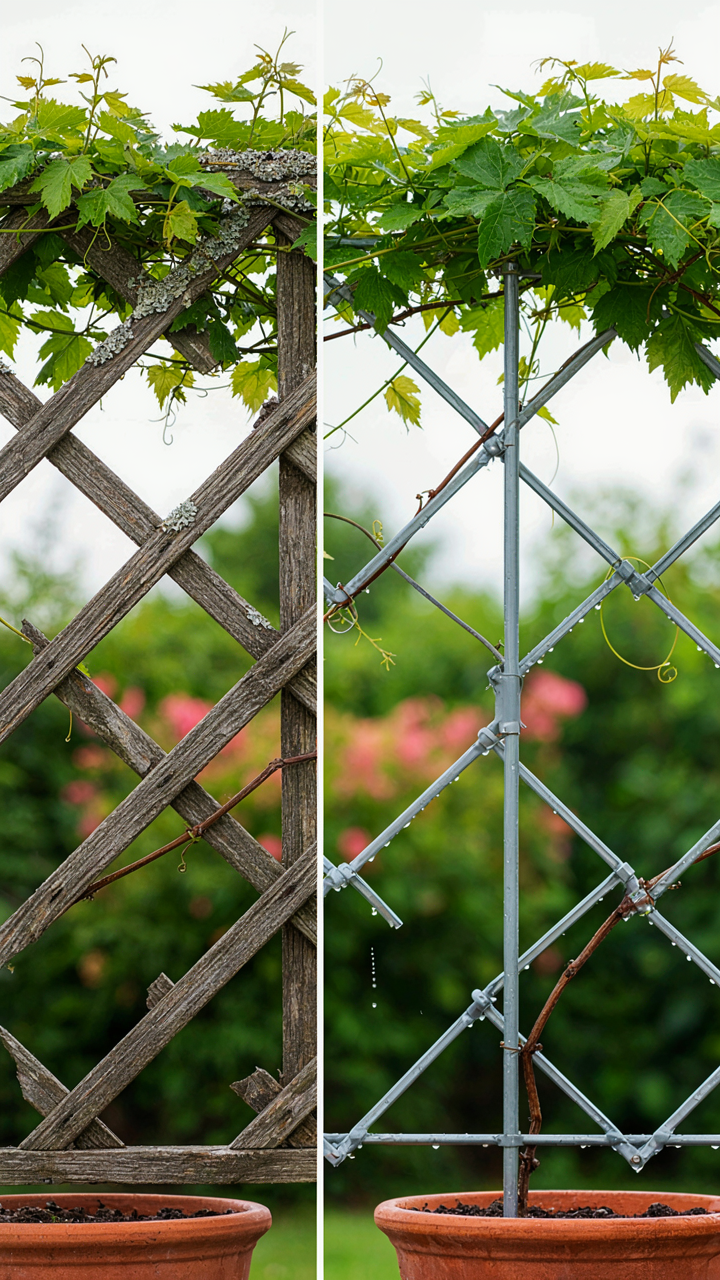
You want wood because it looks better and feels more “natural” than metal. That’s status anxiety disguised as aesthetics. The real mechanism is simple: wood absorbs moisture from rain and humidity, then releases it. This cycle of expansion and contraction creates internal stress. Fungal spores colonize the soft fibers during wet periods. Wood degrades fastest in climates with high rainfall and temperature swings.
Metal avoids this moisture trap entirely because it doesn’t absorb water into its structure. Steel rusts where oxygen and water meet at the surface. Aluminum oxidizes, but the oxide layer actually protects deeper material. Galvanized steel adds a zinc barrier that extends life significantly. Your choice depends on local climate more than personal preference.
Resistance Determines Real Lifespan
The common advice says “treat wood with sealant and it lasts forever.” Wrong. Sealant delays the problem and adds maintenance burden. Untreated wood in dry climates lasts 15 to 20 years before structural failure. Treated wood (pressure-treated or naturally rot-resistant species like cedar or redwood) extends this to 20 to 30 years. Metal supports in standard conditions last 25 to 50 years depending on coating quality and rust exposure.
Corrosion resistance comes from physics, not product claims. Think of it in terms of electrochemistry: a material resists corrosion when it stops electrons from moving between metals and oxygen. Galvanized steel creates a sacrificial zinc layer that corrodes instead of steel. Stainless steel alloys rearrange their surface to form a passive chromium oxide layer. Apply a rust inhibitor paint or use hot-dip galvanizing as your baseline protocol, then inspect joints annually where water pools or vine debris traps moisture.
Garden Dividers: Strategic Placement For Maximum Impact

Light And Airflow Corridors
You want your climbing vines to look abundant without admitting you’re terrified of a dead section ruining the whole effect. Here’s the mechanism: vines follow light and air like water follows gravity. Borrowing from fluid dynamics, think of airflow as pressure differential—stagnant zones create low-pressure pockets where fungal disease and pest colonies establish themselves. Position supports perpendicular to prevailing wind direction, not parallel. This forces air to move through the vine canopy rather than around it.
Sunlight access determines growth density and bloom production. Place supports where morning sun hits first and afternoon shade arrives by mid-day in hot climates. North-facing walls stay cool but receive indirect light only—acceptable for shade-tolerant species like ivy or clematis, but inadequate for flowering varieties. East or west exposure works best for most climbing vines because it balances intensity with duration. Measure your garden’s sun pattern for three consecutive days before positioning any support structure.
Zones With Defined Function
Treating your garden as distinct operational zones—not as one continuous space—changes what support structure you actually need. A privacy screen requires dense, wide coverage and sits on the property line. A vegetable trellis needs different spacing to accommodate hand harvesting and seasonal removal. A specimen display piece for a single showstopping flowering vine demands isolation and visibility from a focal point. Each zone’s purpose dictates the support material, height, and construction angle.
The placement error most gardeners make is clustering supports too close together, then wondering why they compete for light and nutrients. Space supports based on the mature canopy spread of your chosen vine species, not the current stem width. A clematis vine spreads eight feet wide at maturity; position its support with eight feet of clear space on either side. This prevents overlap and keeps each zone distinct enough that you can actually move through and maintain your garden.
Trellis Gate Integration: Function Over Form
When The Gate Actually Moves
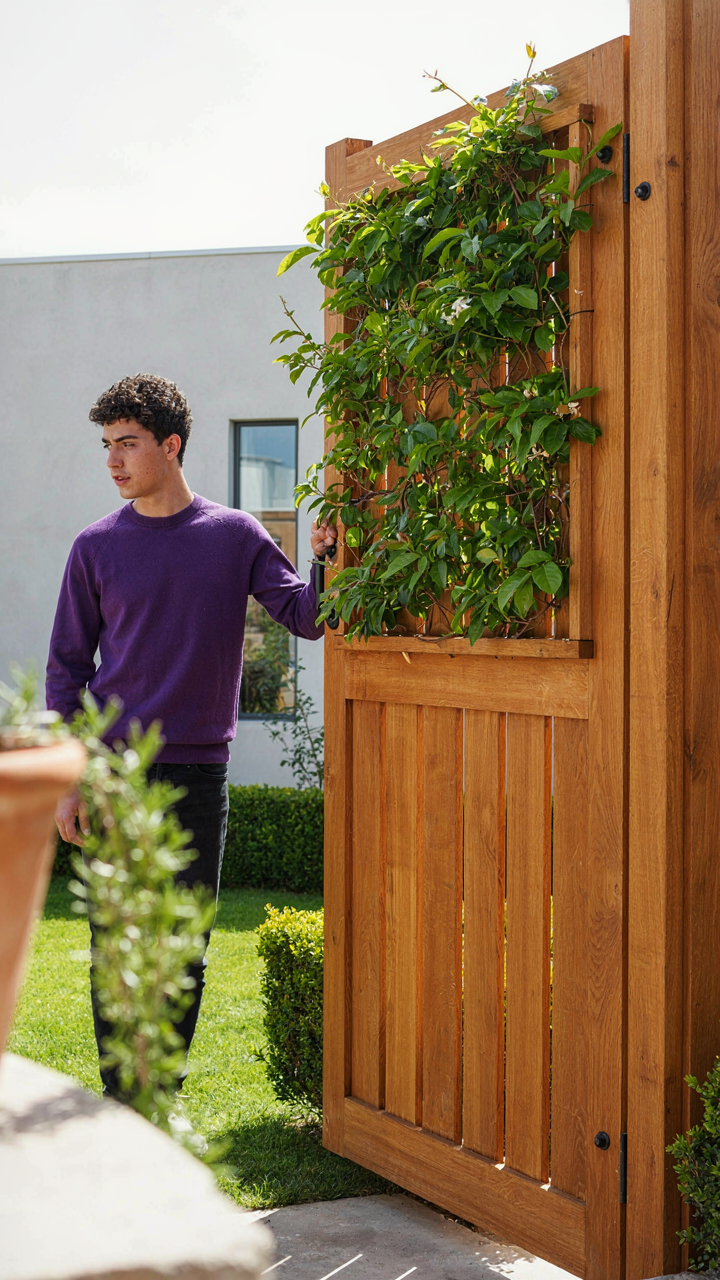
You want the trellis gate to look intentional, not bolted together. That’s the real concern underneath. Here’s the mechanism: a gate mounted to a trellis experiences load vectors that fixed installations never do. When someone opens or closes the gate, they introduce lateral stress perpendicular to the vine’s growth plane. This is mechanical engineering applied to horticulture. The support must anchor at three points minimum, not two, to distribute that opening motion without twisting the frame. Wood expands and contracts seasonally, metal corrodes at connection points. Both fail if you don’t account for movement.
The posts supporting a trellis gate need buried depth equivalent to one-third their above-ground height. A six-foot gate requires two feet of foundation. Concrete sets the posts rigid, but vines add live load that shifts with wind and growth. Use lag bolts instead of nails at gate hinges. Nails work when there’s no repetitive motion. Bolts handle the thousands of open-close cycles that destroy nailed connections. Check all fasteners before the growing season begins, not after failure.
Sight Lines And Boundary Control
Privacy and security through trellis integration works because vines obscure openings while maintaining visual hierarchy. This isn’t decoration. A trellis gate covered with climbing vines creates a perimeter that looks permeable but functions as a barrier. Dense coverage blocks sightlines from outside while maintaining usable views from inside. The gate itself becomes part of the vine structure rather than sitting in front of it. This layered approach stops casual entry without creating fortress aesthetics.
- Lattice density: Smaller openings (half-inch or less) support faster-growing vines like clematis while blocking direct line of sight completely.
- Vine species selection: Deciduous vines provide seasonal privacy, losing leaves in winter. Evergreen options like ivy maintain year-round coverage and security.
- Gate swing clearance: Vines must not interfere with the gate’s arc. Position lattice support three inches behind the swing path to prevent friction.
- Viewing angles: Plant taller vines at gate edges, shorter varieties in center openings to create visual confusion that stops perimeter scanning from outside.
- Maintenance access: Build removable lattice panels or train vines on wires you can release seasonally for gate inspection and hinge service.
Install the gate frame first, then attach lattice panels and plant vines after. Planting before installation creates a tangled mess during hanging and leveling. The vines do the privacy work, but the mechanism depends on structural separation between the gate’s function and the plant’s sprawl.
The Trellis Proof Garden: Cultivating Resilient Systems
Build What Fails Gracefully
You’re reading this because you don’t want to rebuild your support structure in three years. Here’s the mechanism: most gardeners confuse durability with rigidity. They bolt everything down, which means one rotted post takes the whole system. Instead, design for staged failure. Use materials that degrade predictably—untreated wood rots from the outside in, giving you years of warning. Metal rusts visibly. You see the problem before the vines collapse. Rigid systems hide damage until catastrophic failure.
Staged failure design borrows from structural engineering. A load-bearing trellis should distribute weight across multiple points, not concentrate it. If one connection fails, the structure stays standing while you repair it. Wood lattice works better than solid panels for this reason. Vines naturally distribute themselves across gaps. Wind pressure spreads. One broken cross-beam doesn’t drop the whole frame. Replace components individually rather than replacing entire structures.
Systems That Require Less Of You
The maintenance trap is real. People install elaborate supports, then abandon them because upkeep consumes weekends. The fix isn’t better tools or more commitment. It’s choosing materials and designs that decay slowly and fail in obvious ways. Untreated cedar resists rot longer than pressure-treated pine. Metal posts last decades but need rust management. Composite materials need less intervention but cost more upfront. Pick your trade-off consciously.
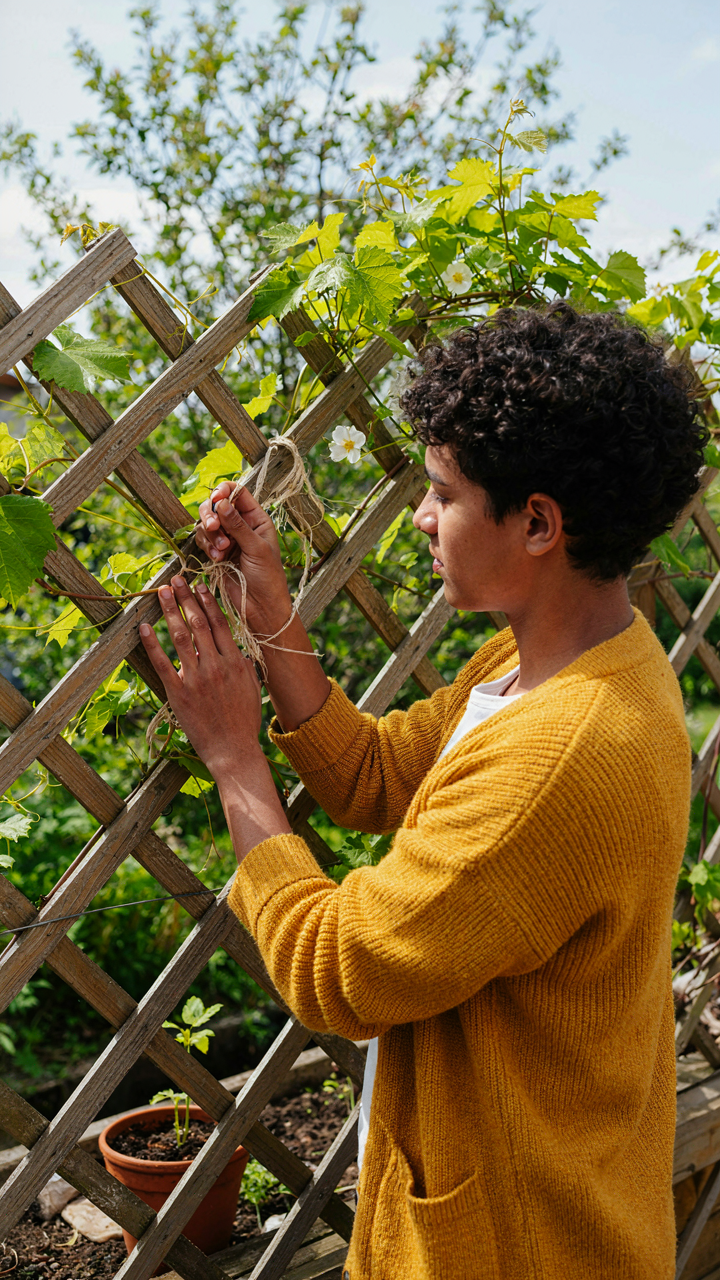
Vine-to-structure attachment determines your actual workload. Use soft ties or twine instead of rigid clips. They degrade predictably and cost nothing to replace. As vines grow, soft attachments give rather than strangle. You won’t spend seasons cutting away dead wood from where ties strangled branches. Check ties every two years during dormant season. Replace what’s degraded. This single protocol cuts maintenance by half because you’re preventing crisis, not reacting to it.
The Real Obstacle Isn’t Finding The Perfect Support; It’s Your Refusal To Think Like An Engineer, Not A Decorator

Most people treat climbing vine supports as an aesthetic choice. Wrong. You’re building a load-bearing system. Stop asking what looks good and start asking what holds weight, what survives your climate, and what actually solves the problem. Pull up your property specs today. Measure the vine’s mature weight. Pick the support that handles it. Aesthetics follow function, not the other way around.



