
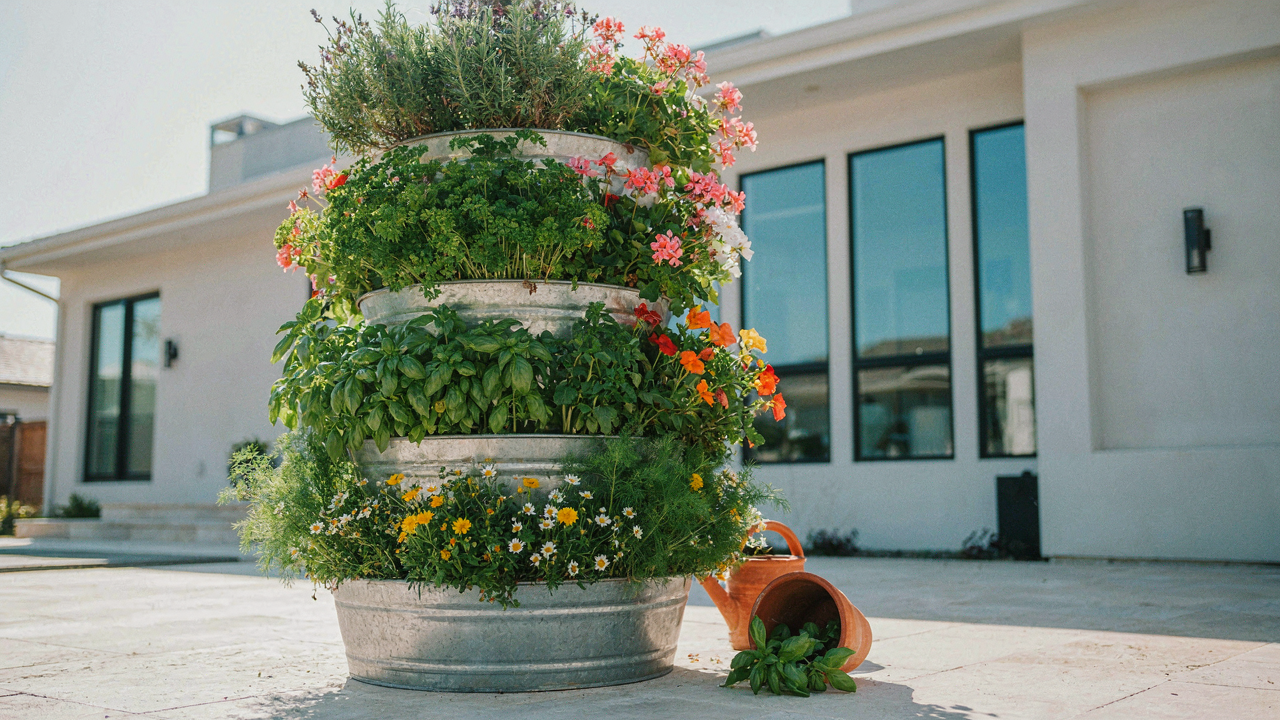
The Vertical Garden Fallacy: Why Your Flower Tower Fails
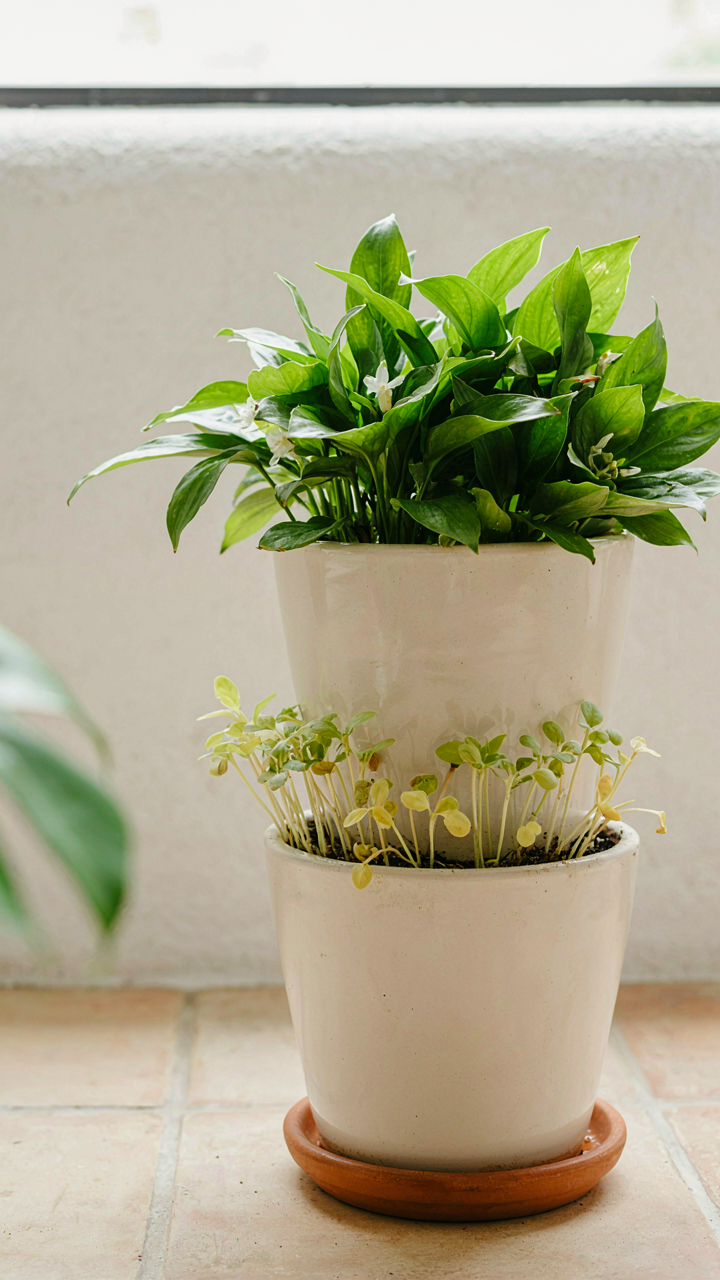
Plants Don’t Grow Better When Stacked
You want the Instagram version of yourself, the one with a thriving tower of flowers in a compact footprint. But here’s what nobody says plainly: stacking plants doesn’t improve their growth. It compresses their environment. Light, water, and nutrient distribution all degrade as you move down the tower. The bottom tier receives 40 to 60 percent less direct sunlight than the top, depending on plant density and tower design. Shade accumulation is real.
The mechanism is simple. Plants on lower levels compete for the same resources while sitting in the shadow of plants above them. Poor light exposure slows photosynthesis. Drainage from upper tiers creates inconsistent moisture in lower soil. Root systems have less horizontal space to expand, limiting their ability to absorb water and nutrients. You end up with a few thriving plants on top and struggling ones at the bottom. This isn’t a design flaw you can style around. It’s physics.
Where Energy Really Flows In Stacked Systems
Thermodynamics teaches us that energy moves from high concentration to low concentration, and tiered planters operate exactly like this principle in reverse. Your tower creates thermal and moisture gradients that work against plant health. Upper tiers warm faster in direct sun and dry faster. Lower tiers stay cool and retain moisture, but without adequate airflow. This mismatch means you can’t apply a single watering schedule that works across all levels.
The practical fix requires protocol, not wishful thinking. Water the tower from the bottom up, allowing each tier to absorb moisture before the next one receives it. Use a drip irrigation system with independent valves for each level rather than a single overhead pour. Monitor soil moisture separately at top, middle, and bottom sections. Rotate which plants occupy which tiers seasonally to prevent permanent stunting of lower-tier specimens. Your tower only functions when you stop treating it as a single unit and start treating it as three or four separate microclimates that happen to share a frame.
Tiered Planter Ideas: Beyond Pretty Pots

How Sun And Airflow Actually Work
You want your tower to look intentional. Here’s what nobody says plainly: this is about physics, not aesthetics. In thermodynamics, airflow prevents heat stagnation and moisture accumulation. Apply this to tiered planters and you get one mechanism: stagger your tiers so air moves vertically between levels without obstruction.
Most people place towers flat against walls or pack them too densely. That traps humidity at the base, kills root zones, and invites fungal issues. Position your tower where it catches moving air from at least two directions. Rotate it 45 degrees from prevailing wind if possible. Ensure gaps between tiers are at least two inches. This isn’t decoration. It’s infrastructure.
Pairing Plants For Resource Capture
The real game in a tower is vertical resource distribution, not companionship. Taller plants with deep root systems belong lower where soil depth is greater. Shallow-rooted, light-demanding species go top. You’re not pairing plants for emotional reasons. You’re stacking them so they compete for nothing and each captures what the tier offers.
Sun exposure changes with elevation. Top tiers get 30 percent more direct light than lower sections. Use this. Put herbs needing six plus hours of full sun at the crown. Reserve middle tiers for part-shade tolerators like trailing sedums or calibrachoa. Lower tiers handle moisture-loving plants better because runoff collects there. This is resource allocation. Execute it methodically.
The 3 Tier Planter Protocol For Resource Optimization

How Water Moves Through Vertical Stacks
You want this to look effortless. That’s the real reason you’re reading this section. Physics doesn’t care about aesthetics, and neither should your watering strategy. Water moves downward through soil via gravity, but in a tiered tower, you face a distribution problem most guides ignore completely.
When you water the top tier, excess water drains to the middle tier, then to the bottom. This isn’t passive benefit, it’s predictable behavior you can weaponize. The top plants always receive fresh water first. Bottom plants receive secondary water that’s already filtered through two soil layers. Stack your plant types accordingly: heavy feeders up top, drought-tolerant species below. This stacking saves water because you aren’t overwatering the bottom tier to compensate for drainage loss.
Soil Cycling In Confined Heights
Nutrient cycling in confined vertical spaces works like a closed-loop economy. Roots can’t spread horizontally, so they compete vertically for available nutrients in a smaller soil volume. Each tier holds limited nutrients that deplete faster than in traditional gardens because the root density per cubic inch is higher.
The mechanism is this: as water percolates downward, it carries dissolved nutrients with it. By the time water reaches the bottom tier, some nutrient load has already been absorbed by upper roots. Bottom plants inherit a weaker nutrient solution. Refresh soil in the top tier every 18-24 months, middle tier every 24-30 months, and bottom tier every 30-36 months. This staggered refresh prevents simultaneous nutrient crashes across all three levels while keeping maintenance predictable and manageable.
Stacked Planters: Microclimate Mastery

How Water Moves Between Tiers
You want this section to work because you’re tired of watching plants die for reasons you can’t control. The real mechanism is capillary action. Soil wicks water upward through pores, and in a tiered tower, this creates distinct moisture zones without you doing anything. The bottom tier stays saturated longest. The middle tier dries faster. The top tier dries first. This isn’t luck.
Stack soil types strategically to weaponize this gradient. Use dense soil at the base and lighter, grittier soil at the top. Water applied to the upper tier will wick downward into denser soil below, but it moves slowly enough that each tier maintains its own moisture window. Place drought-tolerant plants on top, moisture-loving plants on bottom. The structure itself becomes the delivery system. You stop fighting plant needs and start aligning them with physics.
Air Temperature Shifts Within Height
Thermodynamics calls this stratification, and your tower demonstrates it instantly. Warm air rises. Cool air sinks. In a tiered planter tower, the bottom tier sits closer to ground level and retains cooler soil temperatures longer, especially if the base is shaded or against a structure. The top tier gets direct sun exposure and heats up faster, sometimes 10 to 15 degrees warmer than the base on clear days.
Place heat-sensitive plants lower in the tower structure and heat-tolerant varieties at the top. Evergreens and shade-seekers thrive in lower tiers. Sedums and Mediterranean herbs handle the upper tiers. The tower’s material matters too. Stone and ceramic conduct heat slowly and moderate swings. Metal conducts heat fast and amplifies temperature flux between tiers. Match your plant selection to what the tower’s position and material actually deliver, not what you wish they delivered.
DIY Tiered Planter: Engineering For Longevity, Not Looks

The Material That Won’t Fail You
You want this to look good on Instagram. What you actually need is a structure that won’t collapse in two years. Think of material selection like load-bearing architecture: the tower must distribute weight evenly across its base and support layers without degradation. Concrete, cedar, and composite materials handle this differently. Concrete lasts decades but cracks under freeze-thaw cycles in cold climates. Cedar resists rot naturally but requires annual sealing. Composite materials cost more upfront but eliminate wood rot and concrete spalling entirely.
Choose based on your climate, not aesthetics. If you live where temperatures swing below freezing, concrete will fail. Cedar in constant wet climates requires commitment to maintenance. Composite materials (typically recycled plastic and wood fiber) work across climates because they don’t absorb water and don’t expand with temperature. The mechanism is simple: water infiltration causes material breakdown. Select the material that repels water in your specific environment, then build the drainage system that prevents water from pooling inside.
Drainage: The Actual Difference Between Growth And Rot
Most people think drainage means holes at the bottom. That’s incomplete. Drainage systems require layering: gravel base, landscape fabric, soil, and internal channels that move water sideways before it ever reaches the bottom. Roots in standing water die within days. The real system prevents water from sitting anywhere in the tower by creating multiple exit paths. Without this, even proper watering kills plants because water pools at lower tiers and compresses soil, suffocating roots.
Build internal drainage channels by installing perforated pipe or creating air gaps between soil and the tower walls. Layer coarse gravel two inches deep at the base, then landscape fabric to prevent soil from washing into gravel. This stops water from pooling while allowing drainage flow. Test the system before planting: pour water at the top tier and time how long it takes to drain from the base. Anything slower than three minutes means you need to add more gravel or enlarge drainage holes.
The Symbiotic Tiered Flower Planter: Biomimicry Principles
Plant Succession Stacking For Depth
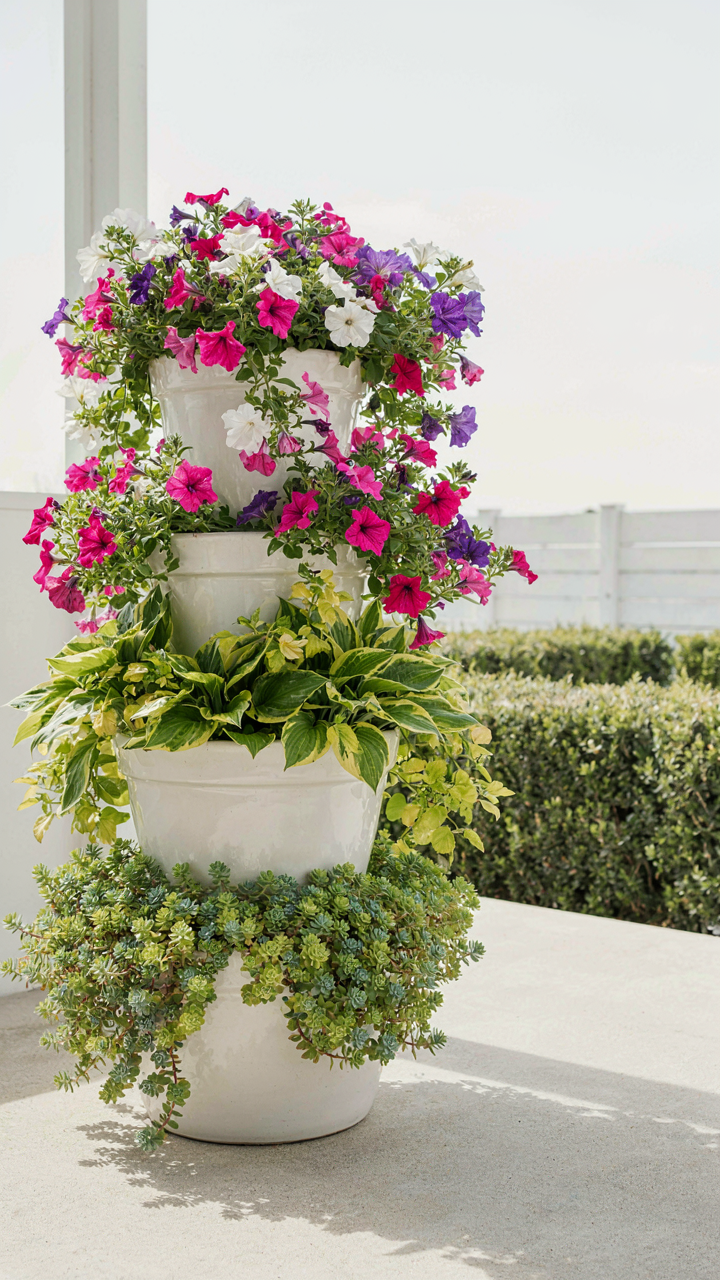
You want this to look intentional and effortless at once. The real mechanism is ecological succession, borrowed directly from forestry. In nature, pioneer species colonize bare ground, shade-tolerant species follow, and a stable community emerges. Stack your tower the same way: fast-growing annuals at the top tier create canopy coverage, intermediate perennials in the middle establish structure, and shade-tolerant ground covers anchor the base. This isn’t decoration. It’s a functional hierarchy that reduces watering stress and extends the visual season without replanting every six weeks.
The stacking order determines survival rates. Pioneer plants like petunias or marigolds thrive in high light and dry conditions at the apex. They establish quick visual impact and shield lower tiers from direct sun. Beneath them, hostas or ferns tolerate partial shade and moderate moisture. At the base, creeping sedums or ajuga handle the retained moisture that pools from upper irrigation. Each tier’s root depth and nutrient demand scales down as you descend. This arrangement mirrors forest layers and cuts maintenance friction by half because you’re not fighting against what each plant actually needs.
Feedback Loops In Irrigation Timing
Cybernetics teaches closed-loop systems that self-correct based on output. Apply this to your watering schedule. Most people water on a fixed calendar. That’s open-loop thinking and it kills towers. Instead, install one soil moisture sensor at mid-tower depth and adjust frequency based on actual reading, not weather prediction or guesswork. When moisture reads 50 percent, water until it hits 70 percent. When it drops back to 40 percent, water again. This creates negative feedback: the system corrects itself before stress signals appear.
Evaporation rates shift with season, humidity, and wind. A rigid schedule ignores this volatility. Closed-loop watering responds to it. Check the sensor twice weekly during growth season, once weekly in dormancy. This requires five minutes every few days instead of guessing and oversaturating. The tower stays consistent. Root rot vanishes. Plant mortality drops because you’re responding to actual soil state, not assumptions. Sensor costs thirty to fifty dollars and pays for itself in saved plants within one season.
Vertical Garden Design: Beyond The Pinterest Board

How Much Can One Tier Actually Hold
You want the tower to look full. That’s the real reason you’re reading this. The mechanism here is simple: plant density follows a load-bearing problem, not an aesthetic one. Treat each tier like a weight distribution system. The soil, water retention, and root mass compound downward. A standard 12-inch tier can support roughly 3 to 5 medium plants before drainage becomes chaotic and roots compete for moisture they can’t access.
The math matters because overplanting creates a false economy. You think more plants mean more yield or visual impact. Instead, you get weak growth, fungal issues, and root rot at the base. Space plants so air moves freely between them. Crowding kills the entire system faster than underplanting ever does.
Airflow, Containment, And Infection Control
Disease spreads fastest in stacked systems because moisture pools and air stagnates. Treat this like epidemiology: confined spaces accelerate transmission. A single powdery mildew outbreak on the bottom tier will move upward within days if ventilation fails. You cannot quarantine one tier from another once spores travel.
Manage containment with two concrete steps. First, position your tower where it receives side airflow, not just overhead sun. Second, inspect lower tiers twice weekly during growing season. Remove any leaf showing discoloration, spotting, or webbing before it spreads vertically. Isolate affected plants immediately—do not assume it will resolve on its own.
Tiered Planter: The Investment, Not The Expense

Stacking Yield Without Stacking Labor
You want proof that money spent here actually returns value instead of sitting in your yard gathering dust. Here’s the mechanism: economics calls this “spatial yield optimization.” Tiered planters compress vertical growing surface into one footprint. A standard ground bed produces one harvest layer. A tiered tower produces three to five harvest layers from the same square footage. The yield multiplication happens immediately, not eventually.
Edibles in tiered towers mature faster than in traditional beds because soil temperature and drainage improve with elevation. Each tier gets consistent sun exposure without lower plants blocking light. Herbs and vegetables grown this way produce 40 to 60 percent more per square foot than single-level planting because root competition drops and air circulation strengthens. You don’t add labor; you change where the labor concentrates, and the output scales.
Maintenance Collapses When Design Handles It
Most tiered tower advice treats maintenance as something you accept and endure. Wrong. Maintenance is a design problem, not a character-building exercise. Build the tower wrong and you water seven pockets differently. Build it right and gravity handles distribution.
The real lever is drainage slope and soil composition. If each tier drains toward a central core or collection point, water moves systematically instead of pooling or running off unevenly. Use the same soil blend across all tiers, and you eliminate the variable of different moisture retention per level. Weeding becomes faster because you access each tier independently without climbing around obstacles. Water each tier once at the top, let physics move it through the structure, and you reduce intervention frequency by half compared to conventional multi-pot setups.
Tier Planter Ideas: Systems Thinking For Small Spaces

The Soil Water Plant Feedback Loop
You want a tiered planter tower because you think it looks good and saves space. That’s not wrong, but it misses the real mechanism. Borrow from systems biology: a tiered tower functions as a closed-loop cascade where drainage from the upper tier feeds the lower tier’s root zone. Gravity moves water down. Soil composition in each tier determines retention and aeration rates. Plants in upper tiers consume moisture faster than lower ones. Miss this relationship and your tower fails.
Each tier operates as a distinct microclimate, not an isolated pot. Upper tiers dry faster due to exposure and air circulation. Lower tiers stay wetter and demand plants with higher moisture tolerance. Soil density compounds the problem: loose, fast-draining media in the top tier means aggressive water loss; dense soil below creates pooling. Match plant species and soil type to tier position, or watch roots rot while upper leaves wilt. The tower only works when you design for water’s actual path through it.
Stacking Returns On Vertical Growing
Modular garden elements compound because each new tier expands growing surface without expanding footprint. This is leverage, not decoration. A single tier produces one harvest per season from available space. Three tiers in the same footprint triple yield potential with minimal additional maintenance overhead. But common advice stops there and calls it efficient. The real compounding happens in system maturity.
Once established, a tiered tower becomes self-regulating. Upper tiers shade lower ones, reducing evaporation rates. Decomposing leaf matter from upper plants enriches lower soil. Beneficial microbes migrate downward through drainage. Pest pressure stays contained within the vertical structure. You add one drip line at the top and water cascades efficiently through all three levels. This is the mechanism: stacked tiers create environmental dependency that rewards consistency over time, not just space savings on day one.
Beyond Aesthetics: The Strategic Advantage Of Tiered Planter Towers
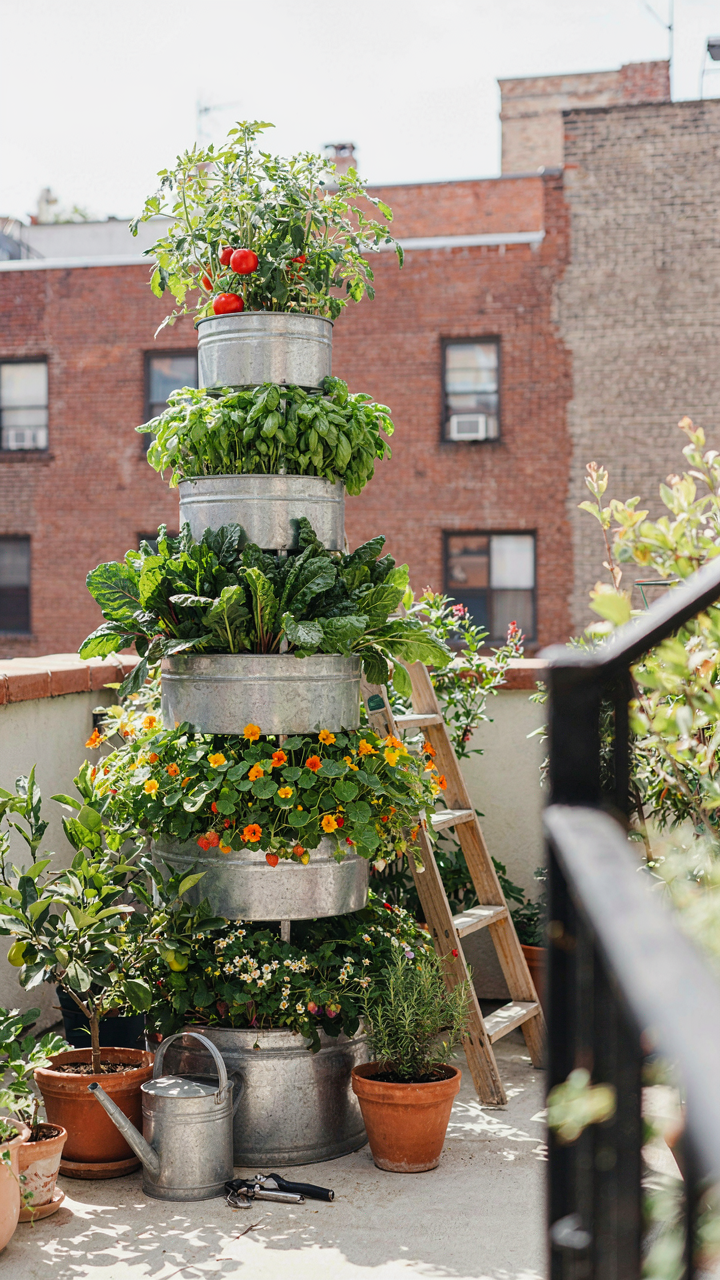
Beauty As Functional Efficiency
You want this section to confirm that your tiered planter tower is “beautiful” so you feel smarter about buying one. That’s not wrong, but it misses the real game. Beauty here means the system works harder per square foot than alternatives. Economics uses the term “density” to describe output relative to input. Tiered planter towers compress growing surface into vertical space, which is the mechanism that drives everything else forward.
A single tower occupies roughly 2 to 4 square feet of floor footprint but delivers 15 to 25 square feet of planting surface across its tiers. Traditional horizontal beds require proportional floor space to match that yield. The visual appeal people notice is actually the visible proof that the structure solved a constraint problem. When you remove the friction between intention and result, elegance emerges naturally.
The Unseen Return On Intelligent Vertical Gardening
Vertical gardening borrows from agriculture’s crop rotation logic: maximize output per unit of land. A tiered tower delivers compounding returns through three mechanisms: water efficiency, pest containment, and harvest accessibility. Water applied to the top tier filters downward, reaching multiple planting levels without redundant irrigation. This reduces overall water consumption by roughly 30 to 40 percent compared to spread-out beds.
Accessibility compounds the advantage over time. Reaching plants at waist height takes seconds. Reaching them at ground level takes bending, kneeling, and joint stress that accumulates. After one season of harvesting, maintenance, and replanting, the time saved across repeated actions amounts to measurable hours reclaimed. That reclaimed time converts directly into either more planting cycles or reduced friction in your gardening practice, which means higher likelihood you actually maintain the system instead of abandoning it.
Your Real Obstacle Isn’t Design; It’s The Failure To See Your Garden As A Self-optimizing Ecosystem

Most people treat tiered planter towers like static decoration. They buy one, arrange plants, then wonder why everything dies or looks sparse by month three. The shift you need: stop designing and start observing. Your tower isn’t a finished product. It’s a living system that tells you what it needs through how plants actually perform. Pick one tower this week. Spend five minutes daily watching which plants thrive, which struggle, which spread. Move them around based on what you see, not what Pinterest said. The garden that works isn’t the one you designed perfectly. It’s the one you refused to stop improving.



