

The Vertical Herb Wall Illusion: Why Most Fail

The Instagram Problem Is Your Real Problem
You want the visual win without understanding what makes it work. That’s the actual motive here, and it kills most vertical herb walls before they start. The mechanism is simple: you’re borrowing from landscape design’s principle of “layering,” which stacks elements for depth. But most people treat vertical herb walls like a static art installation instead of a living system that demands constant input. They nail it to a wall, water it unevenly, and expect it to stay magazine-ready. It won’t.
The gap between expectation and reality comes from ignoring one fact: a vertical herb wall is a performance, not a decoration. Every herb you choose has specific light requirements, moisture patterns, and root depth. Cramming diverse species into the same vertical plane creates microclimates you can’t actually control. Some areas dry faster. Others stay damp. You end up with dead zones alongside thriving ones, and the Instagram version never matches your actual wall. Most people blame themselves. The real problem is they chose plants without matching them to their specific wall’s conditions first.
Biology Doesn’t Negotiate With Aesthetics
You picked thyme because it photographs well. Now it’s rotting because thyme demands drainage you didn’t engineer into that pocket. This is where people abandon the whole project. The biological truth is ruthless: shallow-rooted herbs like basil and oregano need frequent watering. Deep-rooted herbs like rosemary demand less frequent but thorough water penetration. You cannot satisfy both on the same vertical plane with the same watering schedule. Most advice says “just water more” or “use a drip system.” That’s incomplete. A drip system doesn’t solve incompatible rooting depths or the fact that water runs downward, leaving upper pockets dry.
The real mechanism is water flow physics. In a vertical setup, gravity works against you. Water soaks the bottom pockets while upper ones dry out unless you use a wicking system or bottom-up irrigation, which most people never implement. You need to choose either herbs with similar moisture needs or invest in dual-zone watering. Don’t fight biology with wishful thinking. Match your plant selection to your water delivery method, not the other way around.
The 4 Pillars Of A Resilient Vertical Herb Garden

Light, Water, And Nutrients
You want your wall to look effortless. That’s why you’re reading this. But effortless fails fast because you’re skipping the non-negotiables. Light, water, and nutrients aren’t inspirational concepts—they’re the input variables that determine whether your herbs live or become expensive compost.
Most vertical walls fail on light first. Herbs need 12 to 16 hours of direct or intense indirect light daily. If your wall sits in a room corner, supplemental grow lights aren’t optional—they’re mandatory. Without them, you’re not growing herbs. You’re growing stretched, weak stems that taste like nothing and die quietly.
Water moves differently on a vertical surface. Gravity pulls it down. Soil dries faster at the top pockets than the bottom. Standard overhead watering creates runoff waste and uneven saturation. Drip irrigation or a self-watering system solves this mechanically—water flows to each pocket’s root zone consistently, not by luck.
Nutrients deplete faster in contained vertical systems than in ground soil. Herbs pull nitrogen, phosphorus, and potassium from a finite pocket of soil. You can’t rely on natural soil renewal. Feed your system every two weeks with a balanced liquid fertilizer, or use a slow-release pellet in the soil at planting. Without this, leaves yellow, growth stops, and you mistake stagnation for maturity.
Airflow And Root Zone Health
Biology teaches us that stagnant conditions breed disease. Vertical gardens amplify root zone risk because pockets are small chambers where moisture accumulates and pathogens thrive. Airflow is your defense mechanism.
Poor airflow creates fungal issues, mold on soil surfaces, and root rot in lower pockets where water pools. A small oscillating fan positioned three feet away from the wall moves air across all pockets equally, preventing microclimates of stagnant humidity. Run it four hours daily minimum—timing matters less than consistency.
Root zone health depends on drainage and soil structure. Use a potting mix designed for containers, not garden soil. Garden soil compacts vertically and suffocates roots. Add perlite or pumice to your mix—25 to 30 percent by volume—to maintain aeration. The roots need oxygen more than they need moisture. The mix should dry slightly between waterings, signaling roots to search for water instead of rotting in it.
Check the bottom pocket weekly. Water collects there. If it sits wet for more than two days after watering, either reduce frequency or install a drain hole at the wall’s base. Stagnant root zones fail faster than any other system failure. Install drainage first, then monitor it weekly.
The Hydrodynamic Herb Wall: Water Management Protocol

Gravity Fed Systems And Irrigation Efficiency
You want a vertical herb wall because you think it looks smart and saves space. The real reason you need to understand gravity is because water moves downward whether you design for it or not. Hydrostatics—the physics of fluid pressure at rest—governs how your system either thrives or fails. A gravity-fed setup means water enters at the top and descends through your growing medium. The pressure differential creates flow. No electricity required. No timers unless you want them.
The mechanism is simple: higher inlet point equals more consistent pressure throughout the vertical plane. Most people just drill holes and hope. That fails because pressure decreases as water descends, starving lower plants. Position your water source at minimum 12 inches above the highest planting pocket. Use drip lines or soaker tubing sized to your wall’s height and density. Test flow rates before planting. Adjust emitter spacing so every pocket receives adequate saturation without excess.
Managing Moisture And Nutrient Loss
The common advice is to add more drainage holes. That’s incomplete. Drainage holes solve one problem and create another. Too many holes mean water and nutrients flush through before roots absorb them. Too few means standing water rots stems. The real issue is retention time. Your growing medium needs 20 to 30 seconds of water contact per plant pocket before drainage exits. This timing extracts the most nutrient availability while preventing root suffocation.
Use medium-density substrates like coconut coir blended with perlite or a pre-made hydroponic mix. These retain moisture without waterlogging. Test by pouring water into an isolated pocket and timing the drainage. Runoff should be visible but slow. If water pools, increase drainage slightly. If it runs straight through, add more organic material to your mix. Collect runoff from the bottom and measure EC levels. When EC rises above your target range, it signals nutrient concentration is building. Flush the system with fresh water at that point to reset.
Light Spectrum Optimization: Beyond The Sunbeam
Why Your Plants Aren’t Using Light You’re Already Paying For
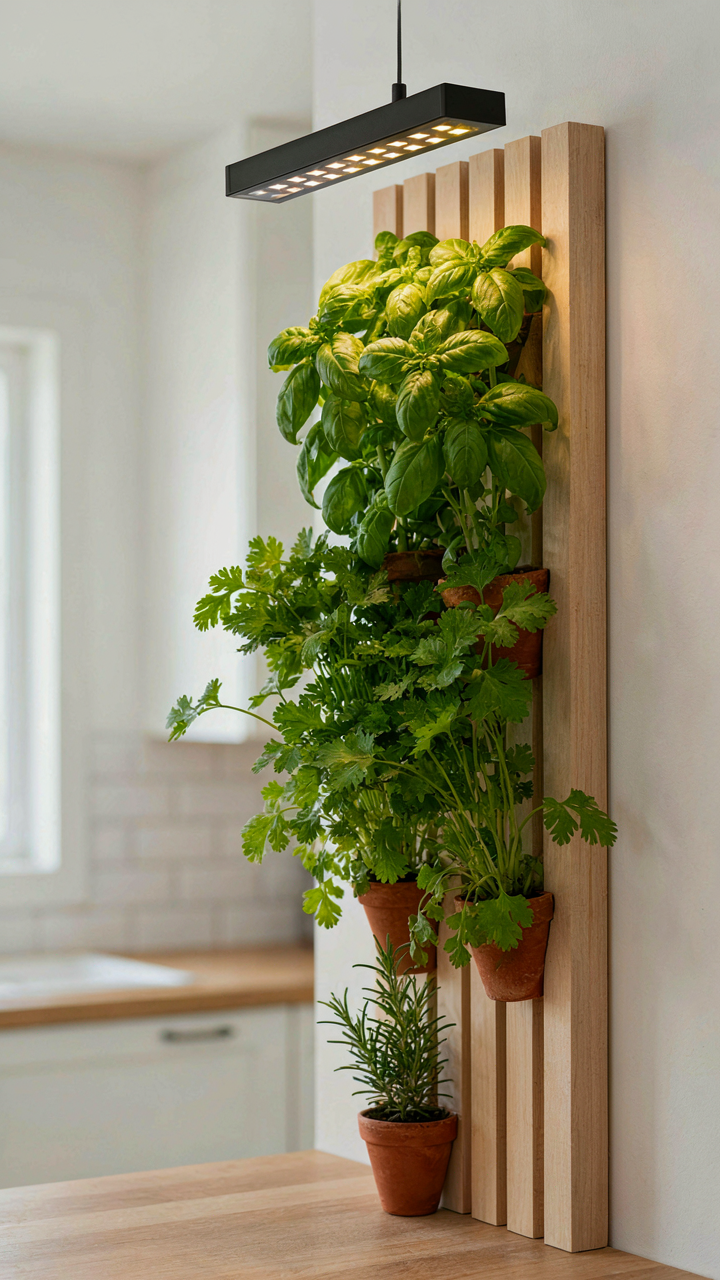
You want proof that your expensive light setup is working, but you’re measuring the wrong thing. Biology calls it photosynthesis—the conversion of light energy into chemical energy plants use to build tissue. In vertical herb walls, this conversion fails when spectrum and intensity don’t match what each herb actually needs. Most growers throw watts at the problem and wonder why yields stall.
Plants absorb light in two primary zones: blue (400-500 nanometers) and red (600-700 nanometers). Green light penetrates deeper into dense canopies, making it useful in high-density vertical systems where lower leaves get blocked. The key mechanism is simple: wrong spectrum equals wasted electricity and slow growth, regardless of total lumens. Your job is matching spectrum to herb type and canopy density, not guessing.
Measuring What Matters For Indoor Herbs
PPFD means photosynthetic photon flux density. It measures the actual photons hitting your plants per second, per square meter. Most indoor growers cite lux or lumens, which measure human eye brightness, not plant usability. This confusion costs money. Basil needs 300-600 micromoles per second per square meter. Mint tolerates lower PPFD around 200-400. Rosemary demands 400-700 to maintain oil production and growth rate.
Calculate your wall’s optimal PPFD by measuring fixture distance, wattage, and spectrum output, then cross-reference against your herb species. Install a quantum meter to verify actual photon delivery at canopy level. Distance matters exponentially: moving a 50-watt LED from 12 inches to 24 inches cuts delivered photons by roughly 75 percent. Start at the lowest PPFD your target herb requires, then increase only if growth stalls or leaf color indicates light stress, not random assumption.
The Nutrient Cycling Method For Kitchen Herbs

What Your Plants Actually Need To Grow
You want a vertical herb wall that looks effortless and produces year-round. That requires understanding what nutrients do the actual work. Most people treat fertilizer like a vague supplement, not realizing macronutrients and micronutrients operate on completely different timelines and serve opposite functions in plant physiology.
Macronutrients—nitrogen, phosphorus, potassium—move fast and get depleted quickly. They’re the structural backbone: nitrogen builds leaf tissue, phosphorus drives root development and flowering, potassium regulates water uptake and stress response. Your herbs burn through these in weeks. Micronutrients like iron, zinc, manganese, and boron work slower and in smaller quantities, but their absence creates stunted growth or yellowing leaves that won’t recover without intervention.
- Nitrogen: Fuels leaf growth and green color. Basil, parsley, and mint demand constant nitrogen supply to maintain productive harvesting cycles without browning or thinning.
- Phosphorus: Strengthens root systems and encourages flowering. Critical for herbs like oregano and thyme that rely on root density in compact vertical spaces.
- Potassium: Regulates water movement and disease resistance. Prevents wilting between waterings and keeps leaves from developing stress spots in fluctuating light.
- Iron: Prevents chlorosis (yellowing between leaf veins). Vertical systems with recycled water often become iron-deficient without chelated iron supplementation.
- Calcium and Magnesium: Support cell wall structure and photosynthesis efficiency. Magnesium especially impacts how fast herbs can recover from harvest stress in confined growing zones.
The practical protocol: soil or hydroponic medium for vertical walls needs a base fertilizer with a 3-1-2 NPK ratio for leafy herbs, applied every 10 to 14 days during active growth. Add a micronutrient spray monthly to catch deficiencies before they show as visible damage. This isn’t optional if you want consistent production from a wall that’s barely larger than a closet door.
Recycling Nutrients Through Closed Systems
Hydroponics teaches us that a closed loop means nutrients recirculate rather than drain to waste. A vertical herb wall functions the same way: every drop that moves through the system either gets absorbed by roots or returns to the reservoir for reuse. This is the mechanism that separates productive walls from dying experiments.
Open systems—where water drains out—require constant nutrient replenishment because you’re always replacing what exits the pot. Closed systems recycle, but they also concentrate dissolved solids over time, which locks nutrients out of plant availability and creates salt buildup on roots. Most herb walls fail because growers don’t track EC (electrical conductivity) or PPM (parts per million) and don’t perform partial water changes to reset the mineral balance.
A functional closed-loop protocol requires three actions: measure reservoir nutrient strength weekly using an EC meter, change 30 percent of the water every three weeks to dilute accumulated salts, and monitor pH weekly because herb uptake patterns shift pH toward acidity or alkalinity depending on which nutrients the plants consume fastest. Skip any of these steps and your wall becomes a static display of struggling plants.
Space Saving Kitchen: Maximizing Density, Minimizing Footprint
Vertical Stacking Without Structural Compromise
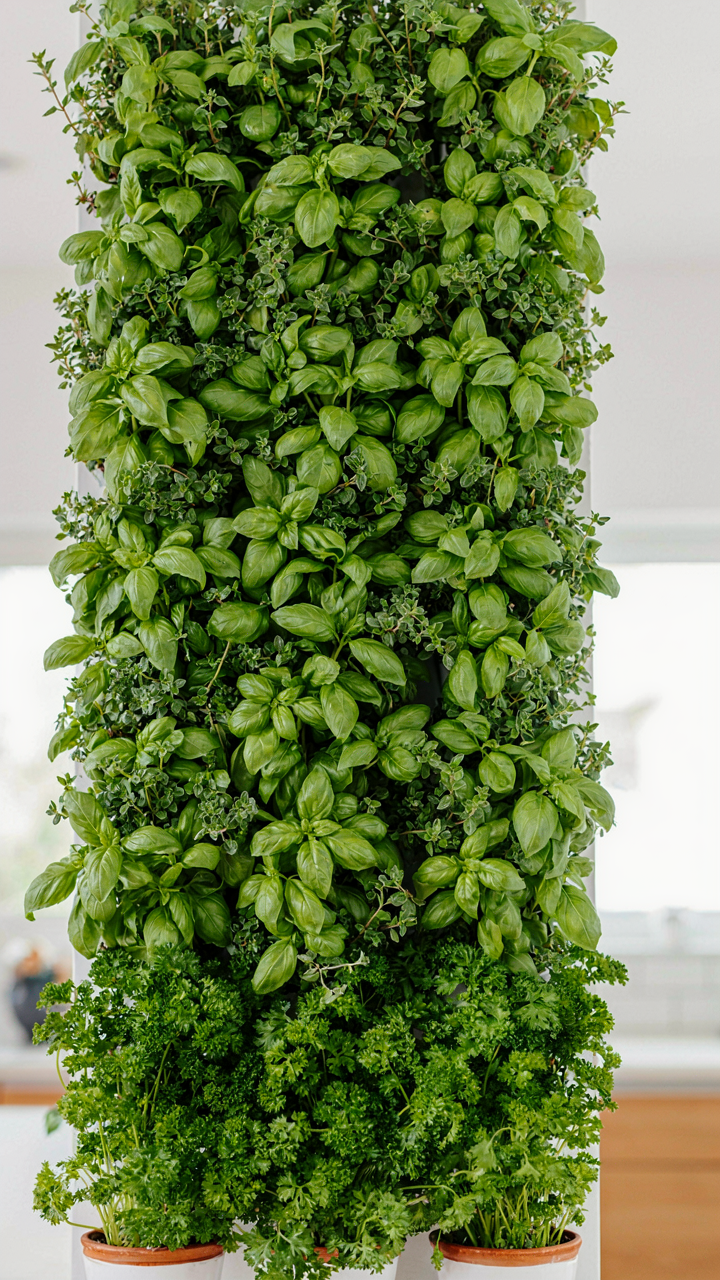
You want to believe a wall can hold infinite weight without sagging or failing. It can’t. The mechanism here comes from load distribution, borrowed from structural engineering: you’re not fighting gravity, you’re directing it downward in parallel paths. A vertical herb wall that stacks modularly spreads force across multiple mounting points instead of concentrating it at one anchor. This is the difference between a system that holds and a wall that cracks.
Modular design means each tier attaches independently to wall studs or a dedicated rail system, not to the tier below it. Pocket planters, channel systems, and panel frames distribute weight vertically rather than asking the bottom row to carry everything above. Most people stack without calculating load, then panic when brackets bow. Attach each module directly to structural support. This keeps density high without accumulating failure points.
Herbs That Yield More Per Square Inch
High yield isn’t about growing giant plants in tight spaces. It’s about choosing varieties that produce harvestable material continuously within physical constraints. Basil, oregano, thyme, and parsley don’t need deep root zones, regenerate after cutting, and tolerate the reduced light that comes with wall density. They’re bred for productivity, not size. This selection determines whether your wall feeds you or just looks green.
Creeping thyme and cascading oregano occupy vertical space efficiently because they spread laterally along shelves rather than growing tall. Compact basil cultivars like Spicy Globe stay bushy without leggy growth. Flat leaf parsley produces harvestable stems faster than root depth would suggest. Chives and marjoram require minimal soil volume. Match variety architecture to available real estate. Dense foliage equals more harvests per square foot of wall.
Integrated Pest Management For Your Indoor Herb Garden

Catch Problems Before They Compound
You want pest control that doesn’t require you to become a botanist or spray chemicals everywhere. The real mechanism is signal detection: insects establish colonies exponentially, so the window between one pest and an infestation is measured in days, not weeks. Early intervention stops the math from working against you.
Scout your vertical herb wall twice weekly. Look under leaves, at stem joints, and along the soil surface with a phone flashlight. Spider mites, aphids, and whiteflies leave visible damage patterns before populations explode. Document what you see. This isn’t paranoia; it’s the difference between removing five insects and removing five thousand.
Build The Environment, Not Just Defenses
Ecology, not chemistry, solves pest problems long-term. Think in terms of predator-prey balance: a thriving ecosystem resists invasion because niches are already occupied and resources are controlled. You’re not fighting pests; you’re making conditions hostile to their reproduction.
Airflow matters most. Stagnant air around vertical walls creates microenvironments where humidity spikes and pests thrive. Position a small fan to keep air moving across all herb layers without drying soil excessively. Humidity between 40-60 percent prevents both fungal infections and the extreme dryness that weakens plant immunity. Water early in the day so foliage dries by evening. Remove any dead leaves immediately, as they become pest breeding grounds. The system works because you’ve eliminated the conditions pests need to establish, not because you’re fighting them after the fact.
Automated Wall Herb Garden Indoor: The Future Of Effortless Cultivation
Real Time Environmental Feedback Loop
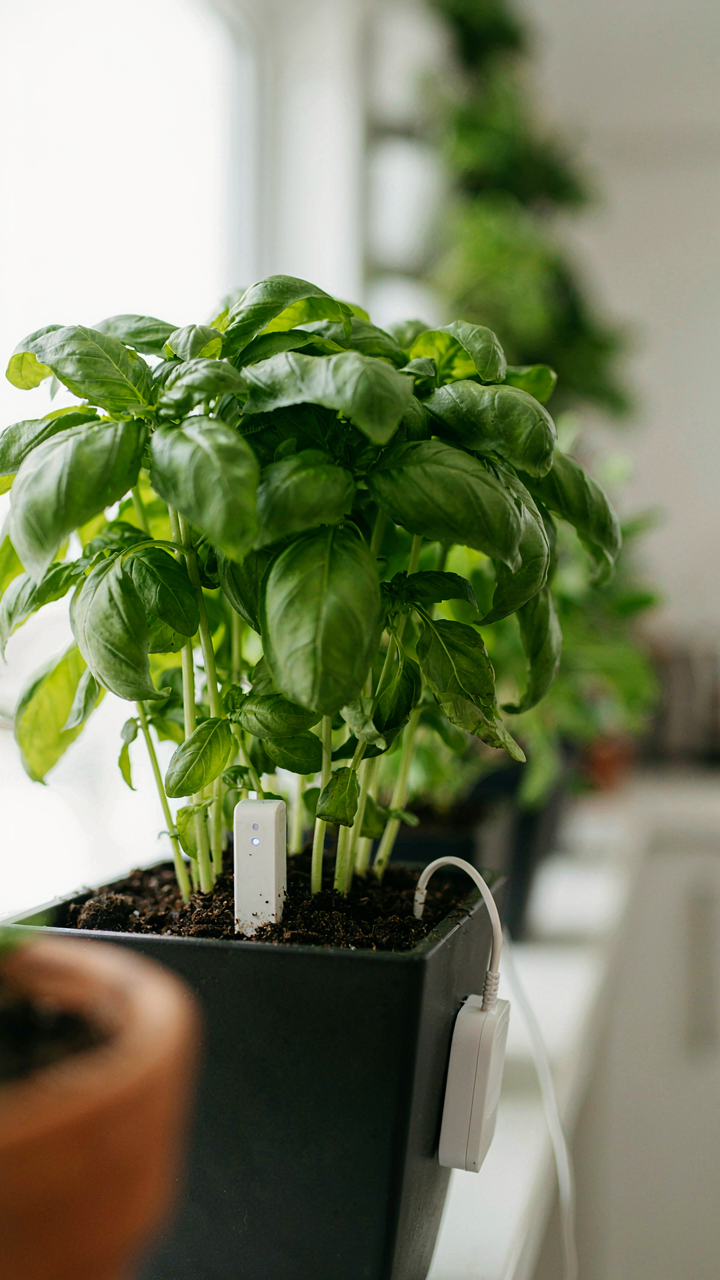
You want automation because you’re afraid you’ll kill the plants and waste money. That fear is the actual problem to solve, not just the watering schedule. Environmental sensors—moisture, light, temperature, humidity—create a feedback system where the wall responds to conditions, not to a predetermined timer. This borrowed mechanism from control systems engineering means your wall maintains a target state rather than guessing when plants need intervention.
Moisture sensors detect soil water content before roots suffer. Light sensors measure photosynthetically active radiation and adjust grow lights accordingly. Temperature and humidity probes trigger ventilation or misting when conditions drift. Most commercial systems relay this data to an app, but the real mechanism is the sensor placement: you need multiple points across the wall because microclimates form—top shelves dry faster, bottom sections stay wetter. Install sensors at three vertical levels minimum to catch these variations.
Precision Watering And Light Cycles On Demand
The common advice says “set it and forget it,” which is incomplete garbage. You can’t forget it because plants don’t operate on fixed schedules—they respond to available resources. Programmable systems let you adjust watering frequency and light duration based on real sensor data, not calendar dates. You create rules: if soil moisture drops below 40 percent, activate drip lines for exactly eight minutes; if light levels fall below 400 micromoles per square meter per second, extend photoperiod by two hours.
Water delivery precision matters more than frequency. Drip irrigation or micro-tubing distributes water directly to soil, eliminating waste and preventing fungal issues on foliage. Light schedules should match your target herbs’ native photoperiods—Mediterranean herbs like rosemary need 14 to 16 hours daily, while shade-tolerant mint thrives on 12 hours. Programmable systems track cumulative hours and adjust seasonally without human input, creating consistent harvests year-round.
The True Obstacle Isn’t The Wall; It’s Your Unwillingness To Embrace The Hidden, High-performance System Beneath The Surface

You don’t need a vertical herb wall. You need to stop treating plants like decorations and start treating them like a system. Most people fail because they build the wall, then abandon it. The shift happens when you realize this isn’t about growing herbs—it’s about building a daily ritual that compounds. Pick one herb today. One. Install it tomorrow. Watch what happens when you actually commit to something small instead of planning the perfect setup that never ships. Your vertical herb wall succeeds the moment you stop waiting to start.



