

The Inverse Illumination Protocol: Crafting Shadows, Not Spotlights

Where The Light Stops
You want your garden to look expensive because you think spotlights make everything visible, which feels safe. That’s backwards. Landscape lighting borrowed a principle from contrast theory in visual perception: the eye perceives value not from constant brightness but from the deliberate absence of it. Darkness creates demand for light. A garden lit everywhere is a garden that looks lit. A garden with strategic shadow becomes a space with depth.
Most garden lighting advice treats darkness as a problem to solve. It’s actually your primary tool. The real move is placing spotlights where they create defined zones of light and undefined zones of shadow. This makes the lit areas feel intentional rather than uniform. Your eye travels to the light because the darkness gives it somewhere to travel from. That’s the mechanism. A 40-watt uplighter on a tree trunk matters infinitely more than two 60-watt floodlights washing an entire bed. Contrast sells. Uniformity bores.
Visual Hierarchy Through Negative Space
Negative space in landscape design works exactly like negative space in graphic design: it forces the viewer’s attention toward what remains. The problem is that most homeowners light everything equally, destroying hierarchy. Your garden becomes visual noise. A strategically dark corner makes a spotlit focal point 300 percent more powerful because the eye has nowhere else to go. You’re not just lighting a feature. You’re removing competition for attention.
Placement dictates this entirely. Identify three maximum focal points: entry, sitting area, signature planting. Spotlight only those. Leave paths dimly lit with path lighting that guides without announcing. Leave background areas unlit. This creates visual depth that reads as intentional design rather than accident. Your garden now has structure. When a visitor enters, their gaze lands exactly where you need it because you engineered what they won’t see. That’s control. That’s style. Place spotlights only at your three focal points and go dark everywhere else.
Beyond Beams: Spotlight Garden Features As Psychological Triggers

What Your Courtyard Actually Reveals
You want people to notice what you’ve built. That’s not shallow—it’s the real reason you care about lighting placement. Courtyard spotlights work because they exploit a gap between what people expect to see and what they actually find. Most outdoor spaces go dark after sunset. Your courtyard doesn’t. That contrast creates cognitive friction, and friction demands attention.
The mechanism borrows from information theory: incomplete data triggers search behavior. When a spotlight illuminates one architectural detail while leaving adjacent areas in shadow, the eye doesn’t settle. It works to complete the picture. Courtyard lighting does this by design—a single uplight on a textured wall creates more visual weight than even illumination ever could. The guest’s brain fills in meaning where the light doesn’t reach.
Designed Restraint Beats Abundance
Scarcity in landscape design means removing options, not adding them. The common mistake is flooding a garden with light fixtures, thinking volume creates desire. It creates fatigue instead. One strategically placed spotlight that highlights a rare specimen or architectural feature triggers want because it suggests exclusivity, not because it’s brighter than alternatives.
Implied scarcity works on the same principle as limited inventory in sales. When spotlights emphasize one element—a sculptural tree, a water feature, a pavilion edge—the visitor interprets that singular focus as significance. They internalize: “This matters because only this is lit.” Install spotlights to frame what you choose to keep visible. Leave everything else in measured darkness. The restraint signals intentionality, which signals status.
The Sculptor’s Eye: Using Light To Redefine Form

Texture Becomes Visible Only Under Angle
You want your garden to look expensive without spending like you’re insane. Here’s what actually works: texture demands side-lighting, not overhead. This is basic physics from stage lighting design. Grazing light—positioned parallel to a surface rather than perpendicular—turns flat or mundane material into visual depth. A brick wall becomes architecture. Weathered stone becomes character. The mechanism is simple: shadows amplify what’s already there.
Outdoor spotlights placed low and to the side of textured surfaces create contrast that the eye reads as dimension. Moss on pavers, bark on trees, render on walls—all register as premium when light hits them at shallow angles. Most people light their gardens from above because it’s obvious. That’s why it looks generic. Move the light source 45 degrees lower and inward, and you’ve rewired the entire space’s perceived value without changing a single material.
Edges Define The Bones Underneath
Contemporary garden lighting doesn’t soften lines—it sharpens them. The mistake most people make is treating architectural elements as secondary. Your pergola, fence posts, raised beds, and pathways are the structure. Light should announce their existence, not dissolve it. Spotlights positioned to trace the outer perimeter of built features—not flood them—make boundaries read as intentional design rather than accident of property.
A spotlight aimed at the corner junction of two walls, or along the spine of a pergola beam, creates clean shadow lines that define space. This works because human brains recognize edges as information. Soft, even lighting obscures edges. Sharp lighting, delivered from a single angle, confirms that what you built was deliberate. Install spotlights at ground level pointing upward along vertical elements, or at waist height pointing across horizontal planes, to expose the actual architecture underneath the foliage.
Unveiling The “Invisible” Garden Ground Lights For Drama

Concealed Fixtures, Subtle Elegance Over Overt Display
You want people to notice your garden without noticing you tried. That’s the real play here. Ground-level spotlight garden features work because they operate on a principle borrowed from stage lighting: separation of the light source from its effect. The fixture disappears. Only the illuminated object remains visible.
Recessed spotlights mount flush into garden beds, pathways, or hardscape. They cast light upward onto trees, architectural elements, or textured walls without drawing attention to themselves. This creates drama without announcing effort. The mechanism is simple: eliminate the fixture from the viewer’s sightline, and the eye tracks only the lit subject.
Pathways Of Intrigue, Guiding With Minimalist Light
Minimalist pathways don’t announce themselves with excessive brightness or frequent markers. Ground-level spotlights space further apart than conventional path lights, forcing the eye to anticipate rather than follow. This mirrors how military operations use sparse waypoints to suggest a route without advertising it. Spotlight garden features here become navigational cues, not decorative ornaments.
Install low-voltage ground spotlights 8 to 12 feet apart along movement routes. Point them at subtle angles to catch edges, plantings, or surface texture rather than flooding the path itself. This approach uses fewer fixtures, reduces energy load, and creates visual intrigue. The viewer moves through intentional shadow and light rather than uniform brightness.
The Bioluminescent Blueprint: Borrowing Nature’s Lures

When Glow Matches Pupil Dilation
You want people to notice your garden at night without looking like you’re running an interrogation room. Biology teaches us about tropism, the directional growth toward stimulus, and spotlight garden features operate on the same principle: humans orient toward subtle, wavelength-specific light sources. Most people flood gardens with 5000K daylight temperature and wonder why it feels harsh and artificial. The mechanism is simple. Your eye dilates in low light. When you hit it with bright white, the pupil contracts violently. That jolt registers as discomfort, not beauty.
Natural glow exists in the 2700K to 3000K range. This matches candlelight and twilight. Fireflies emit this exact spectrum to attract mates. Position warm spotlights to create pools of light rather than wash everything. The goal is depth perception, not visibility. Place fixtures low and angled upward through foliage so light filters and scatters. Let shadows exist. Darkness makes the lit elements work harder. A 15-watt warm LED spotlight creates more visual impact than a 100-watt cool-white floodlight because your eye responds to contrast, not volume.
The Pulse Over The Blast
Evolution shaped human attention toward movement and rhythm, not static brightness. Spotlight garden features that pulse or shift in intensity capture the primitive brain faster than constant illumination. Most landscape lighting ignores this entirely. Designers install static spotlights and call it done. The real play happens when you introduce temporal variation.
Install spotlights with dimmers or smart controllers set to shift intensity gradually over 30-second cycles. This mimics the flicker of fire or moonlight through leaves. The pupil responds to these micro-changes by staying engaged rather than habituating and tuning out. Use this protocol: set base intensity at 20 percent, peak at 50 percent, repeat every 45 seconds. This consumes less power than constant full brightness while commanding more attention. The eye tracks change faster than it registers stillness.
Outdoor Tree Lighting Ideas: The Vertical Dimension Of Value

Uplighting: Commanding Presence, Not Mere Visibility
You want people to notice your trees at night because it signals you have taste and resources. The mechanism is simple: uplighting uses gravity’s opposite—light traveling upward—to reframe what viewers perceive as important. In architecture, uplighting is called emphasis through inversion. A tree lit from below commands attention because it contradicts the natural direction of daylight. Most people install tree lights and call it done. They’re wrong. Uplighting without angle precision produces a washed-out, theatrical effect that reads as try-hard, not intentional.
The real work is positioning fixtures 3 to 5 feet from the trunk base at a 45 to 60-degree angle upward. This angle illuminates the canopy structure—branching patterns, density, form—rather than flattening the tree into a silhouette. You’re not lighting the tree. You’re lighting the architecture of the tree. LED spotlights between 10 and 20 watts deliver enough output without overexposure. Place one fixture per major tree. Multiple fixtures around one tree create competing light vectors and cancel the commanding presence you wanted.
Shadow Play: Creating Depth And Mystery
Shadows are the inverse of light. Most landscape designers ignore them entirely, treating shadow as the absence of light rather than a design tool with weight. That’s the mistake. In photography, shadow placement determines spatial depth and viewer focus. One uplighting fixture casting sharp shadows from branches onto a wall or secondary plane creates perceived distance between foreground and background. Your yard expands. The eye travels deeper.
Position uplighting fixtures so their shadows fall on neutral surfaces—fences, walls, ground planes. Shadows must have definition. Soft, diffused light creates mushy shadows that read as accident. Crisp shadows read as intention. Dense trees cast complex shadow patterns. Sparse, structured trees cast readable geometric shadows. Choose trees accordingly for the effect you want. Install fixtures 6 to 8 feet from the shadow target surface to stretch and sharpen the projected image. Adjust height after dark. You’re designing for night perception, not installation convenience.
Grass Lighting: The Underestimated Canvas
Subtle Washes Enhancing Expanse
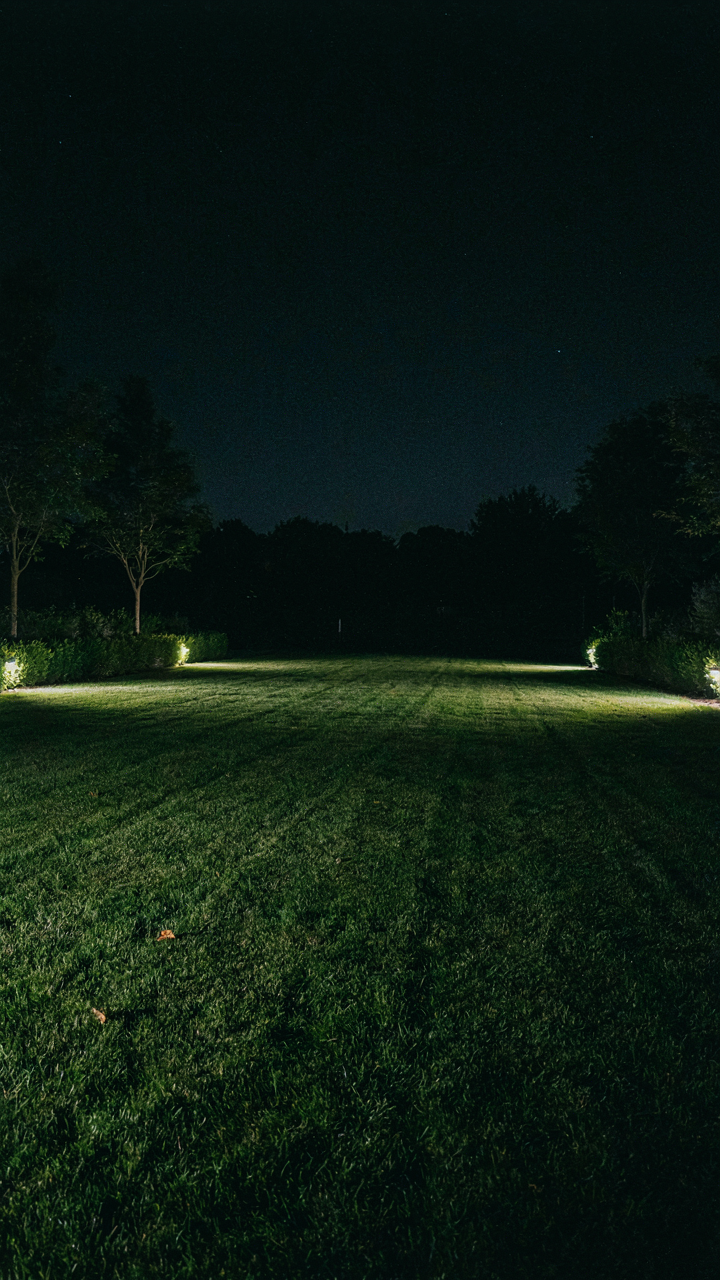
You want your yard to feel bigger than it is. Most people light grass like a parking lot—even coverage, flat, dead. That kills depth. Borrowing from stage lighting, think of grass as a surface that needs gradient, not uniform illumination. Subtle washes create the illusion of expansion by controlling where the eye travels and where it stops.
Position uplights or well lights at the perimeter, angled inward at low angles. This pulls light across the turf surface rather than flooding it. The goal is directional wash, not scattered points. Thirty to fifty lux on grass is enough. Anything brighter reads as artificial and shrinks the space visually. The mechanism: low-angle light creates shadow gradation, which the brain interprets as depth and distance.
Defining Zones With Low Level Luminescence
Low-level lighting works only when you understand what zone you’re actually marking. Most people install path lights randomly and call it design. Instead, place them to reinforce functional separation: where lawn meets patio, where the yard transitions from social space to planted beds, where a seating area begins. Each light source should answer a question about movement, not just exist.
Use lights between fifty and one hundred lux for zone definition. This is bright enough to signal boundary without bleaching out the grass or neighboring plants. Spacing matters more than brightness. Five to eight feet apart maintains visual continuity while preventing the “runway effect.” The protocol: map your yard’s actual use patterns first, then position lights to reinforce those paths. Light follows function, not the other way around.
Home Garden Lighting Ideas: The Ecosystem Of Envy

Layering Light For Dynamic Perception
You want people to notice your outdoor space without admitting that’s why you spent money on it. The mechanism is borrowed from stage lighting: you control what the eye lands on by manipulating contrast and depth. Spotlight garden features work because they break visual monotony. A single light source flattens everything equally. Multiple light sources at different intensities and angles create hierarchy. The brain reads hierarchy as intentionality, which reads as wealth.
Start with ambient light at low intensity across the hardscape. This is your baseline. Then place spotlights at 45-degree angles to isolate specific plants, architectural details, or water features. The overlap creates shadow and dimension. Spacing matters more than brightness. Most homeowners over-light and kill the effect. You want darkness between zones, not uniform brightness. This contrast is what makes the curated areas stand out.
Seamless Integration Into Daily Use
Most garden lighting advice ignores the actual problem: people don’t want outdoor lights that look like outdoor lights. They want the space to function at night without announcing the infrastructure. This means hiding fixtures, running low-voltage wiring through existing pathways, and choosing spotlights that blend into their surroundings during daylight.
Mount spotlights in hardscape or embed them at ground level rather than suspending them overhead. A well-integrated spotlight garden feature system lets you move through the space without tripping over cables or avoiding glare. Use warm color temperature (2700K to 3000K) to match interior lighting and create visual continuity. Set up a simple timer or smart control so the system activates without manual intervention. Integration isn’t about adding features, it’s about making features disappear into function.
Stop Illuminating Your Garden; Start Curating Its Mysteries. Your Obsession With Visibility Masks A Deeper Need For Envy

Most people flood their gardens with light because darkness feels like a problem. It’s not. Darkness is contrast. Darkness is intrigue. Your neighbors don’t envy what they see completely. They envy what they can’t quite figure out. Pick one focal point. Light it strategically. Leave the rest to shadow and imagination. This week, kill half your outdoor lights and watch what happens to your garden’s actual power.



