

The Myth Of Effortless “Simple” Why Your Small Patio Garden Fails

Stop Believing What Garden Blogs Tell You
You want to believe a small patio garden is simple because admitting it requires real constraints forces you to accept you can’t have everything. The mechanism nobody states: “simple” in gardening writing means “simple to describe,” not “simple to execute.” Garden blogs strip away the actual variables—your specific light exposure, wind patterns, drainage conditions, soil composition, and watering discipline—and replace them with stock advice. What works in zone 7 full sun doesn’t work in zone 9 partial shade. Generic layouts fail because they ignore the physics of your specific microclimate.
The real work happens before you buy a single plant. You need to document your patio’s actual conditions over two weeks minimum. Measure sun hours with precision, not feeling. Test your soil pH and drainage rate. Observe wind direction and velocity. Note temperature swings between morning and evening. This data collection feels boring. It’s the difference between a functioning garden and dead plants masquerading as a layout problem.
What “Easy” Solutions Actually Cost You
The economics of gardening contradict what you’ve been sold. Low-maintenance plant recommendations exist because they tolerate neglect, not because they thrive under it. Container gardening in a small patio demands more water management than in-ground beds because containers dry faster—that’s thermodynamic fact, not opinion. Pre-made modular raised bed systems cost 3 to 5 times more than raw materials for the same volume. Self-watering systems introduce complexity: they fail silently, leaving you with root rot instead of a wilted plant that signals stress.
The real cost isn’t money or time—it’s decision-making capacity. Every “simple” product or hack you adopt adds a new failure point. You’re trading upfront complexity for hidden downstream complexity. Start with the smallest viable layout: one container type, one soil mixture, one watering method, one plant selection rule. Master that before adding systems. The moment you stop adjusting your patio garden layout based on observation and start following a preset template, it becomes someone else’s garden in your space.
The Brutalist Budget Patio Protocol: Design By Omission

Pick Three Things And Stop
You want permission to do less because you’re afraid of making the space feel empty. That’s not a design problem. That’s a decision problem. In military logistics, the principle of constraint states that removing options forces better allocation of resources to what remains. Your patio operates the same way. Choose one focal point, one functional zone, and one accent element. Everything else becomes noise that fights for attention and loses.
Most people add plants and features until something sticks. Wrong approach. Start by naming what you actually use the space for, then select items that serve that function. A small patio with five purposes becomes a small patio with no purpose. Three intentional choices beat ten random ones every time. The constraint forces you to design defensively, eliminating weak players before they waste square footage.
Subtract Until It Hurts
The advice to avoid clutter is generic nonsense. Clutter isn’t the problem. Unclear hierarchy is. When everything competes for visual weight, nothing wins, and the space feels cramped whether it’s full or half empty. Remove anything that doesn’t align with your three chosen elements. This means walking through and cutting decorative objects, redundant seating, extra pots, and plants serving no structural or functional purpose.
Harsh but necessary: most people won’t do this. They’ll keep the second chair, the backup planter, the decorative rock collection. Those items are friction points that make movement harder and sightlines murkier. You’re not removing beauty. You’re removing distraction. The patio gains function when you strip it down to essentials and let what remains breathe. Keep only what serves, grows, or seats you.
Vertical Planter Systems: Exploiting The Z Axis Advantage
Going Up Instead Of Out
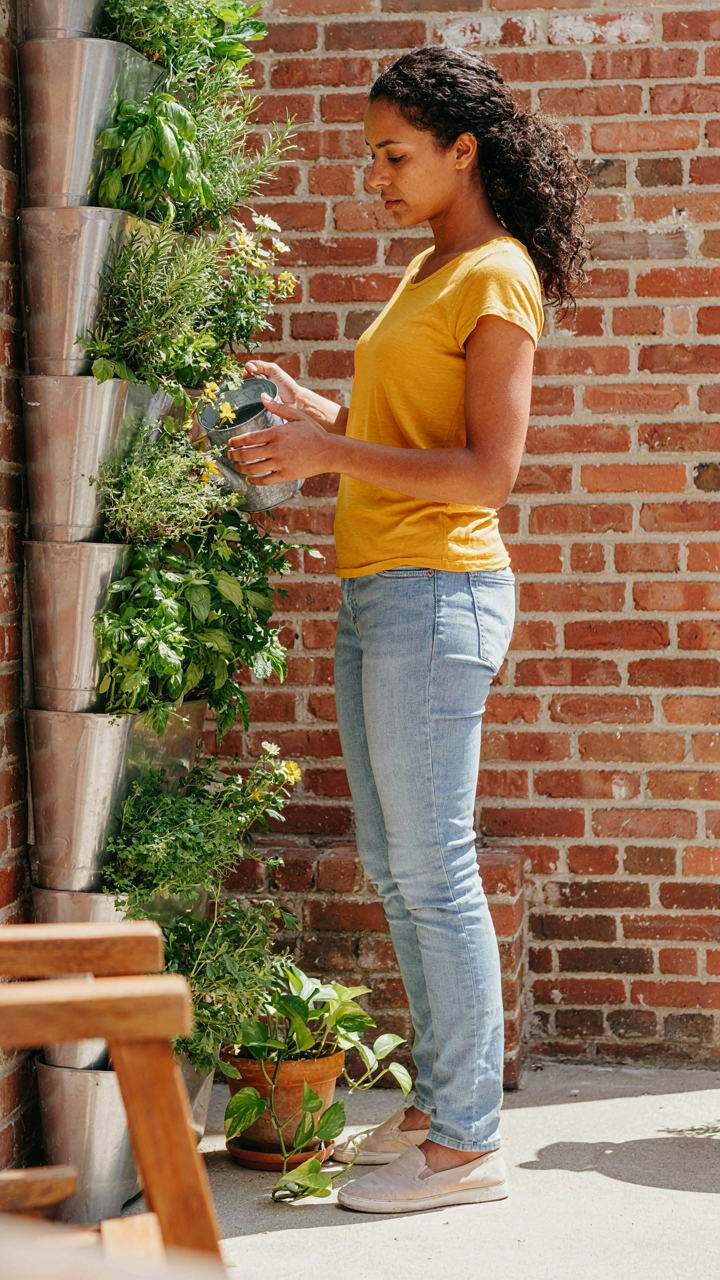
You want to feel like you’re maximizing space without admitting you’re limited. Here’s what actually works: physics calls it volumetric efficiency. In patio gardening, it means trading horizontal footprint for vertical height. A standard 4×8 foot patio can hold 12 pots on the ground or 60 plants stacked upward using tiered systems. The mechanism is simple: gravity pulls down, structures push up, plants grow either way.
Wall-mounted systems and stacked planters force you to commit to one spot. You lose flexibility to rearrange, but you gain density. Most people ignore this trade-off and end up with half-dead plants on cluttered ground. Place your vertical structure where it gets 6-8 hours of light. That’s the actual constraint that determines what survives, not the structure itself.
The Right Materials Won’t Rot Away
Aluminum, cedar, and recycled plastic compose most durable vertical systems. Cedar rots within 5 years in moist climates unless sealed annually. Aluminum lasts 15-20 years with zero maintenance but costs 40-60 percent more upfront. Recycled plastic doesn’t degrade, holds weight reliably, and requires only occasional cleaning. Many guides suggest welded steel as a premium option, but rust prevention demands painting every two years.
Metal brackets and galvanized fasteners prevent structural failure when soil weight builds. Install your system on a wall or fence that receives direct sun exposure and air circulation to prevent mold and moisture damage. Check weight capacity before filling. A vertical planter filled with moist soil weighs far more than it appears. Secure the top, middle, and bottom attachment points to wall studs or concrete footings, not just surface mounting.
Architectural Plants, Not Fluff: Building With Green Elements
Form Over Decoration
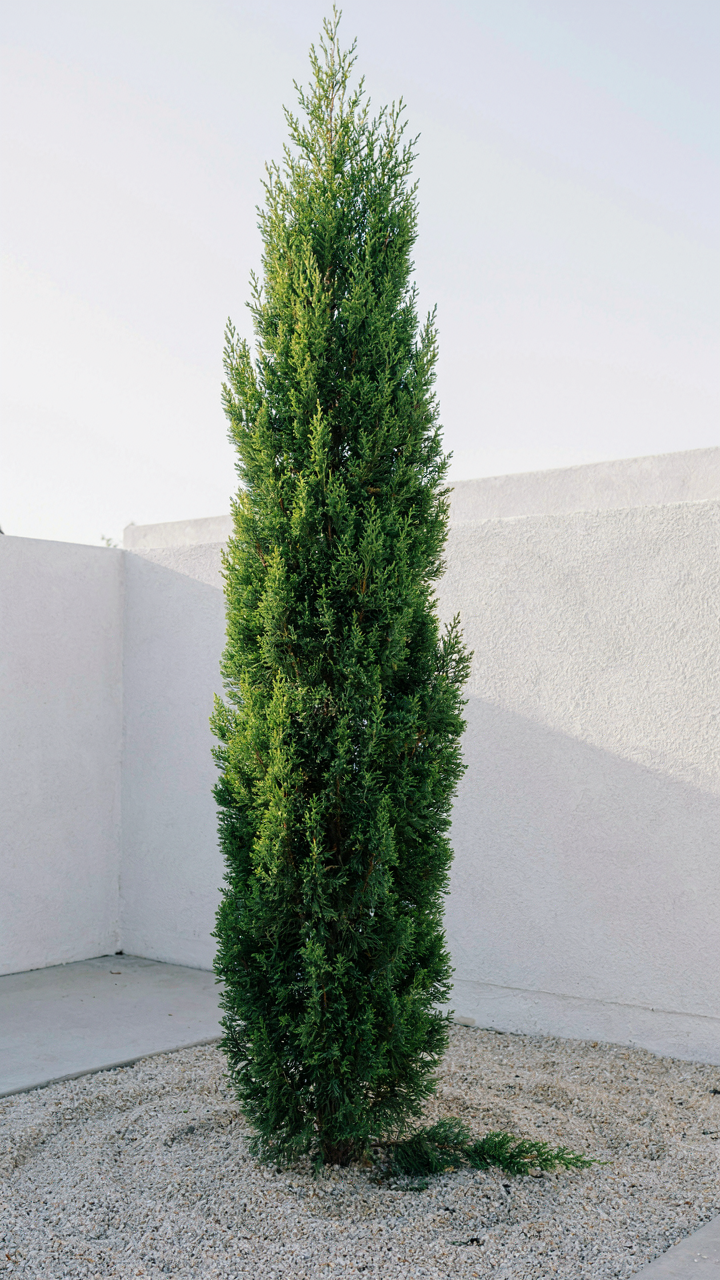
You want your patio to look intentional, not like you grabbed whatever was on sale. That’s the real driver here. Most people treat plants as decoration, then wonder why their patios feel scattered. Borrow from architecture: plants function as structural elements with load-bearing presence. A single columnar juniper or upright boxwood carries visual weight the way a pillar does. It anchors space. It doesn’t apologize.
Form means the plant’s three-dimensional shape. Texture means how light hits its surface. A feathery Japanese maple catches and breaks light differently than a dense privet. Choose plants where shape matters more than flower color. Rounded forms, spiky forms, cascading forms, columnar forms. Each one solves a spatial problem. Plant for the skeleton of your garden first. Everything else fills gaps.
One Strong Specimen Over Many Weak Ones
The consensus says “add variety with multiple plants.” That’s incomplete. One mature specimen with distinctive form outperforms five generic shrubs fighting for attention. A well-proportioned tree or large shrub becomes the focal point. It stops the eye. It organizes everything around it spatially.
Size discipline matters here. In a small patio, a single 6 to 8-foot specimen can anchor the entire layout without crowding it. The plant needs to be visibly mature, not a sapling you’re betting on. This means choosing species that naturally fit your space at full size, not ones you’ll prune constantly to manage. Quality over quantity is not motivational fluff. It’s a measurement principle that saves years of wasted effort.
The Ecology Of Small: Applying Biomimicry To Patio Layout

How Natural Systems Stay Efficient
You want this to feel effortless because maintenance feels like failure. The mechanism is borrowed from ecology: in natural systems, nothing exists to serve a single function. Every organism feeds something, gets fed by something, and modulates the environment for others. This is the antithesis of ornamental gardening, where plants sit around looking pretty and demanding fertilizer schedules you’ll forget.
A small patio garden layout works the same way. Your herbs don’t just season food, they attract pollinators that service your vegetables. Your taller plants shade the soil, reducing evaporation and watering frequency. Your soil feeders become insect habitat becomes bird food becomes pest control. When each element pulls multiple loads, the system runs on less external input. This isn’t philosophy. It’s resource allocation.
Every Element Earns Its Space
The common advice says fill your patio with variety for visual interest. That’s wrong. You fill it with density of function. A single climbing vine on a trellis provides shade, privacy, food or flowers, structural support for smaller plants below it, and wind break all at once. A ground cover plant between containers suppresses weeds, holds moisture, and provides habitat for beneficial insects. A water feature doesn’t just sit there looking contemplative, it creates microclimate humidity and attracts the predatory insects that eat aphids.
Start by listing what you need from this space: food, aesthetics, privacy, shade reduction in summer. Then inventory which plants and structures deliver multiple items from that list. Remove anything that solves only one problem or sits idle most of the year. This forces prioritization. Your patio layout becomes tighter, denser, and paradoxically easier to maintain because the system does the work instead of you.
Strategic Flow: Crafting An Intentional Small Garden Layout

Zones Built For What You Actually Do
You want your patio to look intentional so visitors think you have your life together. That’s not the real problem. The real problem is that without defined zones, you’ll end up with a cluttered rectangle where nothing works. Think in terms of program—a concept borrowed from architecture and urban planning. Program means assigning specific function to specific area. Your patio isn’t one space. It’s three or four separate rooms doing different jobs in the same square footage.
Most advice says “create a seating area, a planting area, a dining area” like you’re reading a checklist. That’s incomplete. You need to define zones by what blocks you from using them repeatedly. If your seating overlaps your passage to the door, you won’t sit there. If your herbs sit where morning sun never reaches, you won’t harvest them. Zone first by utility constraint, then by square footage available. Measure your actual sunlight patterns across the day before you place anything.
Movement Paths Determine Actual Use
People move through space following the path of least resistance—this is biomechanics. Your patio layout either channels movement or creates friction. A small garden fails when the primary route to the door cuts through where you want to sit or garden. You won’t override your own friction every day, so you’ll stop using that area entirely. The mechanism is simple: straight lines beat obstacles. Curved paths and awkward placement aren’t charming. They’re abandoned spaces disguised as design.
Map your movement patterns before you lay anything down. Where do you enter from the house? Where do you exit to access the street or yard? Those two points form a vector. Anything in that vector creates resistance. A functional small patio routes circulation to the perimeter, leaving the interior for static activities like sitting or planting. This doesn’t require perfect symmetry. It requires acknowledging that you move through space faster than you linger in it, so passage always wins over placement.
Tiny Yard Ideas With Big Impact: The Power Of Scale Manipulation

How To Trick Your Eyes Into Seeing More Space
You want this section to work because a small patio feels like a constraint on your status. It isn’t. Scale manipulation is borrowed directly from physics: perceived distance increases when objects decrease in size relative to their container. Apply this to your patio and the space expands without touching the property line.
The mechanism works through focal point compression. Place smaller plants and hardscape elements near the viewer. Push larger structures and plantings toward the back. This depth gradient makes the patio recede visually. Your brain registers the compression as distance.
- Gravel Over Pavers: Finer materials read as smaller, pushing the boundary back. Gravel occupies less visual weight than large stone slabs.
- Vertical Gardening: Wall-mounted planters and trellises lift your eye upward, away from ground-level constraint. Height creates the illusion of openness.
- Narrow Pathways: A tight winding path feels longer than a direct one. Curves multiply perceived distance without adding square footage.
- Layered Planting Depths: Front, middle, and back layers create atmospheric perspective. Objects blur and fade as they recede, just like landscape painting.
- Low Seating Positions: Sitting lower lowers your horizon line. The sightline expands upward, making the patio feel taller and more open.
Never add large furniture to the center. It anchors the eye and shrinks the space. Position seating at edges and let the middle breathe. This single move transforms how six by eight feet actually feels.
Rough Against Smooth, Dark Against Light
Contrast operates as visual tension. Without it, spaces feel flat and cramped. With it, they register as intentional and larger. Mix material textures and color values deliberately, not by accident.
Pair smooth poured concrete with rough gravel paths. Place dark mulch against bright limestone. Combine matte leaves with glossy ceramic pots. Your eye travels between these elements, stopping at each one. The stops create perceived distance. Each material gets its own moment rather than blurring into background noise.
The real leverage point is isolation through contrast, not saturation through color. A single bright red object in muted surroundings grabs attention and anchors space. Five bright objects confuse it. Limit your high-contrast pairs to two or three maximum. Restraint expands patio gardens faster than adding more.
The Neglected Elements: Lighting, Sound, And Scent In Your Small Patio

Why Your Patio Feels Dead Without Sensory Layers
You want people to think you’ve designed something intentional. That’s why most people ignore this section entirely. The mechanism is simple: humans don’t experience space through eyes alone. A small patio with only visual appeal feels hollow because three of your five senses sit dormant. The space becomes a photograph instead of an environment. Sensory engagement is what transforms a planted corner into somewhere you actually want to spend time.
Lighting, sound, and scent function like layered defense systems in strategy. Each operates independently but amplifies the others when coordinated. Poor lighting flattens depth and kills mood. Unwanted sound (traffic, neighbors) dominates the space. Missing scent leaves the experience incomplete. You can plant perfectly and still create something that registers as “off” because these three elements aren’t orchestrated. They’re not decoration. They’re structural.
Ambient Design That Works Against Nature
Most advice tells you to “add ambiance” with string lights and calming music. This is incomplete. Ambient design means controlling what penetrates your space and what you actively introduce. In landscape architecture, this principle is called microclimate design: the small climate conditions you create within a larger hostile environment. Your patio’s microclimate includes everything that reaches the human senses, not just temperature.
Lighting serves a function first, mood second. Warm overhead lights washed out by solar panels create dead zones. Path lighting that spills onto neighbors’ windows creates friction. Scent from a nearby restaurant overpowers any fragrant plant you choose. The strategy isn’t adding more sensory input; it’s controlling what gets through and what you deliberately introduce. Use directional lighting to highlight plants without glare. Position fragrant plants upwind. Install soft barriers that absorb external noise. Each layer operates on a principle of controlled permeability, not abundance.
Maintenance Minimalism: Designing For Longevity, Not Constant Effort

Automate The Recurring Tasks
You want a garden that doesn’t demand your weekend. The real mechanism here comes from systems thinking in operations management: you eliminate the variable by removing the human from the loop. Smart irrigation systems don’t replace watering—they replace the decision and the labor simultaneously.
Drip irrigation on timers handles water delivery without you standing there with a hose. Soil moisture sensors trigger watering only when needed, cutting water waste and overwatering failures. You set it once in spring, verify it runs, then ignore it until fall. The system becomes passive infrastructure instead of an active task.
- Drip Lines On Timers: Delivers water directly to soil at preset intervals. Cuts watering time to zero and prevents the guessing game of frequency and amount.
- Soil Moisture Sensors: Trigger irrigation only when moisture dips below threshold. Prevents overwatering and root rot, the two failure modes that eat maintenance hours.
- Soaker Hoses: Low-cost alternative to drip lines. Water seeps slowly into soil, reducing runoff and targeting roots instead of foliage.
- Battery Powered Timer Valves: Attach to existing outdoor faucets. Turns water on and off without electrical installation, useful for renters or temporary setups.
- Rain Sensors: Shuts off irrigation when rainfall occurs. Prevents redundant watering and lowers water bills automatically.
The payoff isn’t comfort—it’s accuracy. A timer doesn’t miss days or overcompensate during heat waves. It waters at 6 AM before heat stress peaks and stops when the soil holds enough moisture. You go from hands-on gardener to system operator.
Choose Materials That Don’t Degrade
Resilient plants and durable surfaces aren’t about aesthetics—they’re about breaking the replacement cycle. Most people plant annuals or pick materials that crack, fade, and demand refresh every two years. That’s not gardening. That’s paying rent to your patio.
Native perennials come back each year without replanting. Sedums and ornamental grasses handle drought and neglect. Concrete, composite decking, and sealed pavers last decades with minimal intervention. You pick plants that thrive in your climate zone, not ones that beg for coddling. The difference between a high-maintenance garden and a low-maintenance one isn’t effort—it’s starting material. Choose wrong and you fight the garden every season.
The Obstacle Isn’t Your Small Patio, It’s Your Oversized Expectations

You’re waiting for the perfect layout. You’re waiting for more space. You’re waiting for inspiration to strike like lightning. Stop. Pull out a measuring tape today and sketch your patio on paper. One sheet. Ten minutes. You don’t need permission or perfection to grow something real. The small patio garden layout you build beats the perfect one you never start.



