

The Illusion Of Effortless Backyard Cascades

Why Most Simple Designs Fail
You want to believe a waterfall is simple because that belief protects you from the work you’re about to waste. The mechanism is thermodynamic loss. Every waterfall design loses energy through evaporation, seepage, and pump friction. Most DIY plans ignore this entirely. They show you a pretty picture of water flowing but never account for the fact that you’ll need to refill the basin constantly or watch the pump run dry. The water doesn’t disappear into a mystical void. It leaves your system through predictable channels you didn’t engineer around.
The designs that fail share one root cause: they treat the waterfall as a static structure instead of a closed-loop system that demands maintenance. You build the rock stack, run the pump, and assume it works forever. Real waterfalls require you to size your pump correctly, calculate basin capacity against your evaporation rate, and plan for seasonal adjustments. Most online tutorials skip these steps entirely because they’re not visual or glamorous. Plan for the loss upfront, or you’ll spend the first month chasing leaks that don’t exist.
Hidden Costs In DIY Kits
The kit model works like venture capital: sell you the vision, hide the infrastructure. A prepackaged waterfall kit costs $150 to $500, but it never includes the foundation, the electrical work, the extra plumbing, or the replacement pump you’ll need in three years. The pump is the first casualty. Cheap kits use pumps rated for continuous operation that fail under actual summer heat and algae buildup. You don’t notice the cost because the kit arrives looking complete.
The second hidden cost is scale mismatch. Kits assume a standard backyard plot and standard water pressure. Your yard might drain differently, sit on clay instead of soil, or receive more sun exposure than the kit designer imagined. You’ll buy supplemental materials—extra rock, sealant, replacement tubing, a new basin—until you’ve spent as much as a professional installation. The real cost isn’t the kit price. It’s the gap between what the kit promises and what your specific site requires.
The Unseen Foundation: Water Flow Dynamics For Garden Waterfalls

How Water Actually Moves
You want your waterfall to look effortless. That’s why you’re skipping this section. Don’t. Water obeys physics, not aesthetics, and most garden waterfall failures happen because people ignore the three variables that control everything: velocity, volume, and head pressure. Velocity is how fast water moves. Volume is how much water moves. Head pressure is the force created by height. Together they determine whether your waterfall flows like a sheet, a cascade, or a trickle that disappears into the rocks.
The common advice says bigger pumps equal better waterfalls. Wrong. A pump rated for 5000 gallons per hour can produce a pathetic dribble if the head pressure is too high. Head pressure is the vertical distance water must travel against gravity. Every foot of elevation costs flow rate. A 1000 GPH pump at 10 feet of head will push roughly 500 GPH by the time water reaches the top. You need to calculate this trade off before buying anything.
Pump Selection As Hydraulic Leverage
Think of pump selection like leverage in physics. A small force applied at the right point moves heavy loads. Your pump is that lever. The right pump for your setup amplifies minimal energy into maximum visual impact. Wrong pump selection wastes electricity and produces disappointing results. Most people buy pumps based on maximum GPH rating alone and ignore the head pressure curve, which is where the real decision lives.
Pump curves show flow rate against head pressure in a graph. This curve is your decision tool. Find your desired height and look down to see actual GPH delivery. A pump rated 3000 GPH at zero head might only deliver 1500 GPH at 5 feet. Your job is matching the pump’s curve to your waterfall’s dimensions before installation. This one calculation prevents 80 percent of garden waterfall problems.
Strategic Placement: Maximizing Impact, Minimizing Maintenance

Sunlight And Shade Balance
You want your waterfall to look pristine without spending weekends scrubbing algae. The real mechanism is this: algae thrives in direct sunlight combined with stagnant water and excess nutrients. Partial shade reduces photosynthesis rates, which starves algae growth. Full shade eliminates the problem entirely but kills the visual appeal most people chase.
Position your waterfall where it receives 4 to 6 hours of indirect or filtered sunlight daily. Morning sun is safer than afternoon heat. If your space only offers full sun, you’ll need mechanical circulation and regular water changes to compensate. The trade-off is maintenance intensity versus aesthetic payoff. Shade placement always wins on effort.
Sound Projection And Water Path
Acoustic behavior determines whether people hear your waterfall or miss it entirely. Think of your waterfall basin as a speaker cavity. The water’s entry point, drop height, and basin shape function like speaker positioning in audio engineering. Most people ignore this and wonder why their waterfall sounds like a faint trickle from ten feet away.
Position the spillway to direct water toward the basin’s center rather than the edges. This creates resonance instead of diffusion. Harder surfaces like stone amplify sound better than soil or mulch. A basin depth of 12 to 18 inches typically produces the best acoustic return without requiring expensive engineering. Test water flow rates before finalizing placement—lower flow rates rarely sound impressive, no matter the setup.
The Permaculture Protocol For Self Sustaining Waterfalls

Plants As Natural Water Filters
You want a waterfall that doesn’t demand your constant maintenance. That’s the real ask here. Permaculture borrowed from ecology the concept of “nutrient cycling,” and your waterfall basin becomes a closed loop when you treat plants as the filtration system instead of relying on mechanical filters alone. Most people install pumps and hope the water stays clean. They’re wrong.
Marginal plants like pickerel rush, water iris, and cattails absorb nitrogen and phosphorus directly from the water column. Submerged plants like anacharis oxygenate the basin while breaking down organic debris. You position these species in shallow zones around the waterfall’s perimeter where water velocity slows. The plants don’t just look intentional—they’re doing the chemical work that would otherwise require replacement filters or constant cleaning.
Stream Bed Design Mirrors Actual Geology
Actual streams don’t flow as smooth sheets over flat rock. They meander, pool, and accelerate through sections of varying substrate. Most garden waterfalls fail because builders treat the spillway as a uniform slope. This creates erosion patterns that shift stone, damage seals, and require yearly rebuilds.
Layer your creek bed the way nature does: larger stones create the skeleton, smaller pebbles and gravel nest between them, and fine sediment collects in pools. This stratification dissipates water energy gradually instead of concentrating force at one point. Water finds the path of least resistance through the gaps, which slows its movement and prevents undercutting. Build the bed sloped at 3 to 5 degrees maximum. Grade the slope steeper and you’ve engineered a failure waiting to happen.
Beyond The Kit: Crafting Unique Small Garden Waterfalls

Reclaimed Materials Beat Store Bought
You want people to think you built something sophisticated without spending money like it. That’s the real driver here. The mechanism is simple: mass-produced waterfall kits signal “I followed instructions” while reclaimed materials signal “I understood the principle.” Salvage yards, demolition sites, and estate sales contain slate, stone, and timber that already weathered decades. They cost less than kits and carry visual weight that plastic never will.
The material itself becomes part of the design logic rather than a constraint you’re hiding. Reclaimed brick stacks differently than uniform pavers. Old slate fragments at natural angles. Salvaged copper pipes oxidize to patina that took years to develop. You’re not choosing these materials for sentimental value, you’re choosing them because they solve a structural problem while eliminating the uncanny valley of obvious fakery that kills most DIY waterfalls.
Working With Existing Slopes And Rocks
Topography isn’t decoration, it’s load bearing infrastructure. In civil engineering terms, you’re using existing grade as your compression layer. Most yards have a slope, a rock outcropping, or a depression nobody uses. Start there instead of building from flat ground. A natural grade change of even eighteen inches gives you a functional waterfall without excavation work. Existing rocks become your spillway structure instead of obstacles to remove.
The real efficiency move is reading what’s already present before adding anything. If your yard has a buried boulder or a shallow ravine from erosion, that’s your anchor point. Build your pump and basin downstream. Route your water to flow down the existing contour. This approach cuts labor by seventy percent compared to creating height from scratch, and the result looks integrated rather than imposed on the landscape.
The “Less Is More” Law Of Waterfall Designs

When Restraint Beats Ambition
You want your waterfall to look like something from a design magazine, not like you tried too hard. That’s the real fear here. Most people pile on features—multiple tiers, excessive rockwork, competing focal points—and kill the thing they built. The mechanism is cognitive load. Your eye needs a clear path. When a waterfall competes for attention with surrounding plants, hardscape, and ornaments, none of it registers as intentional. Simplicity forces every element to earn its place, which paradoxically makes the design feel more sophisticated, not cheaper.
The common advice says “add variety” or “create visual interest.” That’s backwards for small spaces. A single, well-executed drop with clean lines reads stronger than a cluttered cascade trying to do everything. The Japanese garden tradition understood this for centuries—restraint creates presence. Your waterfall should disappear into the landscape as a feature, not announce itself as a project you completed. The moment someone notices the effort instead of the effect, you’ve already lost the design.
Scale Determines Both Appeal And Real Work
Perception and physics are inverses here. Smaller waterfalls feel larger when you tighten the viewing angle and reduce context clues for size comparison. A two-foot drop viewed from three feet away dominates the visual field. A six-foot drop viewed from twenty feet away feels underwhelming. Most people size their waterfall based on available space, not on sight lines from where they actually stand or sit. This is why a modest design placed near seating creates more impact than an ambitious one tucked in a corner nobody sees from inside the house.
Maintenance scales worse than appeal. A three-foot waterfall circulates maybe 500 gallons per hour and needs quarterly pump cleaning. A seven-foot waterfall circulates 2000 gallons per hour and needs monthly attention, more complicated plumbing, and larger reservoir capacity to avoid water loss during dry seasons. The physics of evaporation and sediment accumulation compound with height and flow rate. Start small. You can always expand the basin or add a secondary feature. You cannot unmaintain a system you’ve already built.
The Maintenance Myth: Building Water Features That Work For You
How Gravity Does The Work You Won’t
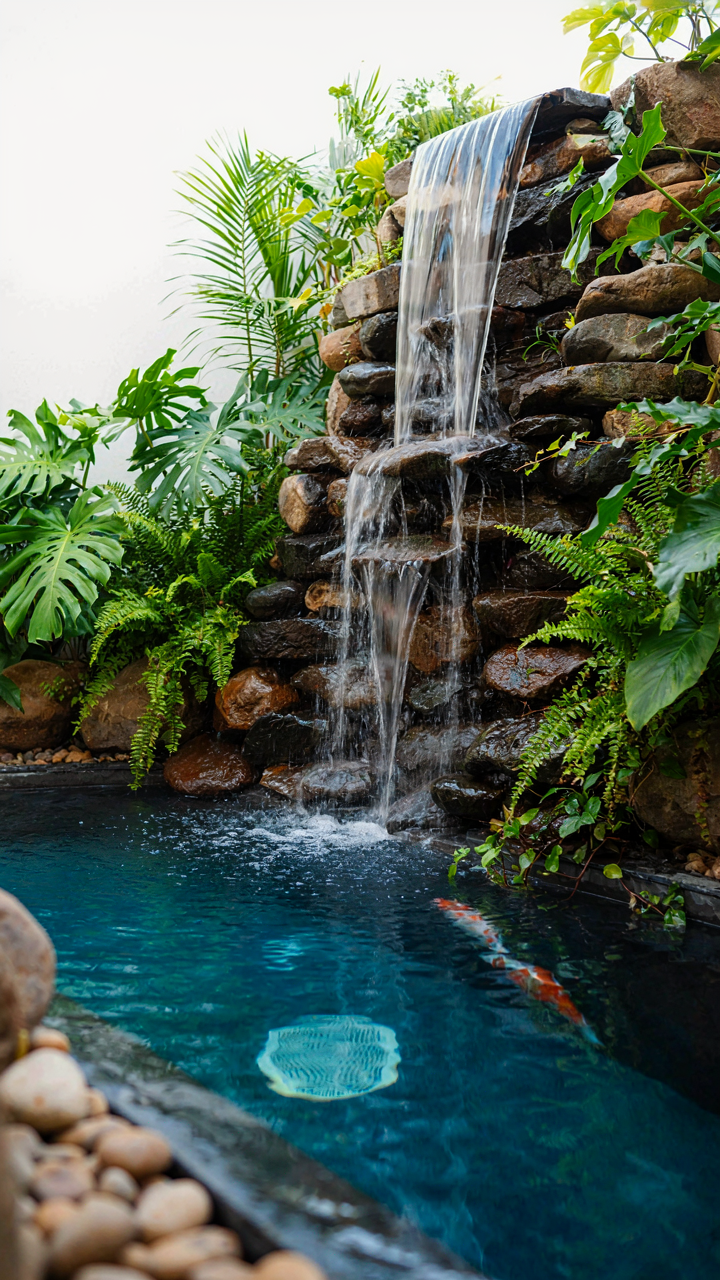
You’re worried you’ll abandon this project in six months. That fear is honest, so let’s use it. Apply the physics principle of potential energy: a waterfall converts stored height into motion. The mechanism is simple. Water at elevation wants to fall. You don’t pump it back up manually. You install one pump that recirculates water through a closed loop. The pump moves water uphill once. Gravity handles the rest indefinitely.
Most people overcomplicate this by obsessing over aesthetics before system design. They build first, add pumps after, then resent maintenance. Build the height differential and basin first. The pump capacity matters less than people think. A 1000 GPH pump creates adequate movement for features under four feet tall. You need a basin large enough to catch recirculated water without depletion. The basin depth prevents the pump from running dry when water settles or evaporates. That’s the non-negotiable part.
Surviving Winter Without Sabotaging Next Spring
Different climates demand different protocols, not wishful thinking.
- Freezing climates below 20°F: Drain the system completely before the first hard frost. Leaving water in pipes and basins causes expansion damage that cracks materials and splits equipment housings irreversibly.
- Moderate climates 20°F to 40°F: Run the pump intermittently on warmer days to prevent ice formation, but drain basins if you won’t monitor it. Ice dams block water flow and strain the pump motor.
- Mild climates above 40°F: Keep the system running year-round at reduced capacity. Moving water resists freezing longer than still water, reducing maintenance risk significantly.
- All climates: Remove and store the pump indoors before the freeze cycle begins. Store it in a dry space. Pumps left exposed to freeze-thaw cycles fail faster than stored units.
- Basin protection: Use a pool cover or tarp weighted at edges to prevent debris accumulation and reduce water loss. Debris breaks down into sludge that clogs intake screens.
Winterization isn’t optional maintenance you do if you feel like it. It’s the decision between a feature that lasts ten years and one that fails in three. Start draining or protecting by mid-fall in cold climates, not November. Document your shutdown steps so spring restart doesn’t become guesswork. The pump intake screen needs cleaning before you restart flow.
Reclaiming Your Backyard: Waterfalls Beyond Decoration

Water Movement And Mental Recovery
You want this because you’re exhausted and tired of feeling it. Here’s the mechanism: moving water triggers the parasympathetic nervous system through acoustic and visual input. The brain processes flowing water as a signal of safety and resource availability, the same neurobiology that made humans settle near rivers. This isn’t mystical. Your stress response downregulates when specific sound frequencies hit your ear and your eyes track motion across space.
A waterfall in your yard creates what neuroscience calls “soft fascination.” This means your attention engages without strain. Unlike scrolling or work tasks that demand constant decision-making, water movement holds focus while allowing your prefrontal cortex to rest. The result is measurable: lower cortisol, slower heart rate, reduced mental fatigue. You don’t need to sit and meditate. The effect works passively while you’re doing other things nearby.
Ecosystem Function And Species Movement
Biology has a term called “habitat connectivity.” Moving water in your garden acts as a corridor. Insects, amphibians, and birds need transit routes between food sources and shelter, and a waterfall with a basin creates waypoints they actually use. Most people think a waterfall is just scenery. It’s infrastructure for movement.
A functioning garden waterfall becomes a microhabitat. The spray zone supports moss and ferns. The basin holds larvae and invertebrates. The sound masks predator noise, making the space feel safer to wildlife. Birds bathe and drink at the edge. Frogs breed in calm pool sections. Build the waterfall with irregular stone edges and shallow shelves, not smooth walls. This design choice determines whether animals actually settle there or bypass it entirely.
Your Real Obstacle Isn’t Complexity; It’s Believing That ‘simple’ Excuses A Lack Of Fundamental Understanding

Most people don’t build garden waterfalls because they think simplicity means skipping the hard part: understanding water flow, soil stability, and pump sizing. It doesn’t. Simple means you’ve already solved these problems in your head. Stop browsing Pinterest and sketch your exact site today. Mark where water enters, exits, and pools. That single sketch reveals what actually matters. You don’t need permission to start; you need clarity on what you’re building.



