
Beyond Green: The Deceptive Simplicity Of Hanging Ferns

What Everyone Gets Wrong About Fern Basics
You want a hanging fern because it looks effortless, and that bothers you when it dies. The mechanism nobody names: ferns fail because people treat them like decorative objects instead of systems that demand consistent input. You’re not actually growing a plant. You’re maintaining humidity, airflow, and moisture in a suspended container that works against all three. Most fern owners think watering is the variable that matters. It’s not. The container itself is the saboteur.
Ferns evolved in forest understories where air moves slowly, humidity stays above 60 percent, and soil never fully dries between rains. A hanging basket in your living room or office inverts every condition. Heat rises. Air circulates faster near walls and windows. Moisture evaporates from all sides of the basket, not just the soil surface. Standard care advice addresses none of this. It tells you to water when soil feels dry, as if that single input solves a structural problem.
Where Standard Care Tips Actually Fail
Hydrology teaches us that water moves through systems based on pressure and resistance. In hanging ferns, the basket material itself creates excessive resistance to moisture retention. Moss-lined baskets, coir liners, and wire frames all accelerate water loss through evaporation. You can water correctly and still fail because the container is engineered to fail. Generic advice says mist your ferns. Misting is theater. It wets leaves for twenty minutes and does nothing for soil moisture or ambient humidity, which is what ferns actually need.
The real mechanism: ferns need roots in consistently moist media and air around foliage with humidity above 55 percent. Most indoor environments sit at 30 to 40 percent. You cannot mist your way out of this gap. You cannot water more frequently without creating root rot in poorly draining containers. The solution requires abandoning the myth that “more care” solves the problem. Instead, engineer the system: use containers that retain moisture longer, group baskets to create micro-humidity zones, and accept that ferns demand environmental control, not just attention.
The “Right Place, Right Fern” Protocol For Outdoor Hanging Plants

Match Your Fern To Its Microclimate
You want your hanging basket to look effortless. That’s the real reason you care about this. The mechanism is simple: ferns don’t adapt to environments, they die in them or thrive. Microclimate matching is a concept borrowed from ecology, where habitat specificity determines species survival. Your outdoor hanging basket isn’t a general environment, it’s a specific pocket of temperature, humidity, and air movement that either matches a fern’s native conditions or doesn’t.
Boston ferns demand consistent moisture and moderate humidity in sheltered spots. Maidenhair ferns need protection from direct wind and drying heat. Bracken ferns tolerate neglect better but still need partial shade and reasonable air circulation. The deciding factor isn’t what looks good, it’s whether the fern’s physiological requirements align with what your specific location actually offers year-round, not just in summer.
Sun Exposure As The Non Negotiable Variable
Most advice says ferns like shade. That’s incomplete. The real variable is light intensity and duration, not just shade versus sun. Ferns evolved in forest understories where dappled light passes through layers of canopy, creating consistent indirect illumination. Full direct sun scorches fronds. Deep shade starves them. Your hanging basket must land in a zone that mimics that understory gradient.
East-facing positions deliver morning sun then afternoon protection. West-facing positions bring intense afternoon heat that damages most fern species in hot climates. North-facing locations provide consistent indirect light but may reduce vigor in cooler regions. Measure your spot’s actual light hours at different times of year, not just the direction. Then place your basket where it receives filtered light for 3 to 6 hours daily, avoiding the peak afternoon intensity window.
Strategic Neglect: Watering Wisdom For Ferns In Hanging Baskets

The Daily Watering Trap
You want a simple rule so you don’t have to think. Daily watering sounds like the answer, but it’s actually the fastest way to kill a fern. The real mechanism is evaporation rate, borrowed from physics. In a hanging basket, water moves through soil and exits via surface area exposure and air circulation. Hanging ferns experience more airflow than ground-level plants, so they dry faster. But faster drying doesn’t mean they need more frequent watering. It means the window of optimal moisture is narrower.
Most hanging fern casualties happen because people water on schedule instead of by condition. A fern in winter, indoors, with low light and stable humidity needs water every five to seven days. The same fern in summer, near a vent, needs it every two to three days. The soil tells you when. The plant doesn’t care about your routine. Adjust frequency based on the actual state of the basket, not the calendar.
The Weight Method Works
Skip the finger test. It tells you nothing about the lower soil layers where roots actually live. Lift the basket instead. A saturated basket feels substantially heavier than a dry one. This matters because fern roots need oxygen between waterings. Soil that stays wet kills roots through hypoxia, not thirst. Heavy basket means water present. Light basket means water depleted. Water when the basket feels notably lighter than it did after your last watering.
The heft system removes guesswork because you’re measuring water directly, not inferring it. Pick up the basket regularly enough that you know the weight range. Water when it hits the light end of that range. This prevents both drought stress and root rot. It’s the only protocol that accounts for seasonal and environmental variation without mental math.
Substrate As Foundation: Building Resilient Hanging Pots
Water Movement Beats Nutrient Content
You want the mix to look rich because you think that signals fertility. Wrong motive. The real problem is that hanging baskets dry fast and kill roots through poor drainage, not starvation. Drainage is a physics problem: water moves through substrate based on pore size and structure. In fern baskets, you need substrate that pushes water through ruthlessly, not soil that holds it like a sponge. This is why dense, nutrient-packed mixes fail ferns in hanging positions.
Standard potting soil traps moisture around roots. Ferns in baskets need airflow and water bypass. The substrate must move water downward and out, period. You feed ferns later with liquid fertilizer. The substrate’s job is mechanical, not chemical. Build for drainage first, nutrients second, or you get root rot inside two weeks regardless of how often you water.
Peat Myths Need Correction
Peat dominates hanging basket recipes because it’s cheap and holds water. That’s the sales pitch, not the science. Peat compacts over time, suffocates roots, and creates hydrophobic zones where water channels around the root ball instead of soaking in. This is the opposite of what ferns need. Ferns require consistent moisture with oxygen access. A peat-heavy mix delivers moisture without the oxygen.
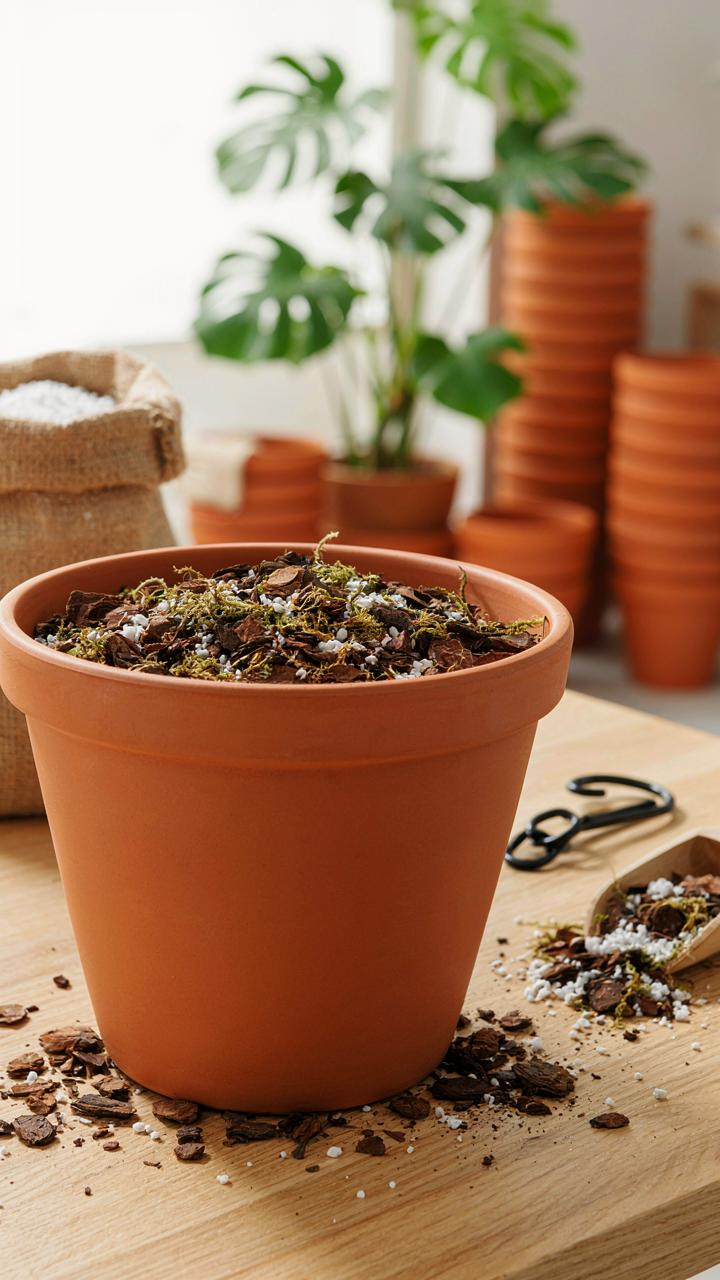
Replace peat with bark chips, perlite, and coir in equal parts. Bark stays chunky and open. Perlite creates permanent air pockets. Coir hydrates fast without compacting. Add worm castings for slow nutrient release. This substrate never becomes waterlogged because water moves through it, and ferns breathe because air reaches the root zone. Test the mix before planting: water a sample, wait five minutes, and it should drain completely. If it doesn’t, add more perlite.
The Minimalist’s Approach To Hanging Baskets & Support

Hardware That Actually Holds Weight
You want the basket to disappear visually so the fern stays the focus, not the rig holding it. That’s the real reason you care about this section. The mechanism is simple: material choice determines how long your setup lasts and how much visual noise it creates. Stainless steel chains and hooks don’t rust, don’t require maintenance, and don’t demand attention. Avoid galvanized steel unless you’re replacing it annually. Brass tarnishes and signals neglect. Choose what works invisibly in the background.
The basket itself matters more than the hardware. Coir-lined wire baskets weigh less than plastic and age gracefully as moss dries. Plastic baskets hide nothing and crack in UV. The hook system should support at least three times the wet weight of your basket and soil. A fern basket with water typically weighs eight to twelve pounds. Use a half-inch eye bolt rated for at least thirty pounds into solid wood, or toggle bolts rated equally into drywall. Calculate this before installation, not after the basket crashes.
Placement That Serves The Plant First
Indoor ferns need indirect light and consistent air circulation. The mistake most people make is hanging baskets at eye level for aesthetics, then wondering why the fern dies. Light sources and air movement should dictate placement, not interior design theory. Position the basket where morning light filters through without direct sun exposure. Indirect east or north-facing windows work. Avoid south or west-facing windows unless filtered through sheer material.
Placement also controls watering patterns. A basket hung in still air dries faster from moisture evaporation alone, forcing more frequent watering and root stress. Hang near passive air movement, away from heating vents and direct AC output. Never hang directly above furniture or walkways where drips matter. Six inches from a wall creates enough space for air circulation without making the basket feel isolated from the room. Install the hook system first, then select the basket position based on light and airflow, not where it looks balanced.
Fertilization Fallacy: What Ferns Actually Need (and Don’t)

The Minimum Element Rules Everything
You want to feed your fern hanging basket because feeding feels like control, and control feels like results. Here’s what actually matters: in biology, Liebig’s Law of the Minimum states that growth is limited by the scarcest resource, not the abundance of others. For fern hanging baskets, that limiting factor is almost never nitrogen. It’s usually moisture consistency or light quality. You can dump fertilizer into a basket that sits in low humidity or inadequate light and watch nothing improve. The fern doesn’t need more food. It needs the conditions that allow it to use food.
Most fern growers treat fertilization like an insurance policy, adding diluted liquid feed every week or two because standard guidance says “feed regularly.” This approach wastes money and risks salt burn on fronds sensitive to concentration. Ferns evolved as understory forest plants in nutrient-poor, acidic soils where sporadic nutrient availability was the baseline. They’re adapted to scarcity, not abundance. Your basket’s potting medium breaks down slowly, releasing trace minerals over months. Pushing extra fertility doesn’t accelerate growth if the actual constraint is air circulation, pot drainage, or water quality.
Stop Overfeeding Before You Start
Most fertilizer recommendations online are generic formulas borrowed from vegetable gardening or houseplants that tolerate higher nutrient loads. Ferns don’t. Weak fertilizer applied infrequently outperforms strong applications. A half-strength balanced formula like 10-10-10 monthly during the growing season accomplishes what you need. But here’s the real mechanism: ferns transport nutrients through water movement in their vascular tissue. If your basket drains well and you water consistently, the fern absorbs what it requires. If drainage is poor or watering is erratic, added fertilizer just accumulates as salts on the roots, causing tip burn and stunted growth.
The diagnostic question isn’t “when should I fertilize?” It’s “is my fern actually deficient?” Slow growth, pale new fronds, and weak stems signal nitrogen need. Yellowing between veins or purplish stems suggest phosphorus or potassium issues. But 90 percent of what people diagnose as nutrient deficiency is actually a light, humidity, or watering problem masquerading as starvation. Before you reach for fertilizer, verify that your basket receives bright, indirect light for at least 8 hours daily, maintains humidity above 50 percent, and receives water when the top inch of soil dries. Only then does a monthly weak feeding make sense.
Winter Survival: The Overlooked Key To Lasting Fern Hanging Basket Displays

Root Protection From Cold Exposure
You want your basket to survive winter so you don’t have to start over in spring. The real mechanism is simple: fern roots die when soil temperature drops below freezing for extended periods. Unlike foliage that can tolerate cold, roots have no dormancy switch once soil freezes solid. Water in the root zone expands, ruptures cell walls, and kills the plant’s ability to absorb anything come spring.
Move baskets indoors before the first hard freeze in your region. If indoor space is limited, insulate baskets outdoors by wrapping them in burlap or moving them against a south-facing wall where they catch residual heat. The goal is keeping soil above 45 degrees. Hanging baskets lose heat faster than ground-level containers because air circulates underneath, so position them in the warmest microclimate available. This is non-negotiable if you want the same basket next year.
Dormancy Triggers Winter Vigor
Botany calls this vernalization: using cold exposure to reset the plant’s growth cycle. Think of it as seasonal programming. Ferns don’t need frozen conditions to reset, but they do need a period of cooler temperatures and reduced light to accumulate energy reserves for spring. Without this rest, your basket exhausts itself pushing weak growth all year and dies before its time.
Stop fertilizing by late September. Reduce watering frequency so soil dries slightly between waterings, signaling the plant to conserve resources. Move baskets to indirect light for 8-12 weeks if possible, maintaining temperatures between 50-60 degrees. This mimics their natural environment. When spring arrives and you restore warmth and light, the fern responds with dense, vigorous new fronds rather than the sparse, pale growth you get from plants pushed year-round.
The Pruning Paradox: Shaping Hanging Ferns For Proliferation

Dead Fronds Are The Symptom, Not The Problem
You want your fern to look full without admitting you’re afraid of killing it by cutting too much. Here’s the mechanism: dead fronds signal poor air circulation or water stress, but removing them alone leaves the root cause untouched. Your basket stays sparse because the living fronds above shade the lower growth points. You’re treating the visible problem, not the structural one underneath.
The real work is redirecting energy flow. Ferns grow toward light and away from crowding. When you only remove dead material, the plant keeps its dense canopy at the top, starving lower nodes of light stimulus. Strategic cuts into living tissue force the plant to activate dormant buds lower on the stems. This is where density actually comes from, not from letting everything grow unchecked.
Cut For Canopy Depth, Not Just Cleanup
Horticulture calls this apical dominance, and it applies directly to fern architecture. The main stem suppresses growth on side shoots below it. Breaking that dominance through deliberate cutting redistributes the plant’s resource allocation downward and outward, filling the basket instead of creating a top-heavy void.
- Cut above the lowest living pinnae: Make your cut just above a healthy leaflet cluster. This leaves a node that will sprout lateral growth within weeks, widening the frond structure.
- Remove no more than one-third per session: Aggressive cutting stresses the plant and wastes energy on wound response instead of new growth. Space cuts across multiple pruning sessions over a month.
- Prioritize stems crossing the basket center: These block light from reaching interior fronds. Cutting them opens the canopy’s core and lets lower fronds photosynthesize and expand.
- Thin opposing fronds equally: Uneven cutting creates an imbalanced silhouette. Cut symmetrically from opposite sides to maintain the basket’s shape as density increases.
- Prune after watering, never when dry: The plant has full turgor pressure, so cuts heal faster and the energy reserves needed for new bud activation are available.
Make cuts at a forty-five degree angle, one quarter inch above a node. This angle maximizes the exposed cambium layer and speeds callus formation. Ferns will push new fronds within two to three weeks if conditions stay stable. Your pruning schedule determines basket density more than genetics or fertilizer.
Elevating Your Front Porch: Beyond Basic Ferns
Visual Density Beats Variety
You want people to notice your porch, not wonder if you forgot to water something. The mechanism here comes from visual hierarchy: contrast works better than abundance. Most people hang one basket and call it done. That’s the mistake. You need one focal point basket with maximum density, then supporting players that don’t compete for attention.
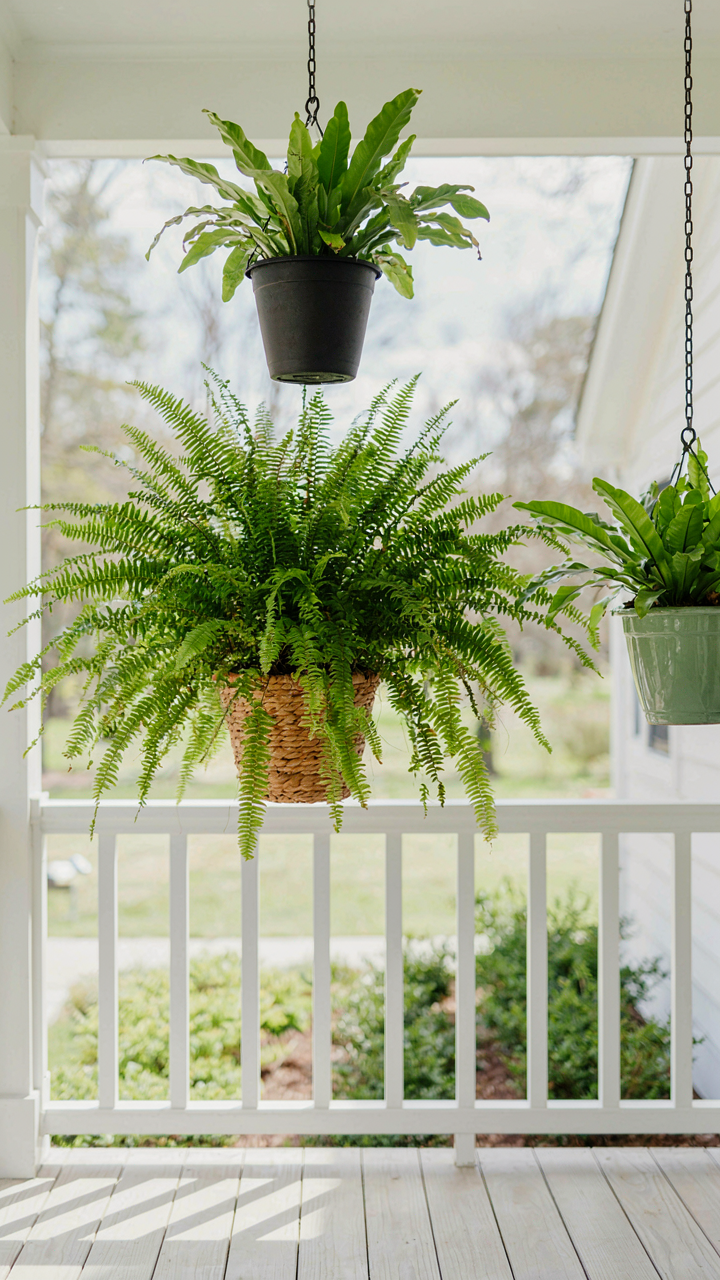
A single Boston fern or maidenhair fern in a twelve-inch basket reads as sparse. Overpack it. Use propagation to build density within the same variety rather than mixing three different ferns. Dense fronds catch light and shadow differently than thin growth. Visitors register density as intention and care before they register the species. Hang the densest basket at eye level when approaching your door. Position secondary baskets higher or lower to create depth without visual noise.
Rabbit’s Foot And Uncommon Choices
Standard ferns dominate because they’re reliable, not because they perform better. Rabbit’s foot fern grows laterally instead of vertically, creating texture variation that common ferns cannot match. The fuzzy rhizomes crawling across the basket surface signal something unusual without screaming for attention. Polystichum setiferum, the soft shield fern, holds fronds in a loose cascade that photographs differently than tighter growth patterns. These varieties thrive in hanging conditions but rarely appear in box stores.
Scindapsus pictus, sometimes labeled satin pothos but functionally a vining fern alternative, tolerates basket conditions better than true ferns while delivering spot variation. Asplenium nidus, the bird’s nest fern, grows upright and compact—it won’t cascade, but it forces a different visual strategy that most porches lack. Choose one uncommon variety and commit to it for three seasons. This builds actual expertise with propagation and problem-solving rather than collecting shallow knowledge across ten species.
Your Real Obstacle Isn’t The Fern; It’s Your Impulse To Overcomplicate The Natural World

You already know what ferns need. Water when soil dries. Light without direct sun. Humidity from misting. The gap between knowing and doing lives in your head, not in horticulture. Stop designing the perfect setup and hang a basket today with whatever you have. Ferns don’t wait for perfect conditions. They adapt or they don’t. Your job is to start, adjust, and stop treating plants like they need a PhD to survive. The fern hanging basket you build beats the perfect one you never start.



