
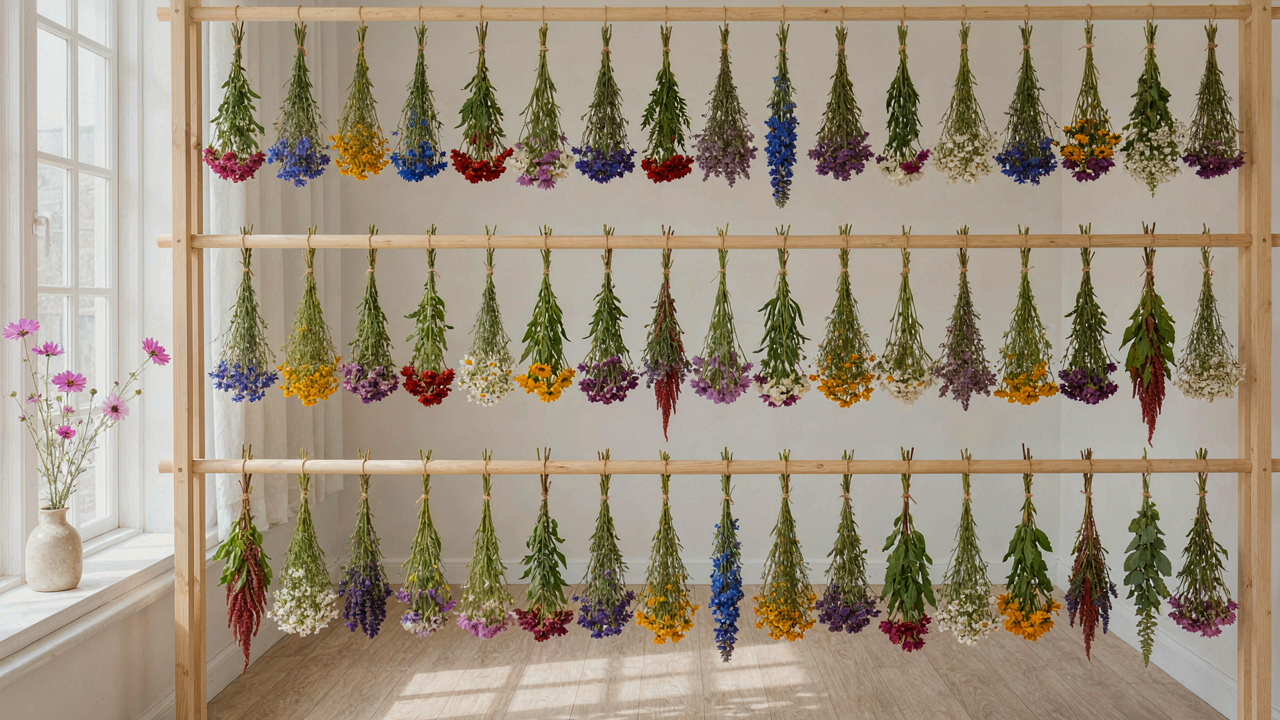
The Pre Drying Protocol: Intercepting Decay Before It Starts
When To Cut Matters More Than You Think
You want your dried flowers to look intentional, not like something that died on your shelf. The real mechanism is this: flowers harvested at peak bloom contain maximum water and structural tension. That tension holds shape during drying. Cut too early, before petals fully unfurl, and you get a shriveled version of what you intended. Cut after peak bloom when petals begin to soften and separate, and decay accelerates faster than drying can arrest it.
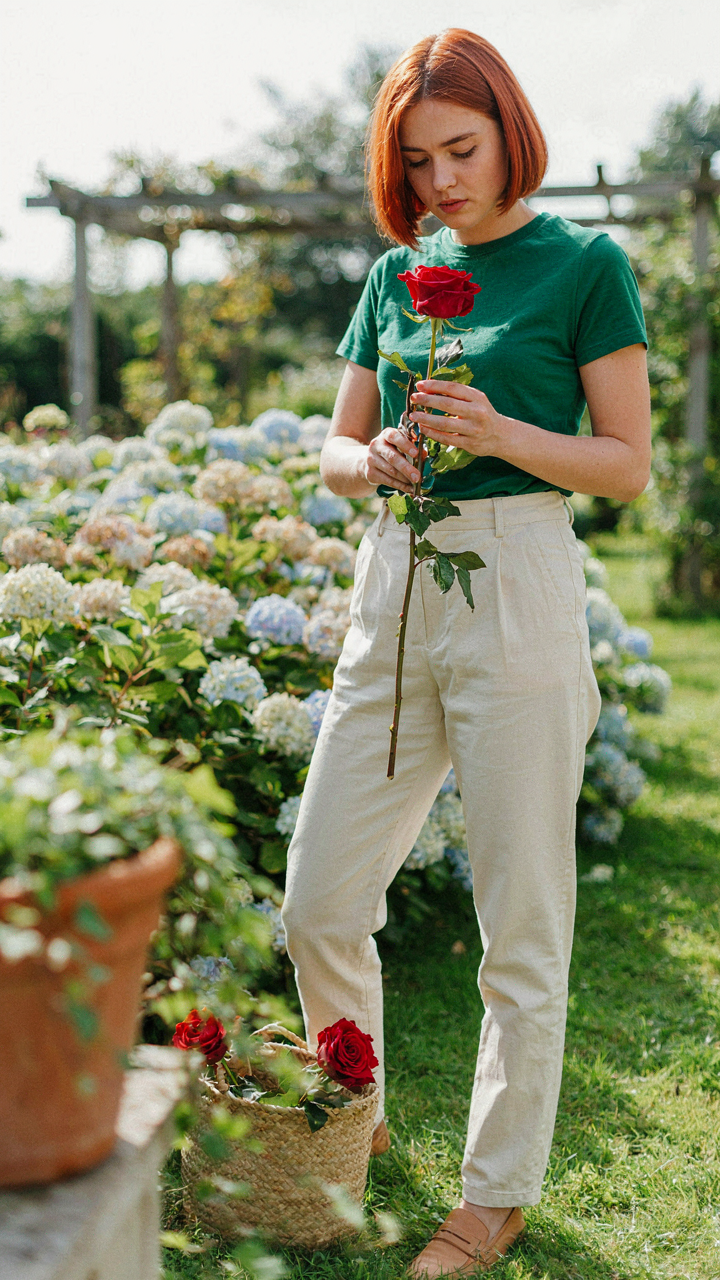
Harvest in the morning after dew dries but before afternoon heat stresses the stem. Most flowers reach peak harvestability between mid bloom and the moment petals start to papery. Rose varieties peak when the outer guard petals loosen but inner petals still hold firmness. Timing here isn’t about aesthetics during drying, it’s about locking in the structural state you want to preserve. Cut with sharp shears to avoid crushing vascular tissue, which speeds decay and weakens water uptake during any final hydration step.
Removing What Rots First
The common advice says strip lower leaves. That’s lazy guidance. The real protocol is removing any tissue that touches or absorbs moisture during drying. Leaves below the anticipated waterline create rot vectors. Leaves pressed against the stem trap humidity. Petals that hang loose or fold inward collect condensation. Remove them before drying begins because you cannot remove them after.
Strip all foliage below where the stem enters your drying medium or hanging mechanism. Inspect the flower head itself, removing any damaged outer petals and loose sepals that will curl and brown. Clip away any leaves that naturally fold inward or create pockets where moisture pools. This step takes two minutes per stem and prevents the moldy, musty smell that ruins dried arrangements. A flower dries properly only when air circulates freely around every surface it contacts.
Flowers For Drying Best: The Selection Matrix
What Actually Dries Without Falling Apart
You want to skip the failures because you’re tired of spending money on flowers that turn to dust. Here’s the mechanism: flowers with low moisture content and structural integrity dry faster and retain form. This isn’t preference—it’s physics. Hydration rates determine outcome. Roses, statice, wheat, and eucalyptus have naturally low water density in their petals and stems. They’re dense enough to resist collapse during the moisture evaporation phase. Flowers with thin, delicate petals like dahlias or peonies hold too much water relative to their surface area, causing them to warp and shrivel unevenly as they lose moisture.
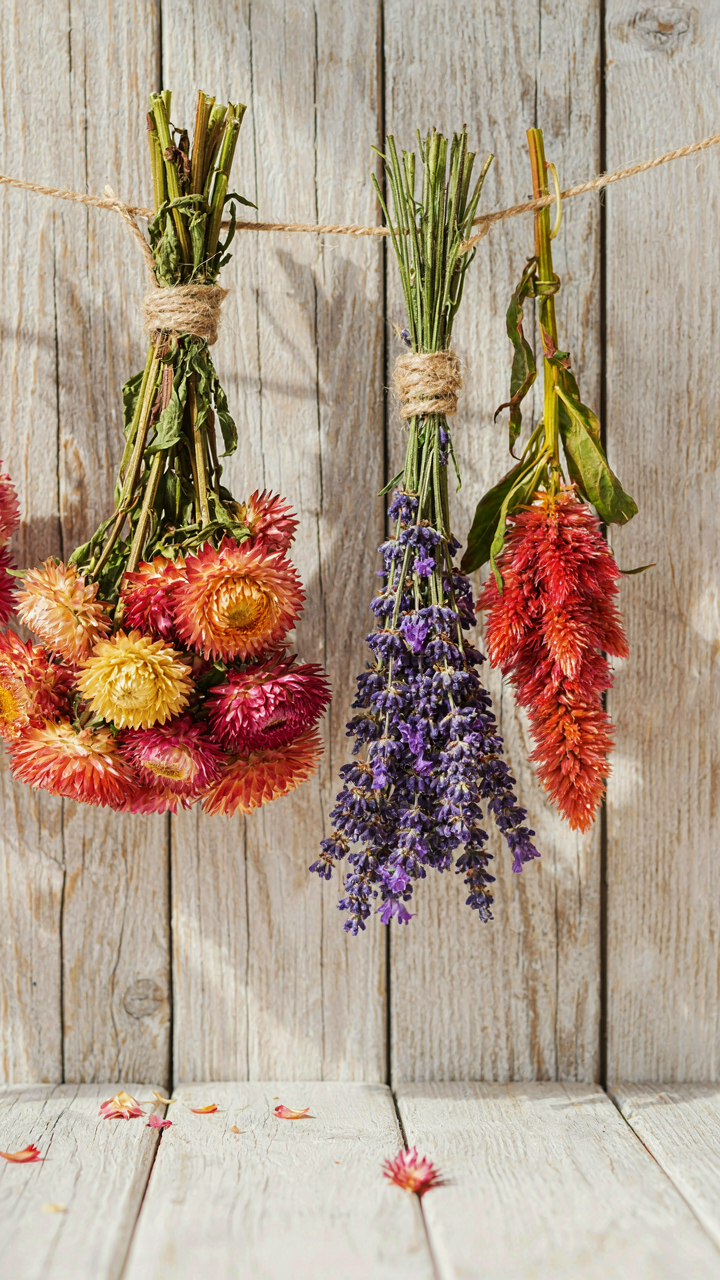
The selection rule is simple: choose flowers already adapted to dry climates or those bred for structural toughness. Strawflowers, celosia, lavender, and dried grasses succeed because their cell walls are reinforced. Hang them upside down immediately after harvest, before they begin wilting. The faster you remove them from water, the faster they stabilize in their current shape. Timing matters more than technique here.
When Popular Advice Leads You Wrong
The common guidance says “dry any flower you like.” That’s incomplete and wastes your effort. Certain flowers fail categorically: hydrangeas turn brown not from improper drying but from their structure’s inability to retain color during moisture loss. Tulips curve and wilt because their stems are hollow and contain excess water. Sunflowers drop their petals because the seed head’s weight destabilizes the dried tissue underneath.
Before selecting, ask one question: does this flower grow in arid regions naturally, or is it a cultivar bred for water retention? If neither applies, it will fail. Delphiniums, statice, pampas grass, and ammobium work. Carnations work. Ferns work because they’re already partially desiccated in their living state. Cut flowers at peak maturity, never in bud or full bloom decline. Mature flowers have finished their cellular development and contain stable lignin levels, making them resistant to structural collapse during drying.
Dehydrate Flowers: Beyond Hanging Upside Down
The Room Matters More Than The Method
You want perfect results without thinking about the invisible work. The real mechanism here is borrowed from physics: drying flowers is a mass transfer problem. Moisture moves from the flower tissue into the air. Your job is to control the gradient that makes this happen. Temperature, humidity, and airflow are the three variables that determine speed and quality. Skip any one and you get mold, color loss, or incomplete drying.
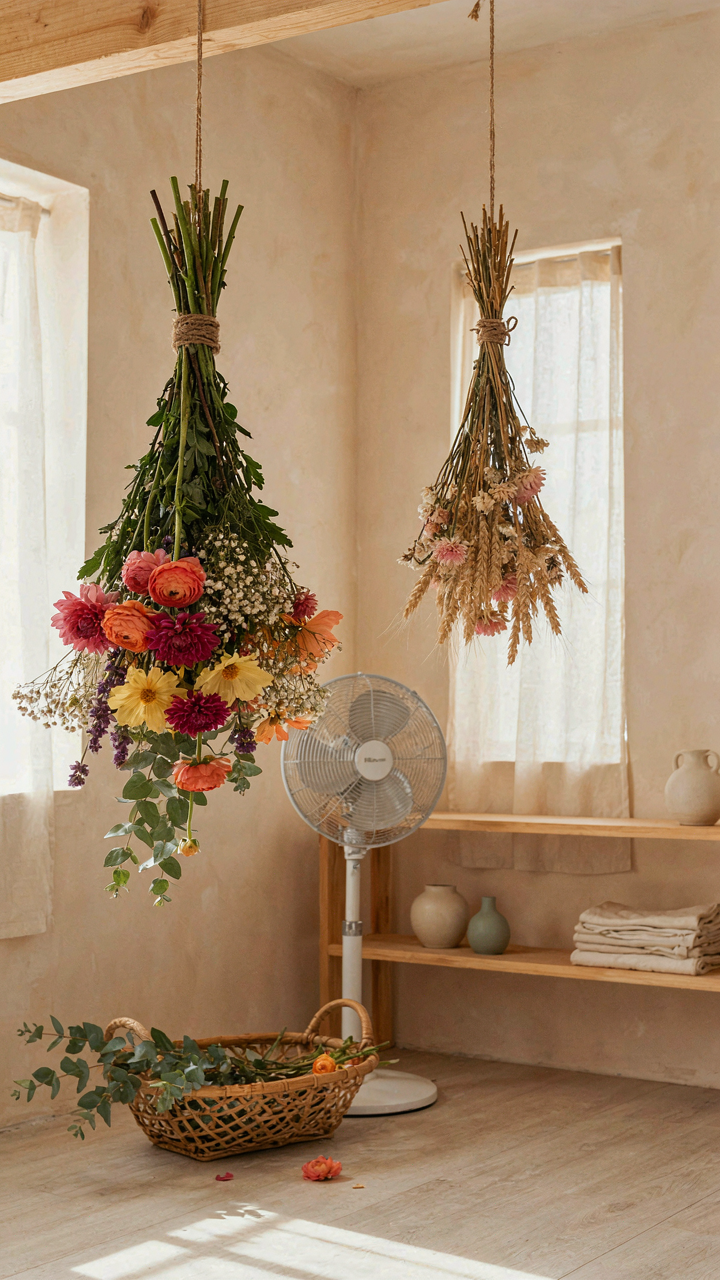
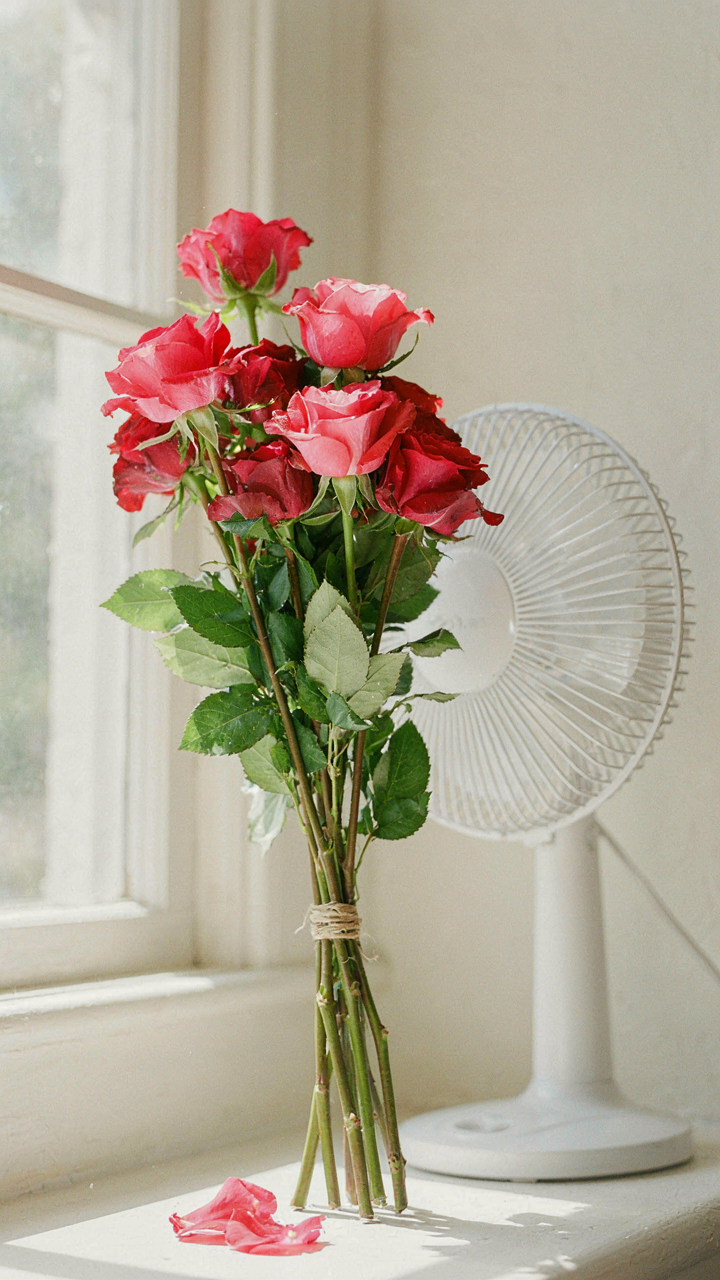
Temperature accelerates evaporation without damaging delicate petals. Most flowers dry best between 60 and 75 degrees Fahrenheit. Humidity below 40 percent pulls moisture out faster and prevents fungal growth. Airflow prevents stagnant pockets where moisture pools and rots tissue. A basement with high humidity and zero air movement will wreck your flowers. A warm, dry room with a fan moving air across the drying space works reliably.
Bundle Size Controls Everything
Tight bunches sound efficient until your center flowers stay damp while outer ones crack. The issue: density blocks airflow to the core. Each stem in the bundle creates resistance to the moisture vapor trying to escape. Thinner bundles dry uniformly because all flowers reach the drying zone simultaneously. You want bunches small enough that your pinky finger fits between stems without forcing it.
Wrap each bundle with twine loosely enough that the fibers don’t compress the stems. Compression restricts water transport up the stems and traps moisture at the base. Hang bundles at least six inches apart from neighboring bundles. This spacing maintains consistent airflow around each group. Drying time runs 10 to 21 days depending on flower type, room conditions, and bundle composition. Check bundles after day 10 by bending a stem from the interior. If it snaps cleanly instead of bending, the entire bundle has finished drying.
The Desiccation Dynamics: A Thermodynamic Approach
Why Vapor Pressure Matters More Than Humidity Charts
You want to dry flowers faster without them turning brown or brittle, and you think a humidity meter gives you control. It doesn’t. Physics gives you control. Vapor pressure, borrowed directly from thermodynamics, is the force driving moisture out of plant cells. Think of it as the gradient between what’s inside the flower and what’s in the air around it. The larger that gap, the faster water leaves. A flower in humid air has almost no vapor pressure gradient, so it stalls. Dead air moves nothing out.
Temperature amplifies vapor pressure exponentially, not linearly. A 10-degree shift doesn’t yield a 10-degree improvement in drying speed. It compounds. The warmer your drying space, the more aggressively water molecules escape plant tissue. You control nothing by obsessing over humidity percentages alone. You control everything by managing the moisture gradient between flower and environment. Lower humidity plus moderate heat creates the conditions for efficient water removal without cooking delicate petals.
Energy Transfer: The Real Bottleneck
Most guides waste time describing hanging techniques when the actual problem is heat and mass exchange. Energy transfer determines whether your flowers dry evenly or collapse from the outside in. Without sufficient air movement, a moisture-saturated boundary layer forms around each flower stem and bloom. Water can’t leave. You’re not drying anything. You’re just storing moist flowers in a closed system.
Convection does the work. Still air fails completely. A slow fan or gentle air circulation breaks that boundary layer repeatedly, forcing fresh, drier air against wet surfaces. This accelerates evaporation dramatically without needing extreme temperatures that damage color and structure. Position flowers in bundles loosely enough to let air reach all sides equally. Dense clumps create dead zones where moisture lingers and rot begins. The mechanism is straightforward: maximize surface exposure to moving air while maintaining a temperature between 70 and 90 degrees Fahrenheit for most species.
Air Drying Flowers: The Staging Environment Blueprint
Where Flowers Actually Dry
You want your dried flowers to look intentional, not neglected. The real issue is that most people think drying happens passively—it doesn’t. Dehydration is a physics problem: moisture leaves flowers through evaporation, which requires three variables working in concert: low humidity, consistent airflow, and darkness to prevent color fade.
Dark rooms with 40-50% relative humidity and stable temperatures between 60-70°F create the fastest dehydration without brittleness. Attics, closets with good ventilation, and basements outperform bright spaces because UV light degrades pigment while flowers lose water. The mechanism is simple: flowers hung in light dry faster but emerge faded. Those in darkness dry slightly slower but retain color worth keeping. Pick one over the other based on what matters to your final product.
Building Airflow Without Buying Equipment
Forget buying a dedicated drying chamber. Real airflow comes from understanding convection patterns, not from expensive fans you’ll use twice. Warm air rises, cold air sinks—this is the engine. Position flowers to exploit it rather than fight it.
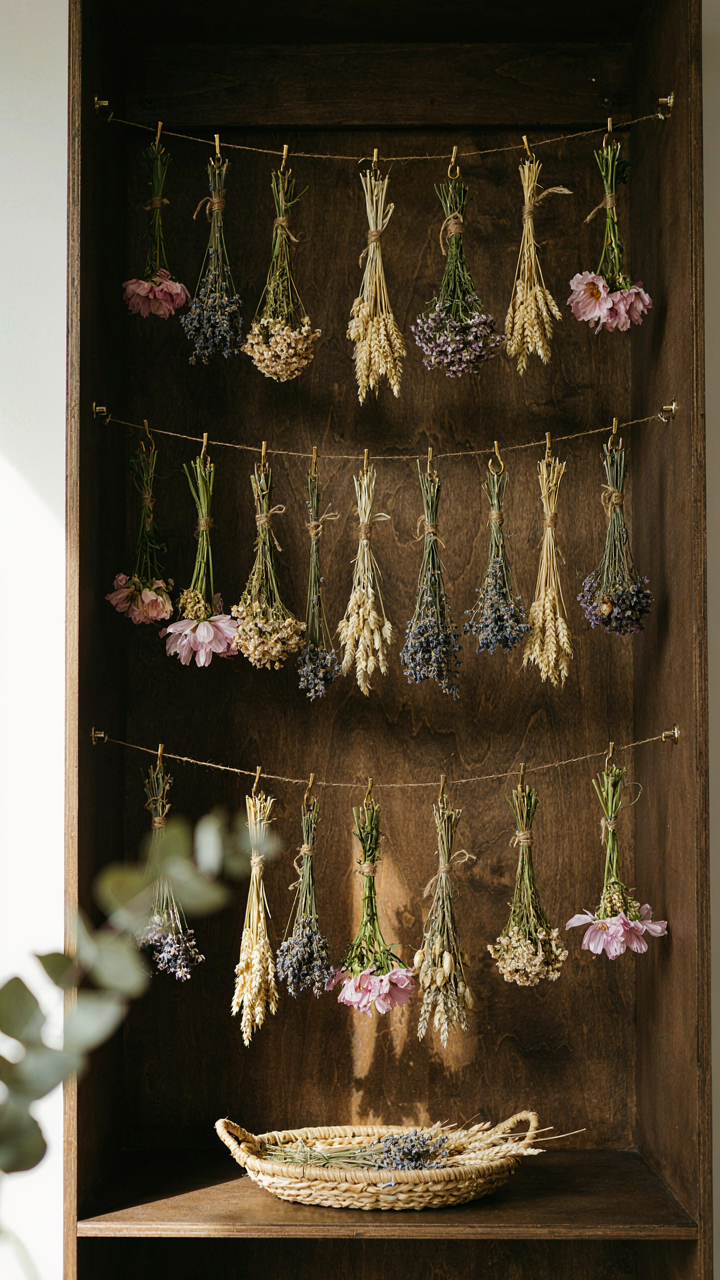
- Ceiling hooks in naturally warm rooms: Hang flowers near the top of rooms where warm air naturally collects, accelerating moisture release without mechanical intervention.
- Window-adjacent racks with spacing: Place drying racks 12-18 inches from windows where indirect light enters but direct sun doesn’t. Space flowers 3-4 inches apart for air passage.
- Fan placement behind, not beside: Position a basic box fan 5-6 feet behind flowers to push stale air out, not blow directly on them, which causes uneven drying and damage.
- Paper bag enclosures with holes: Punch 8-10 holes in kraft paper bags, place bundles inside, and hang them. Bags reduce light exposure while holes preserve airflow circulation.
- Staggered bundle heights: Hang bundles at different heights on the same line so lower flowers aren’t shaded by upper ones, ensuring even moisture loss across all specimens.
Temperature consistency matters more than airflow intensity. Fluctuations force flowers to reabsorb moisture, extending dry time and increasing mold risk. Run fans on low speed in steady patterns rather than cycling them, which creates micro-climates flowers can’t adapt to quickly.
How To Dry Flowers: The Accelerated Method
Bundle Tight, Space Wide
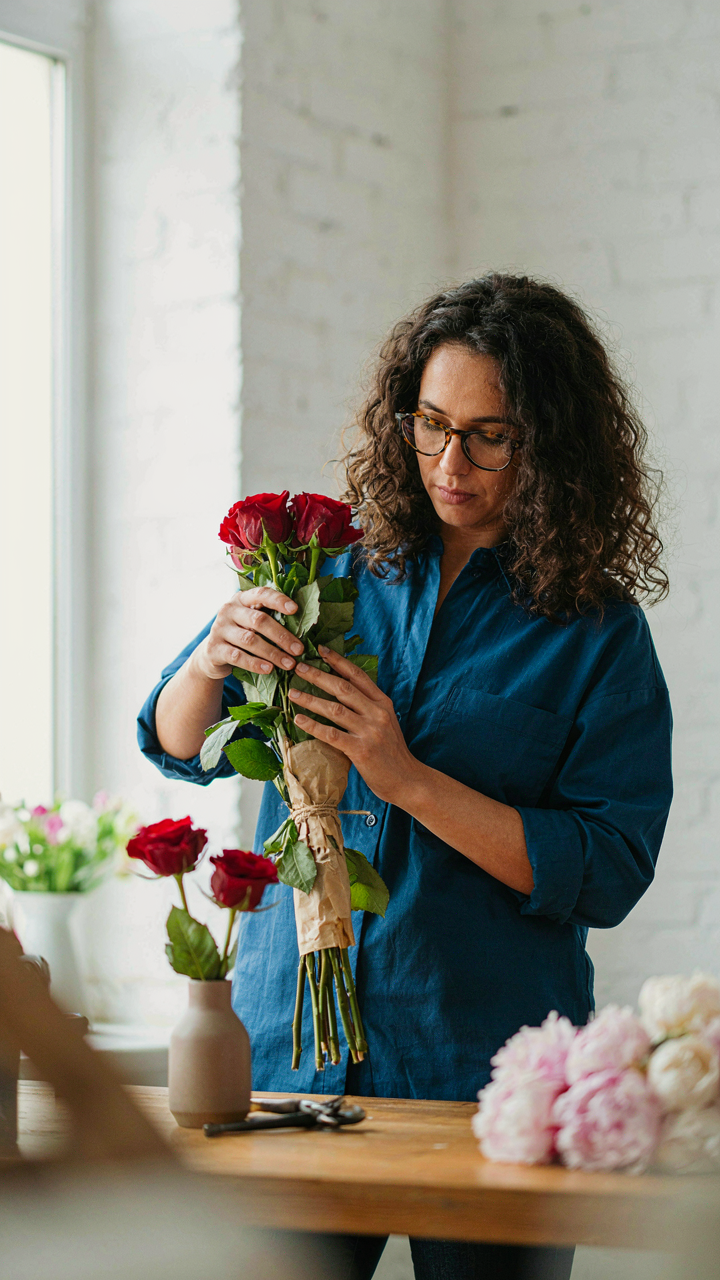
You want results fast because you’re worried your flowers will rot before they dry, and that fear is justified. Here’s the mechanism: moisture moves out through the stem first. Bunch stems tight so water can’t pool in the gap between them. This forces all moisture upward toward the flower head where air circulation matters most. Loose bundles create dead zones where humidity traps and accelerates decay.
Space bundles at least six inches apart on your drying rack or hanging line. Air needs a clear path around the entire circumference of each bundle. Touching bundles create microclimates where humidity lingers. The tighter the flowers are bundled vertically, the more aggressive your horizontal spacing needs to be. This isn’t intuitive, but it’s non-negotiable for speed.
Watch The Stem First, Not The Petals
Most people stare at the flower head and miss the real signal. Stems dry last because they’re dense. When the stem bends slightly but doesn’t snap, you’re in the window where petals are almost done. Check the stem every three days by gently flexing it. A totally rigid stem means you’ve over-dried. A stem that snaps cleanly without bending means you’ve hit the target.
Don’t move dried flowers immediately. Leave them hanging for two more days after the stem signals readiness. This prevents the rebound effect where petals absorb ambient moisture and lose texture. The most common mistake is harvesting at peak dryness then watching your work soften within hours because you didn’t account for humidity stabilization. Verify stem flexibility remains consistent before storing.
How Do You Dry Flowers: Preserving Color And Form
Timing And Temperature Control
You want dried flowers to look like they didn’t die. That’s the real driver here, and it matters because people judge quality on whether color survives the process. The mechanism is simple: heat accelerates moisture loss, but too much heat denatures pigment compounds and causes rapid petal shrinkage that creates visible damage.
Most advice says “hang them in a dark room.” That’s incomplete. Temperature matters more than darkness. Flowers dried at 70-75°F retain pigment better than those exposed to fluctuating heat. Start drying within 24 hours of harvest, before cell breakdown accelerates. High humidity delays the process but slows the chemical oxidation that fades color, so a stable 40-60% humidity environment with steady airflow beats a hot, dry garage every time.
Sealing And Stabilizing After Drying
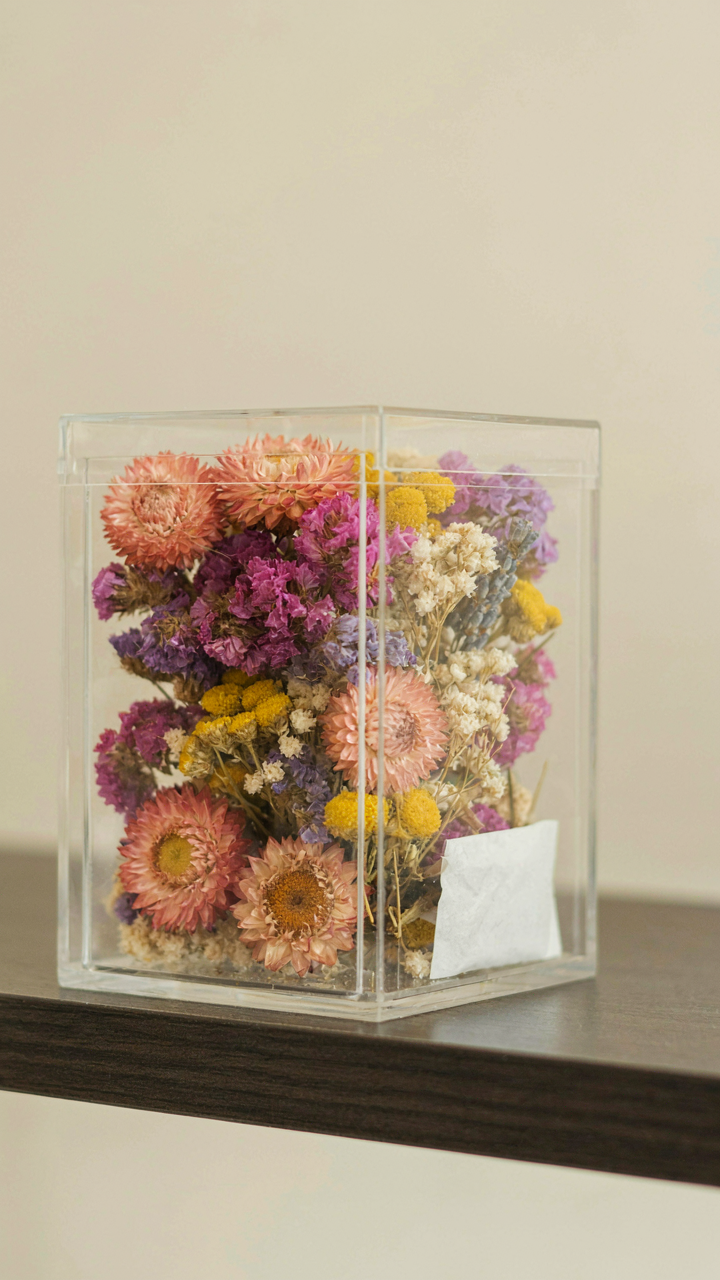
Post-drying treatment isn’t optional if you want flowers that last beyond six months. The dried material is structurally stable but chemically vulnerable. Exposure to light and air continues to degrade pigments and weaken petal attachment points where moisture once held cells rigid.
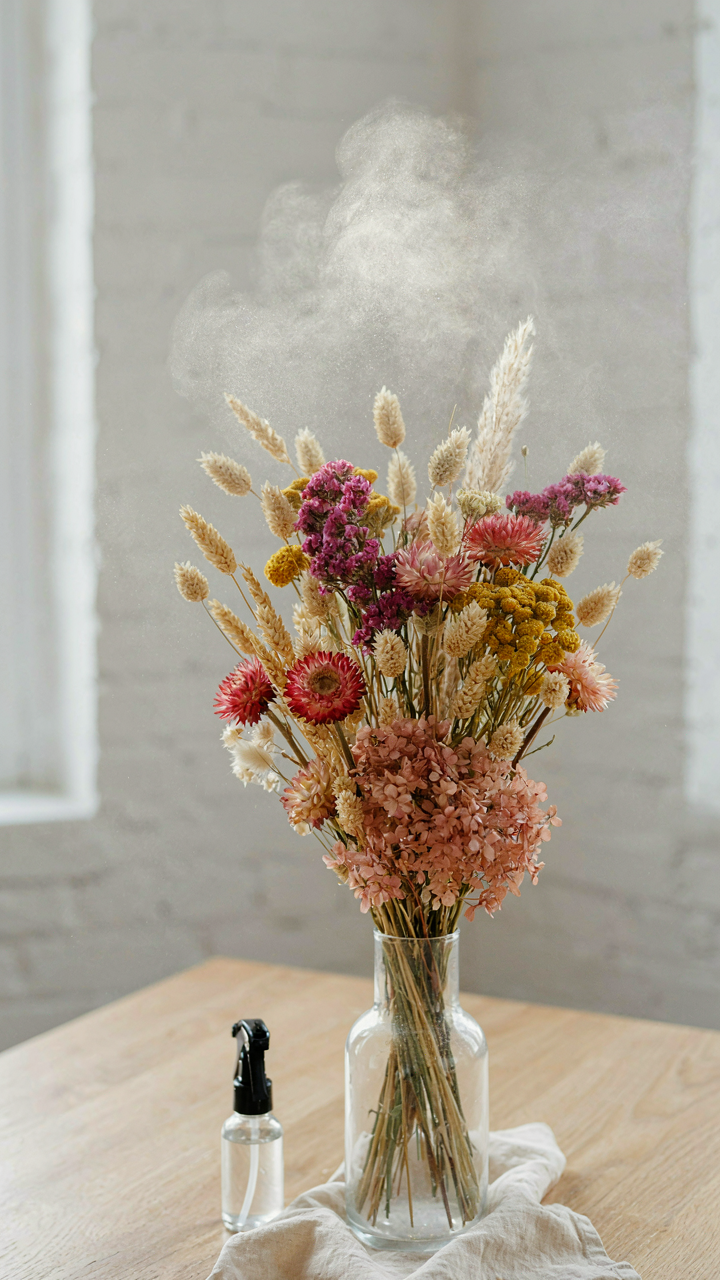
A light mist of florist’s sealant spray creates a protective barrier that slows oxidation and locks remaining moisture into the petal structure. Apply it 48 hours after flowers reach full dryness, in a well-ventilated space. Store dried flowers in airtight containers with silica gel packets to maintain that final moisture equilibrium. This prevents the rehydration that causes mold and the over-desiccation that makes petals brittle.
The Curing Phase: Locking In Preservation
Humidity Control After Drying
You want your dried flowers to last because you’ve already invested time, and losing them to moisture creep feels like waste. The mechanism here is basic physics: humidity equilibrium. Your flowers don’t stop reacting to their environment once they’re “dry.” They absorb moisture from air until they match the surrounding humidity level. High humidity triggers mold, brittleness, and color fade. You need to keep them in spaces below 50% relative humidity consistently.
Most people store dried flowers in normal rooms and expect them to hold. They don’t. A sealed container with silica gel packets or uncooked rice maintains the low-humidity environment your flowers need. Check moisture levels monthly. If petals feel papery-soft instead of crisp, your storage location has too much ambient moisture and needs adjustment immediately.
Storage Conditions For Extended Life
The common advice here is vague: “keep them in a cool, dark place.” Incomplete. Here’s what actually matters: temperature stability, darkness, and zero air circulation.
Temperature swings cause expansion and contraction in stems and petals. This stress cracks tissue and weakens color. Store at 60-70 degrees Fahrenheit consistently, away from heat sources and direct sunlight. Light fades pigment regardless of drying method, so boxes or opaque containers beat open shelves. Stagnant air prevents dust from settling and limits oxidation that dulls tones. Sealed storage beats open display every time if longevity is the goal.
The Best Way To Dry Flowers: Your Optimized System
Build Your Baseline Protocol
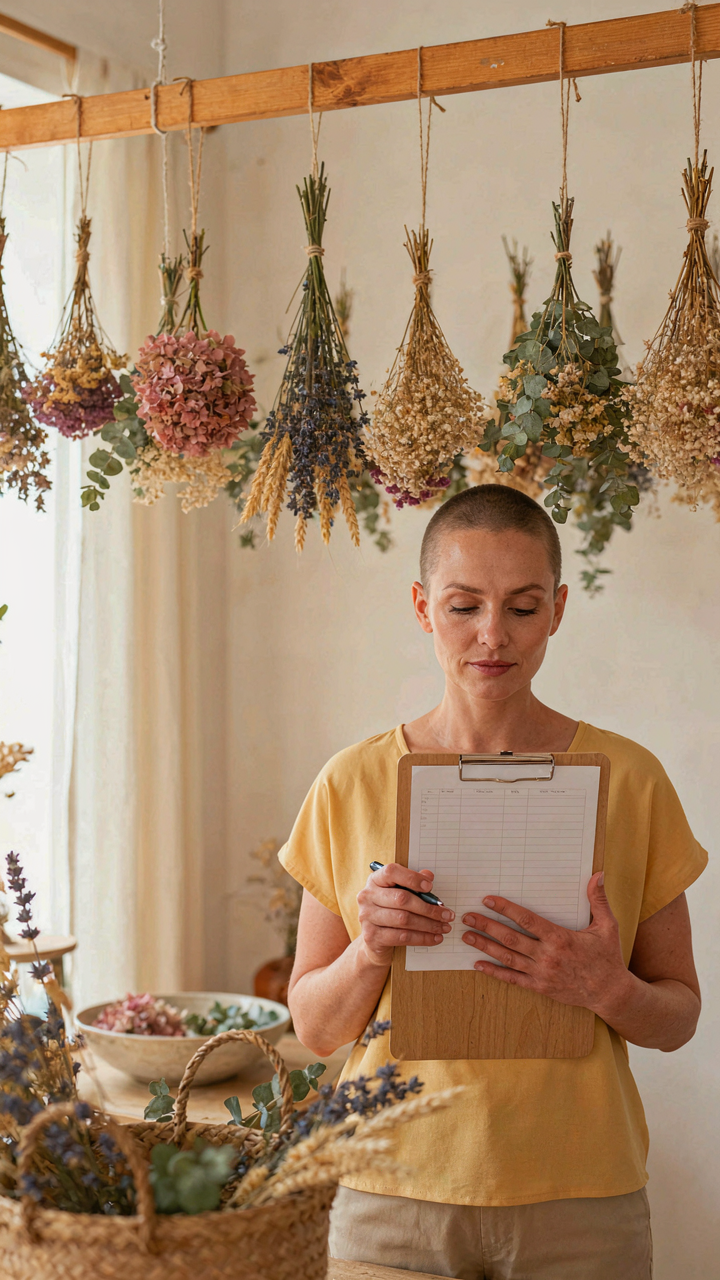
You want this section because you’re tired of guessing and losing batches to mold or brittleness. The mechanism is simple: flower drying follows the same control principle as industrial dehydration. You need to manipulate three variables in sequence—airflow, humidity, and temperature—not randomly adjust them. Start by choosing your primary method: hang drying for most cut stems, silica gel for fast turnaround on delicate blooms, or pressing for flat applications. Document your baseline conditions: room temperature, relative humidity level, how you bunch stems, and exactly how many days to completion. This becomes your control group.
The point isn’t perfection on attempt one. The point is reproducibility. Once you complete one full cycle of any method, you have a reference point to measure against. If flowers turn brown instead of preserving color, you’ll know whether humidity or temperature caused it because you tracked both. If stems snap when you handle them, you’ll know drying took too long or temperature spiked. The baseline protocol transforms flower drying from trial and error into a system you can actually debug.
Document, Test, Then Standardize
Most people skip this step because it feels like admin work. It’s actually where the real gains happen. Create a simple log: flower variety, harvest date, prep method, environmental conditions, and results. Run the same method three times in a row with identical conditions. You’ll spot which variables actually matter and which ones don’t. Some florists swear humidity below 40 percent is mandatory. Others get results at 50 percent because their airflow compensates. Your log reveals your specific threshold, not someone else’s.
After three consistent runs, you’ve earned permission to adjust one variable at a time. Lower temperature by five degrees and measure the outcome. Increase bunch size slightly. Extend drying by two days. Each iteration shows you where the edge of your system lives. Once you find the sweet spot—the exact conditions that give you the color and texture you want—lock those settings in. Stop experimenting and start executing. Your optimized system is now your competitive advantage, whether you’re selling arrangements or just tired of wasting flowers.
The Real Obstacle Isn’t Drying Flowers; It’s Your Passive Approach To Mastery
Most people treat flower drying like a hobby they dabble in between scrolling. You need to treat it like a skill worth perfecting. The difference between mediocre dried arrangements and gallery-worthy ones isn’t luck or talent. It’s obsessive repetition. Pick one drying method today. Master it completely before moving to the next. Stop collecting information and start collecting results. Your best work lives on the other side of boring consistency.



