
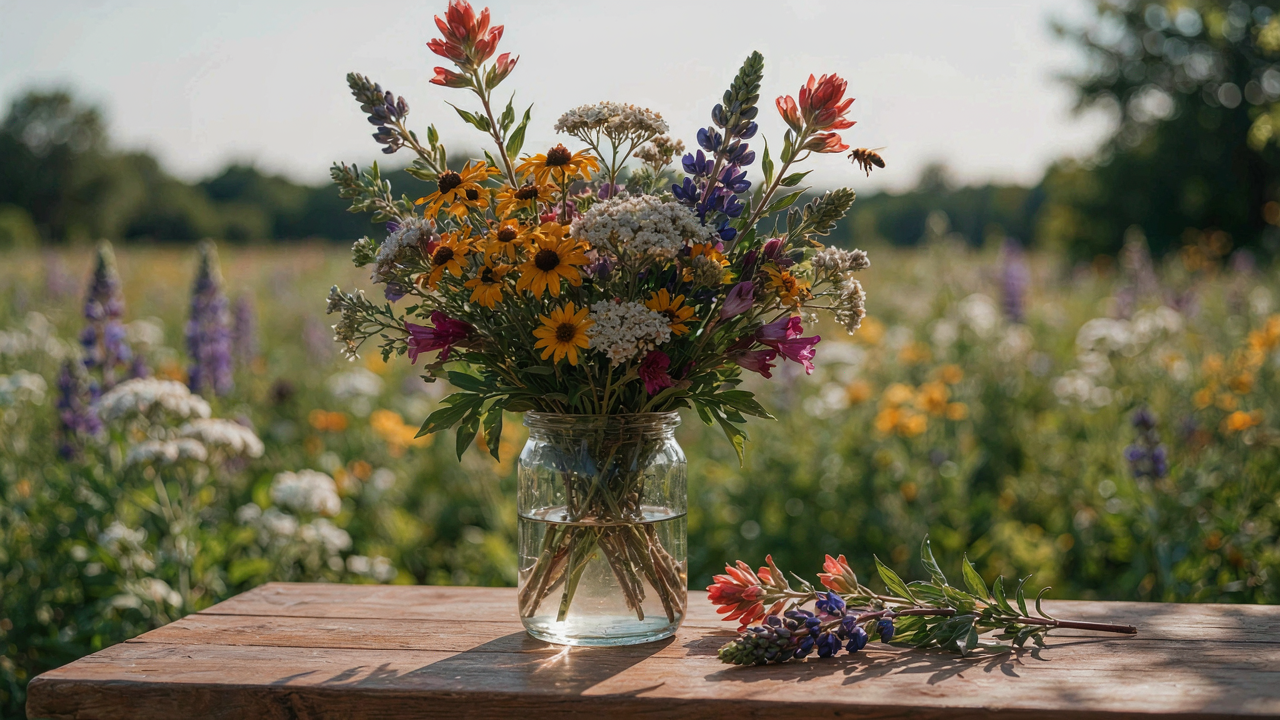
The Forager’s Manifesto: Rejecting The Cultivated Lie
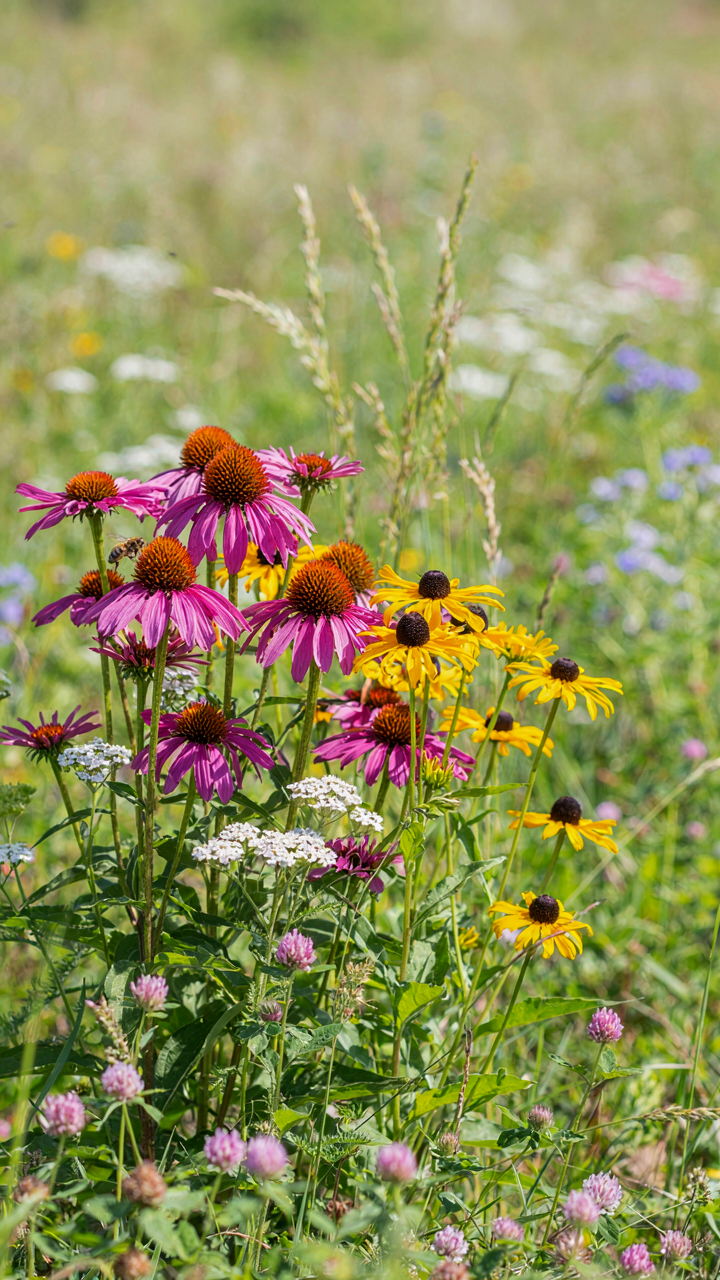
Garden Variety Is Garden Mediocrity
You want to seem like you discovered something real, not ordered it from a catalog. That’s the actual draw here, and it matters because cultivated wildflowers sold as “native” betray the entire premise. They’ve been bred for uniformity, shelf life, and commercial viability, not for the ecological logic that makes them visually coherent in the first place.
True natives carry genetic information from their specific geography. They evolved under particular soil chemistry, rainfall patterns, and seasonal light. A cultivated hybrid selected for a longer vase life has been stripped of these constraints. The result looks correct on the surface but reads wrong to the eye because the color saturation, stem thickness, and petal texture no longer match the environmental story they’re supposed to tell.
The Geography Advantage
Locality functions like a design constraint in systems thinking, and native wildflower bouquets obey this principle absolutely. When you source flowers from your specific region, you’re not choosing based on trend or availability. You’re filtering through thousands of years of local adaptation, which does the aesthetic work for you.
A bouquet of wildflowers native to your region will achieve visual harmony automatically because they evolved to exist together under the same light, moisture, and seasonal conditions. The color palettes coordinate naturally. The bloom times overlap. The structural proportions suit one another. This is not luck. It’s the mechanism of coevolution. Source locally, and coherence follows.
Deconstructing “Wild”: What Your Florist Won’t Tell You
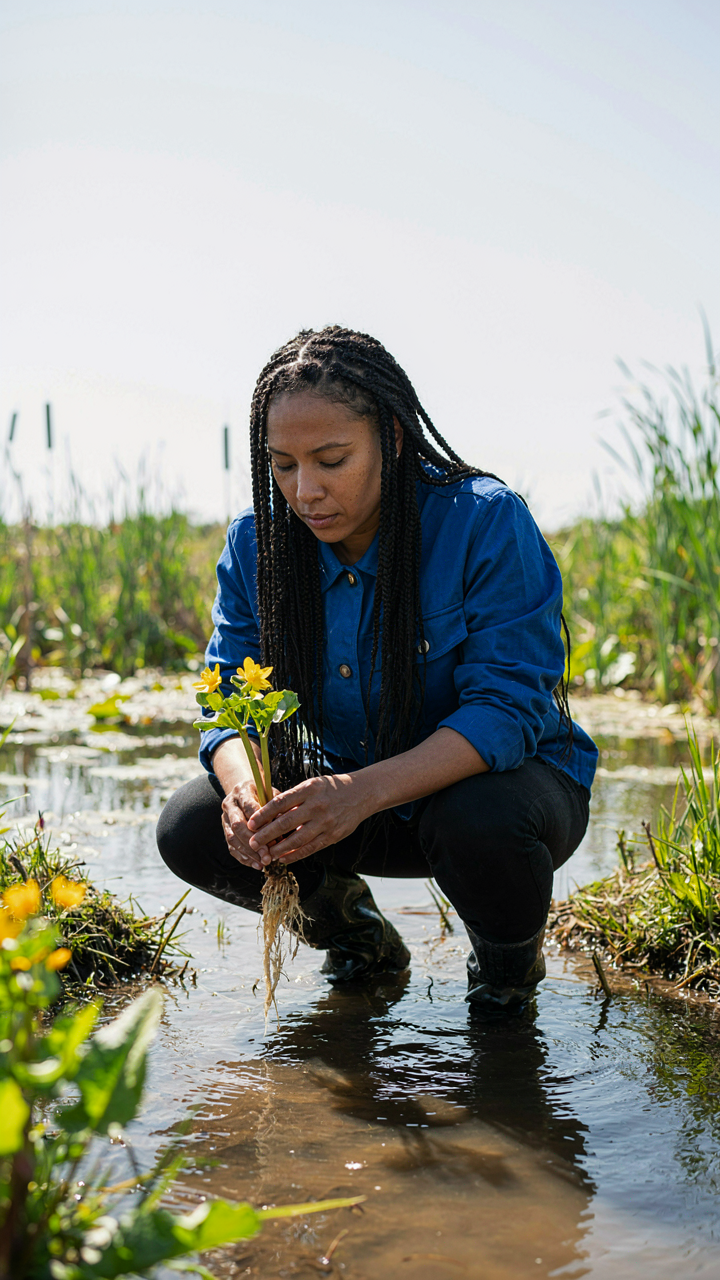
The Real Difference Between Native And Naturalized
You want to look like you know something most people don’t. That’s the real draw here. The mechanism florists exploit is your assumption that “wildflower” means the same thing everywhere. It doesn’t. Native species evolved in your specific region over thousands of years. Naturalized species arrived later, adapted, then spread without human intervention. A black-eyed Susan naturalized across North America. But in the Southeast, native coneflowers perform differently because they’re calibrated to local rainfall patterns, soil pH, and pollinator timing. The distinction matters because native blooms hold arrangement structure longer and pair ecologically with other regional flowers. Florists gloss over this because sourcing true natives requires knowing your bioregion, not just calling a distributor.
Naturalized flowers work in a bouquet, but they’re botanical freeloaders. They colonize disturbed ground and outcompete slower natives. In an arrangement, this translates to aggressive stem hardness, shorter vase life, and visual discord with genuinely regional blooms. Native species co-evolved with companion plants in your area. They share water needs, light tolerance, and bloom timing. When you build a bouquet from flowers that actually belong together ecologically, the arrangement reads as intentional rather than assembled. The vase life extends because the stems aren’t fighting incompatible water chemistry. Start by identifying which species are native to your state’s specific hardiness zone, not just the region. Verify this through your state’s native plant society or university extension office, not a generic seed catalog.
The Ecological Niche Every Bloom Occupies
Ecology teaches a principle called niche partitioning: organisms survive by occupying specific resource spaces others don’t exploit. Native wildflowers follow this exact pattern, and ignoring it collapses your bouquet’s visual hierarchy. A prairie blazing star thrives in well-drained, nutrient-poor soil and full sun. A native woodland aster demands shade and moisture. Put them in the same vase with identical water conditions, and one starves while the other rots. Each native wildflower evolved for a specific combination of light, water, soil chemistry, and seasonal timing. The color, stem length, and bloom density you see aren’t arbitrary. They’re optimizations for that niche. A short, dense native coneflower grows compact because it survives wind and competition in open prairie. Transplant it to a bouquet designed like a woodland arrangement, and its form reads as stunted.
Understanding niche is the difference between a bouquet that looks researched and one that looks like you grabbed whatever was pretty. Each bloom’s performance in water, its stem flexibility, and how long the flower stays open all trace back to where it evolved. A native milkweed species adapted to sandy, quick-draining prairie soil will dehydrate faster in standing water than a native marsh flower. The stem diameter, lignin content, and vascular structure are all tuned to that environment. When you source flowers from multiple niches without accounting for their origin, you create a watering problem disguised as an aesthetic one. Research the native habitat of each flower before buying. Group blooms that share similar niche requirements into the same bouquet arrangement.
The “Native Bouquet” Protocol: From Forage To Form
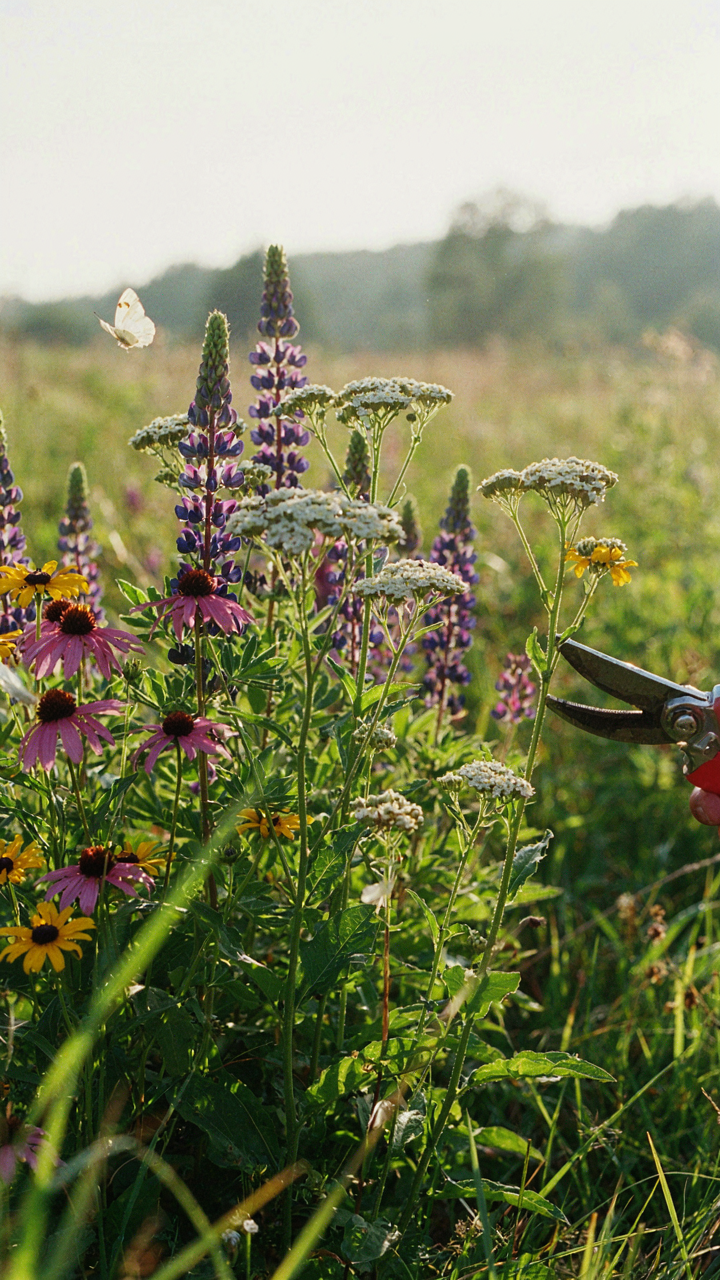
Know Your Site Before You Cut
You want to feel like you’re doing something right without actually doing the work. Here’s the mechanism: most people forage where it’s convenient, not where it’s regenerative. Ecology doesn’t reward convenience. Scout your location weeks before harvest. Walk the same patch at different times. Note which species dominate, which are sparse, what’s blooming when. This reconnaissance tells you what you can take without degrading the stand. Timing matters as much as location—early season means plants are still establishing; late season means they’ve set seed for next year.
The real constraint is population density. If a wildflower species covers ten square feet, you take nothing. If it blankets an acre, you take selectively from the densest zones. Most guides skip this because it requires patience and repeated site visits. You do it anyway because one careless harvest can collapse a population that took years to establish. Document bloom cycles by species at your site. This data becomes your permission structure for future visits.
The Ethical Harvesting Setup
You don’t need much. A sharp knife beats scissors because it cuts cleanly without crushing stems. A shallow basket prevents flowers from crushing under their own weight during transport. A small field guide for your region eliminates guessing. A notebook for population notes matters more than any tool. A water bottle keeps stems hydrated between cut and vase.
- Sharp Harvest Knife: A 3 to 4 inch blade cuts at a 45-degree angle, leaving the plant base intact so it can regenerate. Scissors crush tissue and invite disease.
- Shallow Basket: Keeps stems horizontal during transport, preventing bruising that shortens vase life. Depth should not exceed 6 inches.
- Regional Wildflower Guide: Confirms species identification before cutting. Misidentification leads to harvesting rare plants or protected species by accident.
- Field Notebook: Records what you cut, how much, and from where. This creates accountability and prevents overharvesting the same patch.
- Pruning Shears: Backup tool for woody stems or thick clusters. Bypass-style shears cut cleaner than anvil-style for living plants.
Take stems from the outer edge of clusters, never the center. Leave at least two-thirds of the plant standing. Cut in early morning after dew dries but before heat stress peaks. This timing maximizes water content in stems and extends vase life significantly. The protocol sounds restrictive because it is—that’s the point. Restriction is what separates harvesting from looting.
Designing With Ecological Intelligence: The Biomimicry Blueprint For Wildflower Wedding Bouquets

How Plants Arrange Themselves, Not How Florists Arrange Flowers
You want this to look “natural” because that signals restraint, taste, and authenticity. The mechanism is simple: wild plants don’t follow geometric templates. They cluster by moisture need, bloom time, and root depth. Biomimicry in bouquet design means replicating these ecological relationships, not imitating a Pinterest spiral. Observe how species actually grow together in meadows, then build that logic into your arrangement structure instead of forcing symmetry.
Native wildflowers survive in clusters because proximity solves survival problems. Tall species shade shorter ones. Deep-rooted plants stabilize shallow-rooted neighbors. This stacking isn’t accidental. Your bouquet lives or dies by the same principle: structure water access, weight distribution, and vase mechanics according to how these plants actually support each other. Skip the floral foam and wire cages. Use a grid system that lets stems nest at natural angles, mimicking how they’d stand in soil, not in a design school concept.
The Weight Distribution Problem Nobody Names
Plant architecture isn’t aesthetic theory, it’s structural engineering applied to biology. In engineering, load paths describe how forces move through a system. In native wildflower bouquets, your load path is the vase opening, and your stems are the load. Common advice says “vary heights for visual interest.” Wrong. Vary heights because it distributes weight across multiple vase points and prevents the collapse pattern where all heavy stems compress toward the center.
Deep-rooted wildflowers like Black-eyed Susans and Echinacea become your structural skeleton. Place them lower, angled slightly outward to create tension against the vase rim. Lighter species like Asters and Liatris become your filler, but slot them into gaps where their stems rest against heavier neighbors, not floating in water. This creates a load-bearing web. The bouquet survives three days longer because no single stem carries the weight of the arrangement. Test this by lifting your bouquet gently from the side. It should resist toppling.
The Australian Native Flowers Advantage: Unlocking Untapped Potential

Why Australian Flora Defies Conventional Floristry Rules
You want Australian natives in your bouquets because they signal knowledge. Most florists don’t know how to use them. Here’s the real mechanism: Australian plants evolved under extreme resource scarcity—intense sunlight, poor soil, sporadic water. This created flowers and foliage with abnormal structural integrity and longevity. They don’t wilt like imported roses. They hold form for weeks because survival required it, not sentimentality.
Conventional floristry borrows from horticulture, treating flowers as consumables designed for rapid bloom and fade. Australian natives operate on a different design principle entirely. Banksias, waratahs, and eucalyptus developed as structural elements in harsh ecosystems. Their vascular systems are dense. Their petals contain less water. This makes them behave unlike the soft, high-moisture flowers florists train on. Standard conditioning and vase techniques often fail because you’re applying greenhouse logic to desert-adapted biology.
Specific Australian Species For Unparalleled Texture And Form
Waratahs produce dense, almost geometric flower heads in deep red or pink. Each floret sits rigid within the inflorescence, creating architectural presence that stays intact for three weeks or longer. They require minimal water uptake because they evolved to thrive in drought. Unlike conventional flowers that demand constant hydration, waratahs stabilize quickly and demand less maintenance once conditioned correctly.
Banksias offer another strategic layer: needle-like leaves and cylindrical flower spikes that read as modern sculpture. Eucalyptus species provide secondary foliage with genuine visual weight and color range from silver to burgundy. Kangaroo paw flowers display tubular forms in yellows and reds that maintain rigidity without support. Combine these three categories and you have structure, texture, and durability that imported floristry cannot match at equivalent cost. The protocol is simple: condition Australian natives in room-temperature water for six hours before arranging, strip lower foliage below the waterline, and replace water every three days instead of daily.
Beyond “Wedding Flowers May”: Seasonality As Your Secret Weapon

Ignore The Calendar. Follow The Bloom.
You want your bouquet to look expensive and rare because that signals you didn’t just grab whatever was available. Here’s what actually matters: native wildflowers peak at specific moments, and those peaks don’t align with what the calendar tells you to expect. Biology doesn’t negotiate with tradition. When you force a native species outside its natural bloom window, you get weak stems, pale color, and flowers that close within hours. The mechanism is simple—the plant hasn’t stored enough energy yet, or it’s already spent what it had. Peak bloom is when the plant’s resource allocation hits maximum. That’s your only real window.
Most florists work backward from dates. Wedding in June? Grab June flowers. This creates the “mayflower myth”—the assumption that certain months guarantee certain blooms. False. A native wildflower that peaks in early May in one region might peak in late June in another, depending on temperature, rainfall, and elevation. You don’t pick the month. You pick the location, check historical bloom data for that specific area, then work your event date around reality instead of around someone’s calendar.
The Constraint That Creates Value
Transience isn’t a flaw in native wildflower bouquets—it’s the entire competitive advantage. Economics calls this scarcity pricing: when supply is limited and unpredictable, perceived value increases. Native wildflowers don’t ship well globally on demand. They exist for a specific window in a specific place. That unavailability is what makes them worth using. A summer wedding bouquet built from natives that only bloom for four weeks in that region becomes a statement about intentionality, not just budget.
The practical layer: design your bouquet around the shortest-lived flowers first. If your headliner blooms for three weeks, build the arrangement to peak during days ten through seventeen. Add secondary flowers with longer vase lives around them—native grasses, seed heads, foliage with structure. This forces you to architect the arrangement instead of just stuffing it. The bouquet degrades gracefully instead of collapsing. That degradation becomes part of the story instead of a failure point.
The Longevity Paradox: Keeping Your Wildflower Wedding Bouquet Alive
Ignoring Common Conditioning Myths: True Hydration
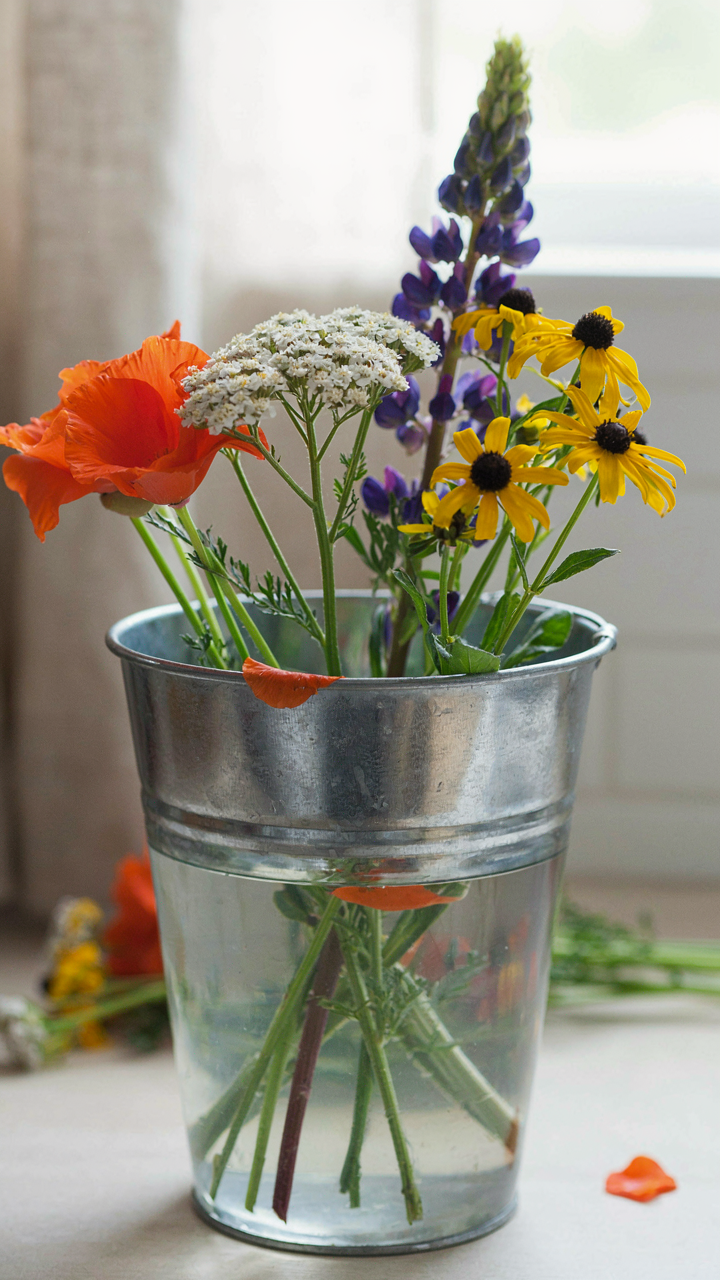
You want your bouquet to last because you paid for it and wilting flowers feel like a personal failure. The real issue is that florists push flower food and stem conditioning like doctrine, but wildflowers operate on different biology than roses. Native species have thinner, less uniform vascular systems. They don’t need flower food. They need immediate water access and nothing else.
Cut wildflower stems at a 45-degree angle and submerge them in room-temperature water within seconds of cutting. That’s the entire protocol. Flower food introduces sugars that native species can’t efficiently process, and it actually accelerates bacterial growth in water. Tap water works. Change the water every two days. Remove any foliage below the waterline because it rots and clogs the stem’s uptake point. That mechanism is hydraulic pressure, not chemistry.
The Real Demands Of Wild Species After Harvest
Native wildflowers aren’t bred for vase longevity, so they don’t store well in cool conditions the way commercial flowers do. Most native species prefer consistent room temperature over the refrigeration that florists recommend. Cold slows their metabolism but also restricts water movement through already narrow stems. Keep your bouquet out of direct sunlight and away from ripening fruit or heating vents, which release ethylene gas that triggers senescence.
The actual limiting factor is air exposure at cut points. Every hour a stem sits exposed, the water vessel closes slightly through oxidation. Condition your bouquet within two hours of cutting. Mist the petals and leaves daily to compensate for the rapid transpiration that native species exhibit indoors. Strip leaves progressively as they yellow instead of waiting until the whole stem degrades. This extends the usable life of the arrangement by three to five days in most cases.
The Anti Arrangement: Asymmetry For A Wild Flower Bouquet
Symmetry Kills What Makes Them Worth Arranging
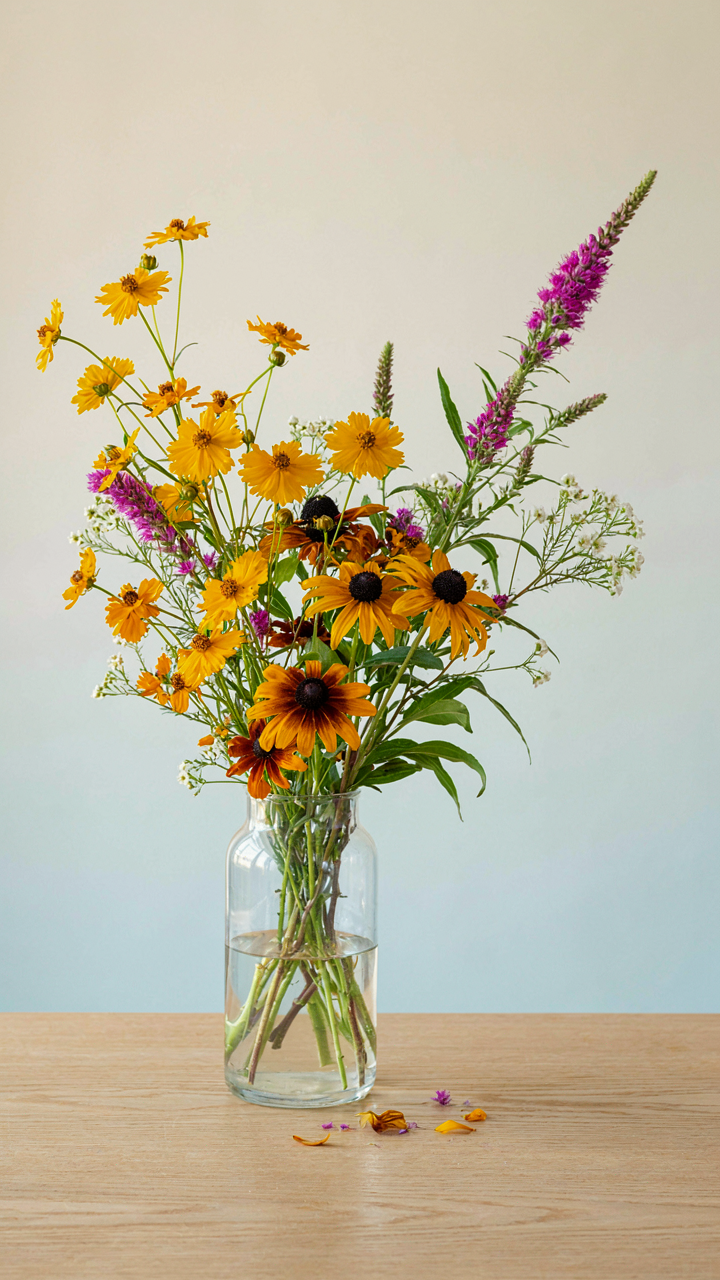
You want the bouquet to look intentional and controlled because you’re afraid a truly wild arrangement will read as sloppy. Here’s the mechanism: symmetry is a human signal for artifice. The moment you mirror stems left and right, you’ve told viewers this came from a florist’s grid, not a field. Native wildflowers evolved in random stands. Their beauty lives in tension and visual weight distribution, not matched pairs.
When you force symmetry onto native wildflowers, you’re fighting their structural DNA. Coreopsis clusters differently than Black-eyed Susans. Blazing Star grows tall and singular while Bee Balm spreads lateral. Symmetrical arrangements require you to cut, trim, and position stems to fit a predetermined shape. This removes the visual information that actually communicates “wild.” The moment you stop fighting the plants’ natural growth patterns, the arrangement gains presence.
Guided Randomness Within Constraint
Biology teaches us that randomness within boundaries produces stability and visual richness. In native wildflower bouquets, constraint means your vessel size, color palette, and height ceiling. Randomness means you’re not pre-planning stem placement or counting how many stems go left versus right.
Start by establishing three constraints before you touch a single stem.
- Vessel constraint: Choose your container first. Its diameter and depth determine maximum spread and height range. This is your only hard boundary.
- Color palette constraint: Limit yourself to flowers from two to three complementary species. Native palettes (Purple Coneflower with Black-eyed Susan, for example) naturally harmonize because they co-evolved in the same habitats.
- Height ceiling constraint: Set a maximum height relative to your vessel. For a 6-inch vase, 14-16 inches total height prevents top-heavy collapse and maintains visual proportion.
- Focal mass constraint: Establish one area of visual density (usually lower-center). This anchors the eye and gives structure without requiring symmetry.
- Stem angle constraint: Decide your maximum and minimum angles from vertical. Allow 15-45 degree variance rather than forcing every stem perpendicular to the vase opening.
Once constraints are set, add stems one at a time without planning their exact position. Rotate the vase between additions. This forces your eye to see the bouquet from multiple angles constantly, preventing the symmetrical clustering that happens when you work from one view. Stop when the arrangement reaches visual fullness, not when you’ve hit a predetermined stem count.
Wildflower Wedding Theme: Integrating Bouquets Into A Larger Vision
Extending The Wild Aesthetic Beyond The Bouquet
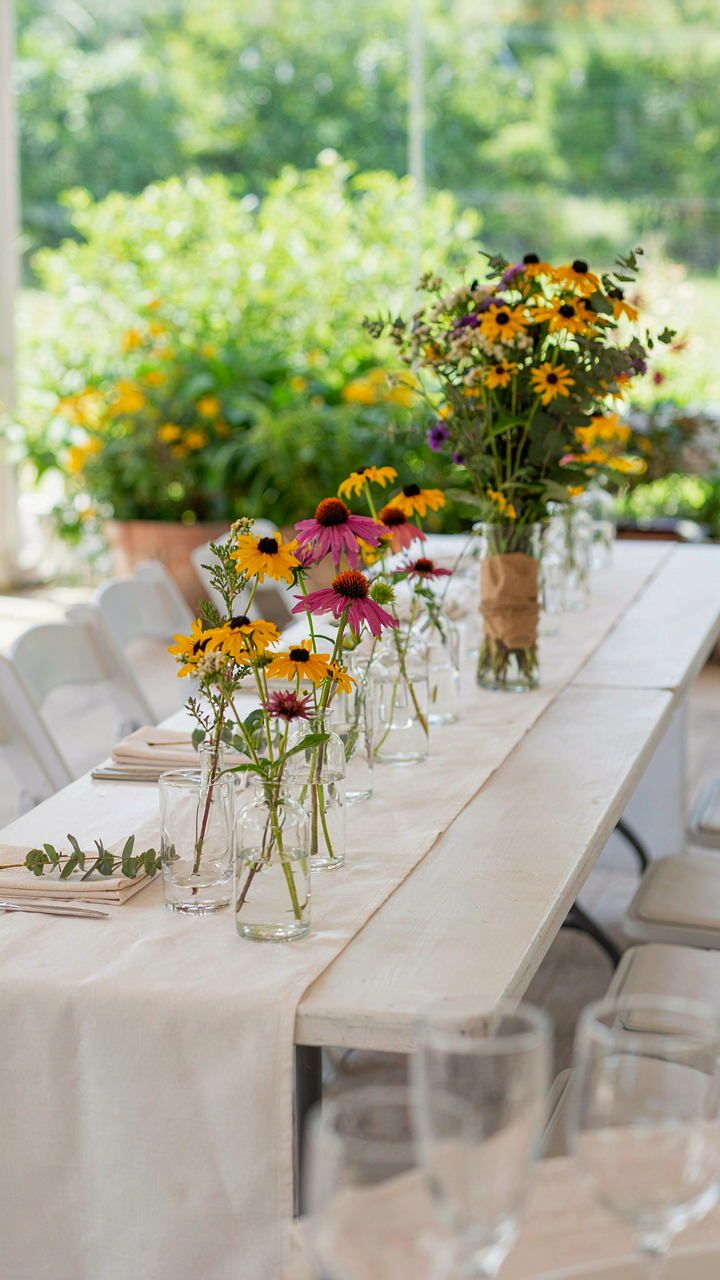
You want people to notice you made a choice, not an accident. That’s the real driver here. The mechanism is consistency of material language across the entire venue. Native wildflower bouquets work only when they’re the visible thread connecting every surface. A bouquet sitting alone on a table reads as confused decoration. The same wildflower species echoed in aisle arrangements, altar backdrops, and table scatter becomes a design system.
This is a restraint problem, not an abundance problem. Wedding planners default to mixing native wildflowers with garden roses, ferns, and imported greenery to “fill space.” That destroys the native narrative immediately. Instead, repeat three to four species throughout the venue in varying scales and densities. Use the same black-eyed Susans in the bride’s bouquet, the ceremony backdrop, and small bud vase centerpieces. Consistency reads as intention.
Material Authenticity In The Details
Ecosystem design from biology teaches us that every organism signals its environment through specificity, not generalization. Native wildflower bouquets signal their place through the exact species that grow there naturally, not through vague botanical abundance. Most weddings fail here by selecting wildflowers for color alone, ignoring which species actually coexist in the same region and season.
The real work happens before design: research what wildflowers bloom together in your specific geography at your wedding date. If you’re in the Midwest in June, you use native coneflowers, coreopsis, and bergamot that flower simultaneously. You don’t mix them with California poppies or mountain lupine. This regional specificity is what separates a native wildflower wedding from a generic meadow fantasy. Your florist sources locally, your arrangements look native to the place, and your guests see a wedding tied to actual land, not a catalog aesthetic. Verify bloom times with your florist before committing to any species.
The Curator’s Eye: Cultivating Your Wildflower Wedding Legacy

Build Your Visual Archive
You want proof that what you created matters. That’s the real driver. The mechanism is simple: documentation creates authority. When you photograph and catalog your arrangements, you build a reference system that proves your decisions weren’t random. This archive becomes your design vocabulary. Each bouquet teaches you what works at which stage of bloom, which color combinations hold under different light, which stems last in water. You’re not keeping a scrapbook. You’re building operational knowledge that compounds.
Shoot every arrangement you create from multiple angles and light conditions. Photograph fresh arrangements, arrangements at peak bloom, and arrangements as they age. Record the exact date, species, water temperature, and any additives you used. This data reveals patterns. Some wildflowers reach their visual peak at day three. Others look better on day one. Native varieties behave differently than florist imports because their genetics demand different conditions. Your archive becomes evidence of these mechanics, not sentiment.
Your Perspective Is The Actual Product
The industry consensus is that wildflower trends matter. This is wrong. Trends are consensus opinions that disappear. Your perspective is the repeatable asset that survives. When you position yourself as someone who understands native species behavior and regional ecology, you own ground nobody else holds. Couples book you because you see something they can’t see in a grocery store bouquet. That vision comes from your documented experience, not from copying what Pinterest shows.
Stop chasing seasonal trends and start building a body of work that reflects your specific region and your specific understanding. A curator’s eye isn’t about following design movements. It’s about having a clear framework that makes your choices intelligible to others. When a client asks why you chose black-eyed Susans over coneflowers, you have an answer rooted in bloom timing, water uptake rates, and how they hold color under venue lighting. That’s when people listen. That’s when you become the authority, not the follower.
The Fear Of An Unprofessional Bouquet Blinds You To Nature’s Superior Design Logic. Your Real Obstacle Is Trusting Your Own Taste

You’re blocking yourself with rules that don’t exist. Native wildflower bouquets work because nature already solved the composition problem. Asymmetry beats symmetry. Odd numbers beat even. Color variation beats uniformity. Stop waiting for permission. Walk outside today and cut five stems you actually like looking at. Arrange them without overthinking. You’ll realize the bouquet you made is better than anything you could buy because it’s yours, not designed by committee. Trust beats perfection every single time.



