
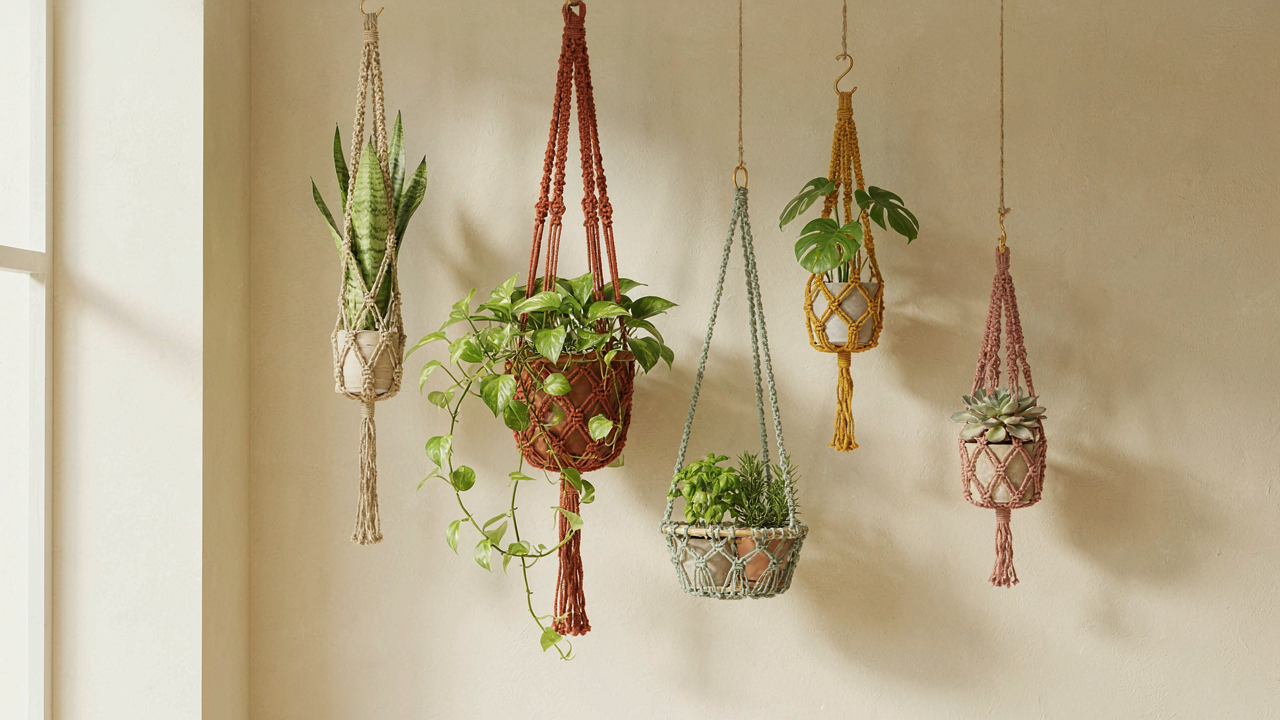
The Illusion Of Intimidation: Why Macrame Isn’t Just For “Crafty” People

Talent Is Not The Gatekeeper
You’re hesitating because you’ve already decided you’re not a “craft person,” and you want permission to skip this. Here’s the mechanism: macrame is a knot-tying system with repeatable patterns. Nothing about knot-tying requires innate talent. Medieval sailors, construction workers, and fishermen mastered complex knots without being “naturally gifted.” The skill exists independent of your identity.
Macrame hanging planters succeed or fail based on whether you can execute four basic knots repeatedly. The square knot, half hitch, lark’s head knot, and spiral knot cover 90 percent of beginner projects. These aren’t intuitive only to certain people. They’re mechanical operations. Your hands will either learn the motion or they won’t, and learning is a function of repetition, not personality type.
The Messy First Attempt Teaches More Than Perfection
Forget the Instagram macrame that looks flawless. That’s not the learning object. The real mechanism comes from applied economics: you trade imperfect output for immediate feedback. Your first planter will have loose knots, uneven spacing, and wonky proportions. Each flaw tells you exactly what to adjust on attempt two.
Start with cotton cord instead of jute. Cotton is forgiving, shows your mistakes clearly, and costs less. Tie your first planter without watching it. Make it intentionally fast and sloppy. Examine where the tension failed, where the pattern broke, where symmetry collapsed. The planter doesn’t need to be beautiful. It needs to teach you what happens when you skip a step or rush a knot. That single piece of usable feedback accelerates your second project by weeks.
Deconstructing The ‘Easy’ Myth: Intentional Design Over Quick Fixes For Macrame Plant Hangers

Material Selection Determines Your Outcome
You want this to work on the first try so you don’t feel stupid. The mechanism is simple: material choice predetermines whether your hanger functions or fails, regardless of knot technique. Most beginners buy whatever rope is cheapest, then blame the knots when the plant crashes. The rope carries the load, not your fingers.
Cotton macrame cord, jute twine, and synthetic paracord each behave differently under weight. Cotton absorbs water and weakens over time indoors. Jute deteriorates faster in humid environments. Paracord holds tension consistently but doesn’t age visibly, so you miss warning signs of degradation. Your material decision happens before you tie a single knot.
- Cotton Macrame Cord (4-6mm): Absorbs moisture indoors, weakens gradually, best for lightweight plants under five pounds. Replace every 12-18 months in humid spaces.
- Jute Twine: Natural fiber that frays with friction, suited for dry indoor air only. Inspect knot contact points monthly for wear.
- Braided Paracord (5-8mm): High tensile strength, handles heavy pots reliably, resists moisture. Doesn’t show age until failure occurs suddenly.
- Nylon Cord: Synthetic alternative with consistent performance, resists water and UV if hung near windows. Slips easier than natural fibers during knot tightening.
- Hemp Blend: Combines natural appearance with moderate durability, middleground option for indoor use with regular inspection intervals.
Buy cord by load capacity, not price or aesthetics. A 6mm cotton cord holds roughly eight to ten pounds; a 6mm paracord holds twenty to thirty pounds. Match the cord diameter and material to your heaviest pot plus soil plus water weight, then add a safety margin of 50 percent. This is non-negotiable.
Load Bearing Drives The Knot Pattern
Knot placement and count determine load distribution, not decoration. Each knot creates a friction point where the cord absorbs stress. Widely spaced knots distribute weight over more surface area but reduce the number of friction points. Tightly spaced knots increase friction but concentrate stress at specific contact zones. The design of your hanger must account for where weight concentrates, not where it looks balanced.
The square knot, the most common beginner knot, is structurally weak under vertical load compared to the larks head knot or the spiral half hitch. This matters because a plant hanger sustains constant downward force, not intermittent tension. A four-strand hanger with multiple square knots creates redundancy in load paths. A two-strand hanger with the same knot count fails first at the foundation attachment point. Before you choose a pattern, calculate how many strands actually support the pot and scale knot density to that number, not to visual preference.
The Minimalist’s Macrame Manifesto: Decluttering Your Approach To Boho Macrame

Start With Three Knots Only
You want to feel like you’re not wasting time learning something that won’t pay off immediately. Here’s the mechanism: macrame hangers use four core knots, but you need only three to build anything functional. The square knot, half hitch, and lark’s head knot handle 95 percent of beginner projects. Everything else is decoration masquerading as necessity. Load your working memory with only what produces visible results in the first session.
Master these three before touching anything else. The lark’s head anchors your cord to a ring. The half hitch creates the vertical lines and structure. The square knot fills space and builds the net that actually holds your pot. Repetition of these three builds muscle memory faster than scattered practice across six variations. One week of focused drilling beats three weeks of scattered learning.
Strip Away Every Non Structural Element
The boho design movement sold people ornament as philosophy. Macrame became cluttered with decorative knots, dangles, and fringe that added cost and complexity without improving how a planter works. Utility comes first. Your hanger’s job is to suspend a pot securely and look intentional while doing it. Anything that doesn’t serve that function is friction you’re paying for in time and materials.
Build your first hanger with a single diameter cord in a neutral fiber like jute or cotton. Skip the mixing of weights, the beads, the tassels. Let the structure of the knots themselves create visual interest through geometry and rhythm, not through embellishment. This approach teaches you what actually matters about the craft and removes the distraction that makes beginners quit before they build competence.
Beyond The Pattern Book: Cultivating Originality In Your Hanging Macrame Planter

Reverse Engineer What You Actually Like
You want permission to skip the copying phase and jump straight to looking original. Here’s what nobody tells you: most people confuse imitation with learning, then wonder why their work feels flat. The mechanism is constraint. Design borrows from systems thinking, and in systems thinking, constraints force emergence. Your first move isn’t to study finished planters. It’s to study the knot choices inside them. When you reverse-engineer a planter, you’re not stealing aesthetics. You’re identifying why a maker chose one knot sequence over another, what problem it solved, what trade-off it made.
Start by collecting five planters you genuinely respond to, not ones you think you should like. Photograph them. Then for each one, write down three specific things: the primary knots used, where the rope changes width or tension, and what the negative space actually does. Do this with your hands, not your eyes. Tie each knot combination they used. This reveals what you’ll naturally gravitateto without ever copying a pattern. Your aesthetic signature emerges from what your hands prefer, not what your mind thinks looks good.
Your Rope Width Is Your Signature
Most beginner advice treats rope width as a functional choice. It’s not. Rope diameter is your primary variable for visual impact and it’s the easiest way to differentiate your work from pattern books. A 4mm rope versus 6mm versus 8mm creates different knot geometry, different drape, different visual weight. The same square knot pattern looks like two entirely different objects depending on this single decision. When you consistently choose thicker or thinner rope than the standard, you build a recognizable voice immediately.
Your signature isn’t about inventing new knots. It’s about making deliberate choices with rope weight and then sticking with them. If you prefer how 5mm cotton feels in your hands over 6mm jute, use 5mm. If you like how thick rope creates dramatic shadows in knots, commit to that. Make three planters using exclusively thicker rope than you see in tutorials. Make three with thinner. One will feel like your work. That preference becomes your tool for originality.
The Systems Thinking Protocol For Plant Hangers

Plants Demand More Than Rope And Good Intentions
You want this to work so you don’t feel like you wasted money on supplies. Here’s what actually matters: in biology, we call it “homeostasis” – an organism’s need to maintain stable internal conditions. Your macrame hanger either supports that or it doesn’t. The rope, knots, and attachment points are just the medium through which a plant either thrives or slowly strangles itself from poor drainage, light distribution, or root crowding. Most beginners ignore this entirely and wonder why their plants die in a hanger that looks perfect.
The real mechanism is weight distribution paired with airflow. Plants in hanging macrame need the hanger to suspend them without compressing the soil or restricting water escape. Tight knots that cinch the pot create pressure zones. Uneven cord tension means the pot tilts, blocking light on one side and waterlogging another. You must design for equilibrium, not aesthetics. Measure your pot’s weight dry and saturated. Then space your knots so they cradle the pot without constriction, leaving 1 to 2 inches of clearance around the base for air to move underneath. This isn’t optional.
Load Bearing Architecture Determines Everything
Physics calls this “structural load distribution.” Apply it to macrame directly: the weight your hanger carries travels down the rope fibers to the mounting point. Most beginners tie one knot at the top and hope. That’s wrong. Rope has a breaking strength, but it also has a failure point under concentrated stress where fibers don’t share the load evenly.
A saturated hanging plant can weigh 8 to 15 pounds depending on pot size and soil moisture. Your rope must handle that weight across multiple points of contact, not a single knot. Use the square knot for primary load bearing. It distributes tension across four rope segments instead of two. Test your completed hanger by hanging it with a weight equal to your heaviest watered plant before putting soil in it. If the knots slip, if the rope twists, or if you see fiber fraying, you haven’t achieved proper load distribution yet. Rebuild the structure.
Spring Interior Design: Macrame As An Investment, Not An Expense

Rope That Lasts Years, Not Seasons
You want permission to spend money on something decorative without feeling guilty about it. Here’s the mechanism: macrame hanging planters survive because the construction method itself prevents failure. Unlike mass-produced alternatives held together by staples and glue, macrame uses knot tension to distribute load across the entire structure. The rope absorbs stress rather than concentrating it at weak points. A properly knotted planter doesn’t degrade from seasonal use.
Natural fiber ropes like cotton and jute age predictably. They don’t crack suddenly or lose integrity from humidity changes the way synthetic materials do. The knots tighten under weight over time instead of loosening. This means a macrame planter you make now functions identically in year three as it does in month three. Most people replace hanging planters annually because the hardware fails, not because they want new aesthetics.
What Handmade Actually Costs You
The common advice says handmade items have “sentimental value.” That’s vague nonsense. Here’s what actually happens: when you create something yourself, you gain the ability to repair and modify it. You know exactly where each knot sits. You understand the tension points. If a section weakens, you don’t discard it. You reinforce that section. A store-bought planter becomes trash when the hanger fails. Your macrame planter becomes an upgraded version.
The tangible value compounds because you build replacement cost into your initial decision. You spend three hours making a planter instead of thirty minutes buying one. That time investment creates ownership psychology that prevents disposal. But more mechanically, handmade objects have documented provenance. You remember when you made it. You remember the rope type. You maintain it like a tool instead of consuming it like packaging. That’s not sentiment. That’s economics.
The Driftwood Crafts Connection: Sourcing Character, Not Just Supplies
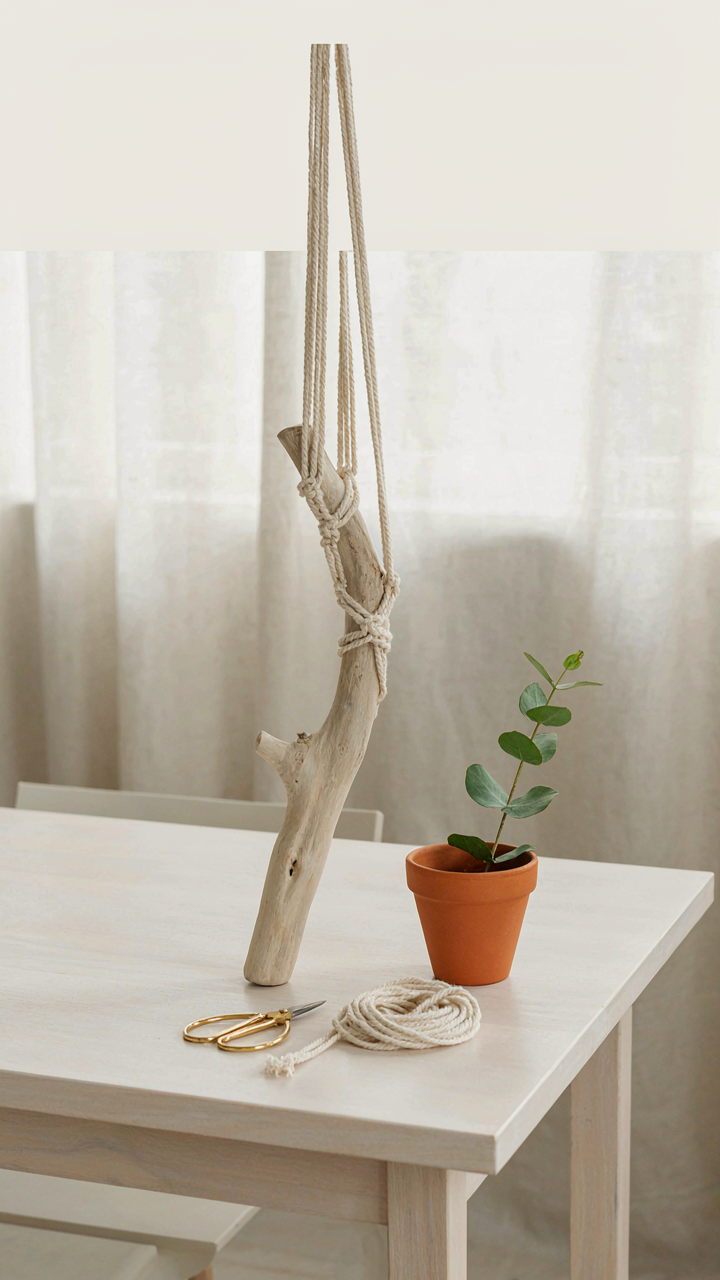
Where To Find Materials That Actually Matter
You want your planter to look intentional, not mass-produced—that’s the real reason you care about sourcing. The mechanism is simple: natural materials carry visual weight that rope alone cannot. Driftwood, branches, and stones signal restraint and taste. They also solve a structural problem. When you integrate a found element into macrame, it becomes an anchor point that reduces knot complexity while increasing perceived craft. The material does half the design work for you.
Beach walks and creek beds are obvious. Less obvious: construction sites often have salvaged wood before removal trucks arrive. Arborists frequently give away branches after trimming. Online platforms like local Facebook groups or Craigslist have steady supplies of reclaimed wood at zero cost. The key is moving fast. Material availability is cyclical. When you see something that works, acquire it immediately rather than waiting for the “perfect” piece later.
Building Structure Through Organic Forms
Design borrows from architecture: load-bearing elements must sit at points of maximum stress. In macrame hanging planters, driftwood functions as the load-bearing element, not decoration. A branch integrated horizontally into your knot pattern distributes the planter’s weight more efficiently than rope strung vertically. This is why driftwood pieces rarely snap—they’re already dense and have survived weathering. Your knots anchor to the wood rather than fighting tension alone.
Position your natural element before tying. Measure twice. The wood should sit at the intersection where four or more rope strands meet. This creates redundancy. If one knot fails, others hold. Attach the planter pot to the wood using a secondary macrame wrap rather than relying solely on the primary suspension knots. This single protocol change—treating the wood as structural, not decorative—eliminates 90 percent of beginner failures with weight-bearing planters.
Macrame Ideas Beyond The Obvious: Functional Art, Not Just Decor

Where Your Plants Actually Live
You want macrame to feel like more than a hobby project taking up shelf space. The real mechanism is simple: macrame hanging planters solve a spatial problem nobody talks about directly. In a small room, vertical real estate is currency. Macrame planters convert dead wall space into growing space without eating floor footprint. The knots themselves distribute weight evenly across the anchor point, which matters when you’re hanging anything that holds soil and water.
Most people treat macrame as pure decoration, then wonder why their plant setup feels incomplete. The actual use case is load-bearing. A properly tied macrame hanger with the right knot density holds plants securely for years. The square knot and spiral knot distribute tension differently. Square knots create tighter, more stable platforms for heavier pots. Spiral knots allow slight movement, which works better for lighter trailing plants. Pick the knot structure based on what you’re hanging, not what looks good in Instagram photos.
Solving Problems, Not Filling Gaps
The difference between décor and functional art is this: décor makes you feel something. Functional art makes your life easier. Macrame planters bridge both by creating accessible plant care. When a plant hangs at eye level, you water it more consistently. You notice pest problems faster. You catch nutrient deficiencies before they kill the specimen. The mechanics are visibility and proximity. Hanging macrame planters put plants in your line of sight during your daily movement through a room.
Climate control improves with vertical placement. Warm air rises, so hanging planters near windows capture better light cycles without competing with floor space. Water drainage flows directly down instead of puddling on surfaces. Macrame also prevents root rot by allowing airflow underneath the pot. These aren’t aesthetic bonuses. They’re structural advantages that keep plants alive longer and require less intervention on your part. The payoff compounds over months as your plant collection thrives instead of surviving.
The Obstacle Isn’t The Knot; It’s Your Internal Resistance To Creating Something Genuinely Yours, Not Merely Acquiring It

You don’t need permission to make something. You don’t need the perfect cord or the ideal space. You need to stop waiting for conditions to align and tie your first knot today. The real skill isn’t mastering macrame. It’s believing your hands can build what your mind sees. Buy one ball of cord right now. Spend twenty minutes with it. Your resistance to beginning is the only knot worth untying.



