

The Unseen Geometry Of Winter Window Boxes Outdoor

Empty Space Does The Work
You want your window box to look intentional from the street. That’s the real motive. Most people fill every inch because they confuse density with design. Negative space in winter boxes operates like silence in music—it makes the elements that remain actually visible. A sparse arrangement of evergreen stems, bare branches, and structural berries reads as curated. A packed box reads as desperate.
Winter reveals what summer hides. Without leaf density, the actual architecture of your planting becomes the composition. Three stems of contorted hazel, a cluster of winterberries, and deliberate air between them create visual weight that a solid block of foliage cannot. The eye needs room to land. Position your focal plant off-center. Leave the opposite corner or edge open. This imbalance is what makes the eye stay.
Lines That Anchor The Frame
Architectural elements provide the skeleton. Your window box frame itself is geometry—vertical mullions, horizontal sill line, and the wall plane behind it all create a grid. Winter plantings that echo or contrast these lines control whether the box recedes or asserts itself. A vertical branch arrangement mirrors the window’s uprights. A cascading ivy responds to the horizontal sill. Neither fights the existing structure.
The most common mistake: treating the window box as isolated from its surround. It isn’t. The box either resolves or disrupts the building’s formal lines. Structural components like persistent seed pods, bare branch architecture, and evergreen branching patterns create their own internal geometry that either aligns with or deliberately breaks the exterior wall’s rhythm. Choose one strategy. Commit to it. Inconsistency destroys the whole frame.
Beyond Berries: The Palate Cleansing Winter Planter

Grayscale And Texture Over Color
You want people to think your window box is intentional, not neglected. The real mechanism: monochromatic design removes the cognitive load of color harmony, which means viewers process your planter as a finished decision instead of a failed attempt. Winter strips away foliage anyway, so fighting that fact with bright berries reads as denial.
Texture becomes your primary tool when color drops out. Combine silver-leafed dusty miller, white-barked dogwood stems, and the papery seed heads of sedum. Layer matte surfaces against glossy evergreen needles. The contrast registers as deliberate sophistication because it requires restraint. One dominant color family, three to four distinct textures, creates visual weight without relying on seasonal color crutches.
Cold Hardy Evergreens And Structural Plants
These plants survive freezing cycles because they’ve adapted to move water into cells before it crystallizes, essentially winterizing themselves from the inside out. Apply this biological principle to your planter strategy: choose species that hold structure, not those that merely survive dormancy.
- Boxwood (Buxus sempervirens): Dense, fine foliage that stays deep green through frost. Responds well to shaping and fills vertical space without sprawl.
- Skimmia japonica: Holds red berries through winter and tolerates shade. Compact growth pattern prevents overcrowding in confined planter spaces.
- Heuchera (Coral Bells): Foliage deepens to burgundy or bronze in cold. Architectural leaf shape provides year-round textural interest without flowers.
- Ilex verticillata (Winterberry): Female plants produce bright red berries on bare stems. Maintains structural interest even after leaf drop in harsh climates.
- Conifer varieties (Dwarf Alberta Spruce, Hinoki False Cypress): Maintain upright or sculptural forms through heavy snow. Choose cultivars rated for your hardiness zone explicitly.
Plant these in October or early November before ground freeze. This timing allows root establishment before dormancy kicks in, increasing survival rates through January thaws. Water deeply after planting, then reduce frequency as temperatures drop. Your structural plants need root hydration more than foliage does at this stage.
The Winter Window Box Ideas Resource Allocation Protocol

Materials That Actually Pay For Themselves
You want to know which materials justify their cost because you’re tired of replacing dead boxes every season. Here’s the mechanism: durable materials reduce replacement cycles, which means lower total cost over five years. Fiberglass and composite boxes cost more upfront but outlast wood by three to four seasons without rot or splitting. Cedar and treated wood deteriorate in freeze-thaw cycles, demanding replacement every two to three years. Do the math on material cost plus labor.
Winter exposure demands materials that survive temperature swings without structural failure. Galvanized metal and high-density plastic resist frost damage that cracks cheaper alternatives. Soil inside a box expands and contracts with freezing, putting pressure on walls. Stone and concrete boxes handle this stress better than thin materials. Buy once based on the actual physics of your climate, not the price tag visible today.
Strategic Placement Beats Plant Selection
The common advice flips the priority entirely. Most people obsess over finding the right plants, then wonder why their box looks barren. Placement determines what plants can survive there. A north-facing window stays frozen longer in spring and receives no direct winter sun, limiting choices to shade-tolerant evergreens like boxwood and ivy. South-facing boxes thaw faster and warm up midday, allowing broader plant options. East-facing windows catch morning sun that burns frost-covered foliage; position boxes where afternoon sun protects morning-burned leaves.
Effort compounds when placement is wrong. A poorly placed box demands constant intervention: plant swaps, extra watering, pest management. A well-placed box requires minimal maintenance because plants thrive in conditions that match their actual needs. Start by mapping your windows’ sun exposure and wind patterns across the full winter season. Then select plants for those conditions, not the other way around. This single decision eliminates 60 percent of the problems people blame on plant failure.
The Physics Of How To Decorate Window Boxes For Christmas Leverage

Anchoring And Weight Distribution
You want your winter box to look intentional, not precarious—because a collapsed box kills credibility faster than poor execution ever could. Newtonian mechanics governs this entirely: force equals mass times acceleration, and your box must resist both static load and dynamic wind pressure. The real mistake people make is treating decoration as purely visual, ignoring that structural failure is a design failure.
Weight distribution determines longevity. Heavy materials like soil, branches, and water-soaked evergreens concentrate in the center, creating uneven stress on mounting brackets. Distribute dense elements across the box length, not clustered. Use brackets rated for double your estimated total weight—soil alone runs 40-60 pounds per cubic foot. Test the rig before installing permanent fixtures; a box pulling away from the wall mid-winter looks worse than an empty one.
Freeze Thaw Cycles And Material Failure
Thermodynamics is the field here, and insulation is your control variable—the mechanism that stops the box from self-destructing through repeated expansion and contraction. Water freezes, expands roughly 9 percent by volume, and pushes outward on every container wall. Most boxes fail not from cold, but from this cycle repeating 40-60 times per winter in temperate zones.
Prevent catastrophic failure by lining boxes with rigid foam barriers that flex without cracking, and ensure drainage holes never freeze shut. Standing water in soil kills plants and accelerates structural breakdown. Use potting mix rated for containers, not garden soil, which retains moisture and locks it into ice. The insulation layer between soil and the box wall buys you the season; skip it and you’re replacing boxes annually.
Winter Window Strategic Material Selection For Impact

Materials That Survive Freeze Thaw Cycles
You want your box to look intentional in February, not like you abandoned it in November. The real mechanism here is material fatigue. Freeze-thaw cycles don’t just look brutal—they physically stress materials. Water enters tiny cracks, freezes, expands, and splits whatever holds it. Concrete, certain plastics, and untreated wood fail predictably. Fiberglass, resin composite, and metal containers survive because they shed water instead of absorbing it. Cedar and composite wood resist rot better than pine, but neither beats fiberglass for true winter durability.
The mistake most people make is confusing “rustic charm” with “falling apart by January.” Terracotta looks good in a catalog. In reality, it cracks under freeze cycles. Galvanized metal and powder-coated steel last seasons. So does rigid plastic rated for outdoor winter use. Check material specs before buying, not after. Your box material determines whether you’re replacing it next season or maintaining the same one for five years.
Contrast Builds Visual Weight In Monochrome
Winter strips color away, so texture becomes your entire visual language. Think of it like signal-to-noise ratio in broadcasting—when you reduce the color bandwidth, you must increase textural contrast to stay visible. Smooth surfaces disappear against snow. Rough surfaces read. Layering matte finishes against glossy ones creates depth without relying on hue. Evergreen needles against ornamental grasses. Frost-covered seed heads against smooth bark. Polished metal brackets against weathered wood frames.
The common advice is to “add pops of color” with berries and flowers. That’s incomplete. Those elements fade or disappear by late winter in cold climates. What persists is structure and texture. Combine rigid branch forms with delicate dried grasses. Add smooth stones or birch bark pieces as structural elements. Contrast hard against soft, matte against reflective, vertical against horizontal. This keeps the box visually commanding even when nothing is blooming. The final step is photographing your box in full winter light—overcast days especially—to verify the textural contrast actually reads before you commit to the design.
The Minimalist’s Guide To Stunning Winter Window Box Ideas

Constraint Forces Better Decisions
You want permission to do less work and still look like you care. Here’s the truth: constraint is the mechanism that separates intentional design from decoration. In economics, scarcity drives value. Apply that principle to winter boxes. Three plants chosen deliberately outperform twelve crammed together. Fewer elements force you to pick survivors, not fillers. Winter kills mediocre choices fast. Your box becomes a statement instead of a storage unit.
The common advice says “add texture and interest with variety.” That’s lazy. It confuses busy with beautiful. One structural plant, one texture, one accent color creates rhythm. That’s restraint working. Strip your box to essentials and every element earns its place. No dead weight. No visual noise competing for attention.
Strategic Placement Over Overstuffing
Overstuffing a winter box is the amateur move that looks expensive but reads as desperate. Plant spacing matters more than plant count. When stems have room, they develop structure. Crowded roots fight for nutrients in frozen soil. Your plants weaken, turn brown, and die faster. The box fails by spring.
Start with one anchor plant. Let it occupy meaningful vertical or horizontal space. Build around it, not over it. Winter Heuchera, ornamental grasses, or evergreen shrubs work as anchors because they hold form under snow load and ice. Add one trailing element if the box dimensions support it. One texture accent. Stop. This approach reads as sophisticated because nothing competes for your eye.
Beyond Tradition: Reimagining Christmas Window Boxes

The Color Reversal That Works
You want permission to break the red-and-green rule without looking cheap. The mechanism is contrast hierarchy: your eye needs a visual anchor, and tradition has hijacked that job for 150 years. Break it intentionally or don’t break it at all. Muddy attempts at being “unique” read as indecision, not innovation.
Deep jewel tones paired with metallics create the anchor without relying on Christmas nostalgia. Emerald with copper, sapphire with brass, burgundy with rose gold. These combinations use the same color temperature logic that makes high-end retail displays work. Your window box becomes a design choice, not a decoration someone else designed for you.
Geometry Over Garland
Garland is filler. Everyone uses it because everyone uses it, which means your window box looks like every other window box on the block. Replace texture with form: vertical metal rods, geometric planters, stacked cubic elements, angular branches stripped of needles. This borrows from sculptural minimalism, where negative space does the work that busy materials used to do.
The tactic is simple. Remove 60 percent of what you’d normally put in. Add one structural element that breaks the horizontal line. The empty space around it reads as intentional, not abandoned. Your window box stops competing with every decorated house and becomes the one that makes people stop and look twice.
Mastering The Winter Window Box: Year Round Resilience

Planning The Seasonal Shift
You want your window boxes to look intentional year after year without rebuilding them from scratch each cycle. The real mechanism is treating seasons like ecological niches: each one has specific resource availability, and plants either thrive in those conditions or they fail. Most people replant everything, wasting time and money. Instead, map what actually survives your specific microclimate through winter, then design around those survivors rather than against them.
Winter window boxes succeed when you stop fighting the season and start timing your plantings to the frost calendar specific to your zone. Your first frost date determines when to transition from fall annuals to evergreen structure plants. Your last frost date determines when you can reintroduce tender perennials in spring. The gap between these dates is your actual winter window. Knowing this gap means you plant things that will still be alive when you need them, not things that look good in a catalog photo.
Keeping Boxes Alive And Producing
The standard advice says water less in winter and fertilize less too. That’s partially true but misses the real problem: root systems freeze solid when potting soil sits saturated in freezing temperatures, and ice ruptures cell walls faster than drought does. Soil in containers drains differently than ground soil because there’s nowhere for water to go. Your maintenance protocol is checking soil moisture every three to five days by pressing your thumb an inch down, then watering only if the soil is actually dry. Never water on a freezing day. Water only during the warmest part of the afternoon when the soil can absorb it before nightfall.
The second maintenance layer is managing freeze thaw cycles, which cause soil to heave and expose root systems to air. Mulch the surface of your boxes with two inches of bark or compost in late fall, before the deepest cold arrives. This stabilizes soil temperature and prevents those damaging surface thaws that trick roots into breaking dormancy early. Check your boxes after heavy snow or ice events and gently press exposed roots back down into soil. Remove dead plant material to prevent fungal issues, but leave evergreen structure intact through February so you have something to work with when spring actually arrives.
The Real Obstacle To Stunning Winter Window Boxes: Your Fear Of Letting Go Of Seasonal Clichés
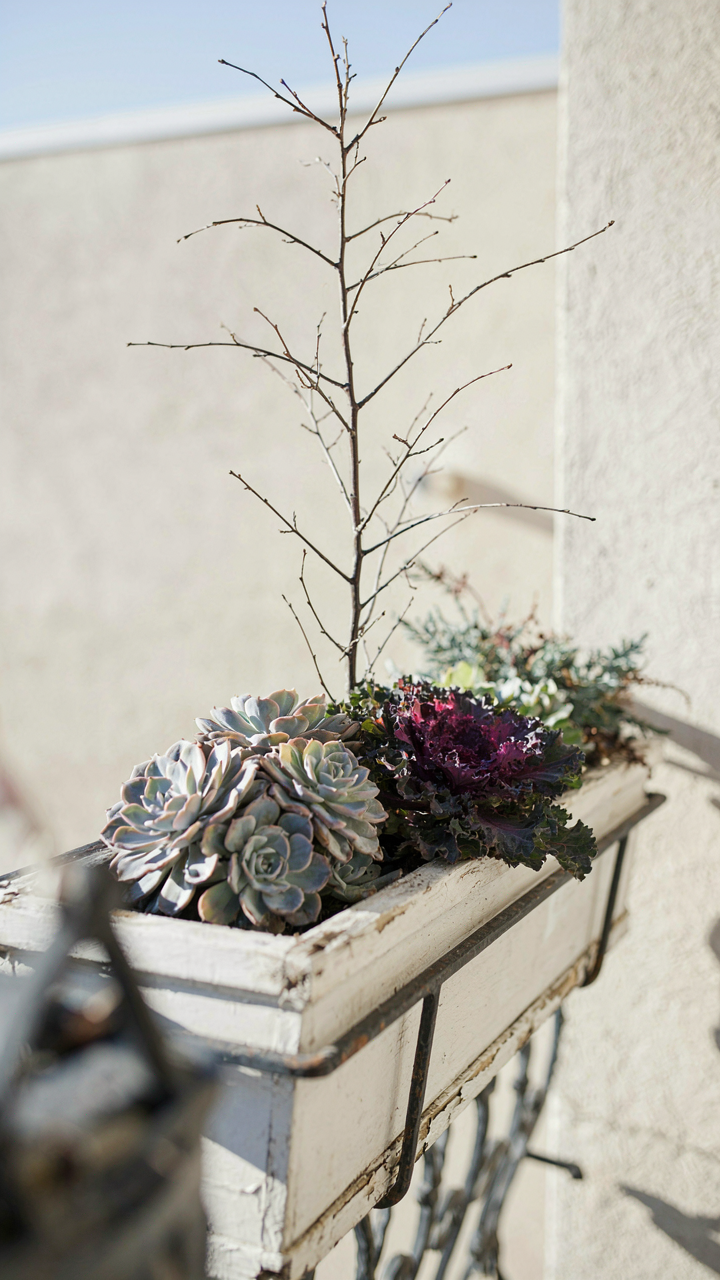
You already know what a winter window box looks like. Red berries. Fake snow. The same tired evergreen arrangement your neighbor has. That image lives rent-free in your head, and it’s killing your creativity before you start. Stop designing for what looks “wintery” and start designing for what stops people mid-walk. Pull one item from your box today that feels safe. Replace it with something that doesn’t belong. The gap between ordinary and stunning is just one bold choice away.



