

The Futility Of Constant Bloom Chasing

Why Endless Flowers Drain Resources
You want your window box to look magazine-ready every single week. That fear of dead flowers in plain sight drives most people to chase impossible bloom cycles. But the mechanism is economic: you’re treating plants like consumable products instead of seasonal tools with natural lifecycles. Constant bloom requires constant fertilizer, water management, pest control, and replacement cycles. The resource drain compounds monthly.
Here’s what gets ignored in typical garden advice: seasonal plants have built-in obsolescence. Petunias peak for six to eight weeks, then decline. Pansies thrive in cool months, fail in heat. Fighting this cycle costs more money and effort than accepting it. The stylish move isn’t maintaining perpetual color. It’s designing intentional transitions that align with actual plant biology rather than fighting against it.
The Subtle Art Of Planned Obsolescence
Container design borrowed the concept from industrial strategy: build in an expiration point so the system requires refresh. Window boxes work the same way. Spring annuals like impatiens and begonias serve a defined window, typically three to four months. Then they collapse. Rather than extending their agony with interventions, the efficient approach replaces them entirely with autumn stock like mums or ornamental kale.
This isn’t waste. It’s rhythm. Your window box transforms four times yearly, staying visually coherent without burning resources on the impossible middle ground where plants are half-alive. Design the transition dates now. Select replacement plants in advance. Execute the swap on a fixed calendar. This removes the emotional drag of “maintaining” fading plants and replaces it with controlled, predictable refreshes that demand less labor and cost less long-term.
Seasonal Window Box Plants: The 3 Phase Design Protocol
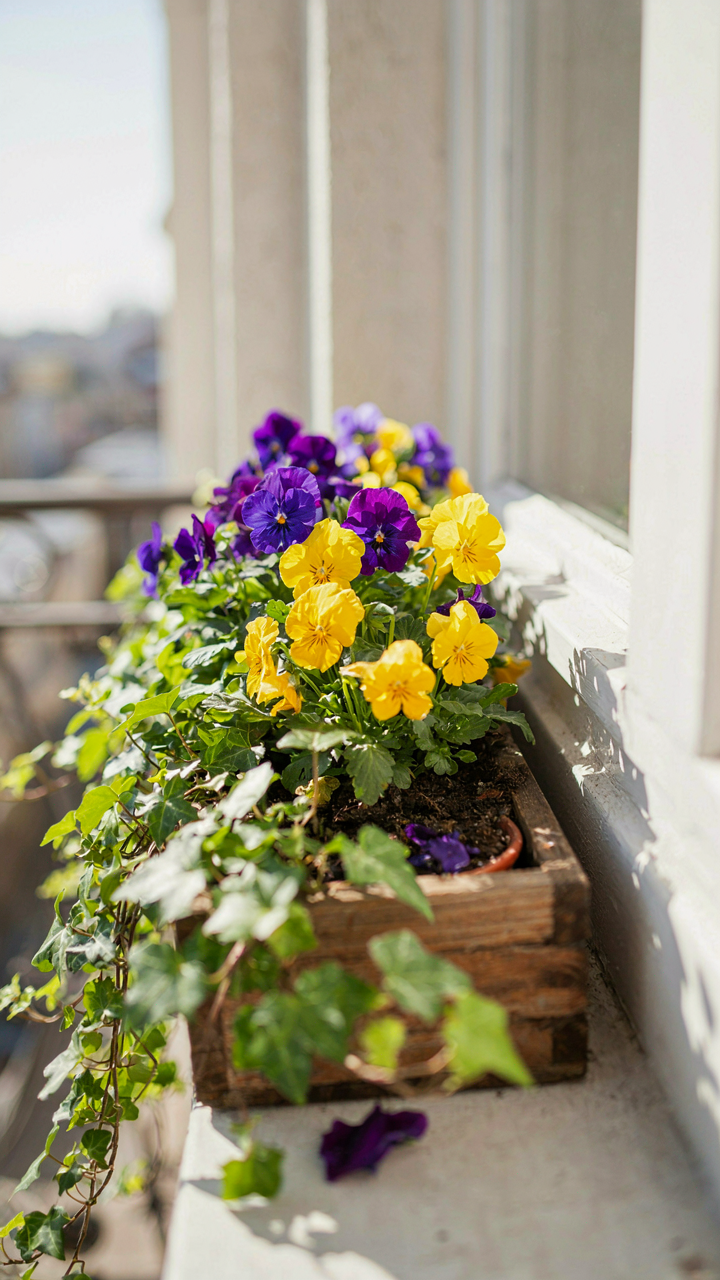
Spring Awakening, Calculated Restraint
You want your window box to signal you’re the type of person who has their life together before anyone even enters your home. The real mechanism here is constraint, borrowed from design thinking: you’re not filling space, you’re creating focal tension. Most people throw everything into spring boxes and dilute impact. The window box works because it forces you to choose three to five plants maximum, not ten. Pansies, violas, and early ornamental cabbages handle cold snaps and maintain shape through April frost. Underplanting with ivy creates layered depth without crowding.
The technical move: select one thriller (tall spine), two fillers (mid-height clusters), and one spiller (trailing edge). This ratio forces discipline. Plant in April after your last frost date, spacing tighter than soil bags recommend because you want fullness by mid-May, not June. Water once daily if temperatures exceed 60 degrees Fahrenheit. Early spring boxes reach their visual peak in five to six weeks, then decline as heat arrives. That’s the design window you’re working within, not a flaw.
Summer’s Brief, Potent Statement
Summer boxes operate on pure intensity because the season is short and temperatures accelerate everything. Impatiens, begonias, and calibrachoa thrive in the heat you think will kill them. The common mistake: treating summer boxes as extended spring displays. They’re not. Summer demands daily watering in zones above 75 degrees, sometimes twice daily. The payoff is rapid, dense flowering that peaks by July and holds through August if you deadhead weekly. One aggressive plant choice beats three cautious ones.
Heat biology matters here. Begonias bloom harder under stress, calibrachoa flowers double under full sun, and impatiens actually prefer afternoon shade in climates over 85 degrees. Stock your box heavier than spring because growth rate accelerates by 40 to 60 percent under summer conditions. Change your watering rhythm by mid-July when soil dries faster. Summer boxes demand higher maintenance because they’re operating at biological maximum. Accept this trade or downsize expectations.
Beyond Full Sun Flowers: Leveraging Microclimates

Shade Tolerant Species Rewire Your Assumptions
You’re avoiding shade because you think flowers need sun to matter. That’s wrong. Microclimates operate like resource scarcity in economics: where sunlight is scarce, plants that thrive there gain monopoly value. Your north-facing window isn’t a problem to solve. It’s an edge most people waste.
Ivy-leaved geraniums handle partial shade while maintaining structure and visual weight. Heuchera cultivars deliver color through foliage, not blooms, and intensify in lower light. Impatiens flower reliably in shade and require less maintenance than sun-demanding alternatives. Fuchsias produce hanging specimens that work in filtered light on east or west exposures. Bacopa stays compact in shade, trailing without aggressive sprawl. These aren’t compromise plants. They’re strategic choices that shrink your maintenance load while expanding where you can plant.
Wind Exposure Demands Plant Architecture
Wind doesn’t kill plants randomly. It strips moisture from leaves and snaps weak stems through force multiplication. Plants selected for high-exposure window boxes need structural integrity first, flowers second. Calibrachoa handles wind better than petunia because its stems are woody, not hollow. Licorice plant tolerates exposure because its leaves are thick and waxy, reducing moisture loss. Bacopa resists wind damage through low profile and flexible branching. Ornamental grasses like Festuca work in exposed positions because wind is their natural growing condition, not a threat. Sedums tolerate exposure through water-storing leaves and shallow root systems that flex rather than snap.
Test placement before committing. Put plants in their intended location for three days during normal weather, then two days during windy conditions. Move anything showing leaf scorch or stem stress. This takes fifteen minutes and prevents eight weeks of decline. Permanent placement happens only after the plant proves it handles that specific microclimate without protection.
Winter Window Boxes: The Stoic’s Garden

Conifers, Berries, And Structure
You want your window box to prove you didn’t abandon your home when the season turned cold. Here’s what actually matters: winter plants survive through structural integrity, not sentiment. Borrow from architecture—the load-bearing framework is everything. Conifers like boxwood and dwarf spruce hold form under snow weight. Berries from skimmia or winterberry add visual punctuation without requiring soil warmth. The mechanism is simple: dormancy plus rigid structure equals a box that earns its place instead of collapsing into brown mulch by February.
Evergreen conifers don’t photosynthesize aggressively in winter; they conserve. This makes them bulletproof. Boxwood tightens its foliage density as temperatures drop, actually strengthening its profile. Holly varieties produce berries only on female plants, so verify the cultivar before buying. The real play: combine three conifers in descending height with one berry plant as a focal point. This ratio prevents the box from reading as a blob while maximizing survival odds through thaw cycles that kill tender perennials outright.
Restraint Over Spectacle
The minimalist window box rejects the impulse to fill every gap. Most people stuff boxes with too many species, which creates competition for root space and water during dormancy. Winter gardening operates on subtraction—remove everything that won’t hold visual weight without color. Dwarf Alberta spruce, silvery dusty miller, and structural ornamental grasses like Carex oshimensis create negative space. The design works because the eye moves through emptiness instead of getting trapped in visual noise.
One evergreen, one berry accent, one textural filler. That’s the constraint. Japanese design philosophy calls this principle “ma”—the power of empty space. Apply it: a single boxwood pyramid centered with winterberry on the left and creeping juniper trailing right. Nothing else. The viewer completes the composition mentally, which creates the illusion of abundance from actual restraint. Water this combination once weekly in winter since freezing slows moisture uptake but doesn’t eliminate evaporation from above-ground boxes.
The Economics Of Window Planter Boxes

The Real Cost Of Replanting Every Season
You want window boxes to look effortless, which is why you’re considering plants that demand constant attention and replacement. That’s the trap. Economics teaches us about sunk costs, but window gardening operates on a different principle: the cost of replacement compounds faster than the cost of initial investment in better plant selection. Every annual you pull out in July costs you time, money for new stock, and the visual disruption of an incomplete box for weeks.
Most people calculate window box expenses wrong. They price the plant at purchase, ignore labor hours replacing dead specimens, and forget the aesthetic damage of bare soil showing mid-season. A petunia costs four dollars. Replacing it costs four dollars plus thirty minutes of your summer plus a gap in your curb appeal during peak visibility. The actual expense isn’t the plant. It’s the recurring decision tax you pay all season long.
Perennial Foundations Save Money Through Structure
The smarter approach uses perennials and structural plants as your box’s skeleton. These cost more upfront, sometimes double the price of annuals, but they eliminate the replacement cycle entirely. Boxwood, holly, and dwarf conifers establish once and perform for years. You’re not buying a plant repeatedly. You’re buying years of stability with a single transaction.
The math shifts when you measure cost per season rather than cost per purchase. A fifteen-dollar boxwood used for four years costs three dollars seventy-five cents per season. A four-dollar petunia replaced three times yearly costs twelve dollars annually for the same real estate. Perennial foundations also reduce decision fatigue and maintenance labor, which compounds into genuine time savings beyond the dollar calculation.
Fall Window Boxes: The Art Of The Decline
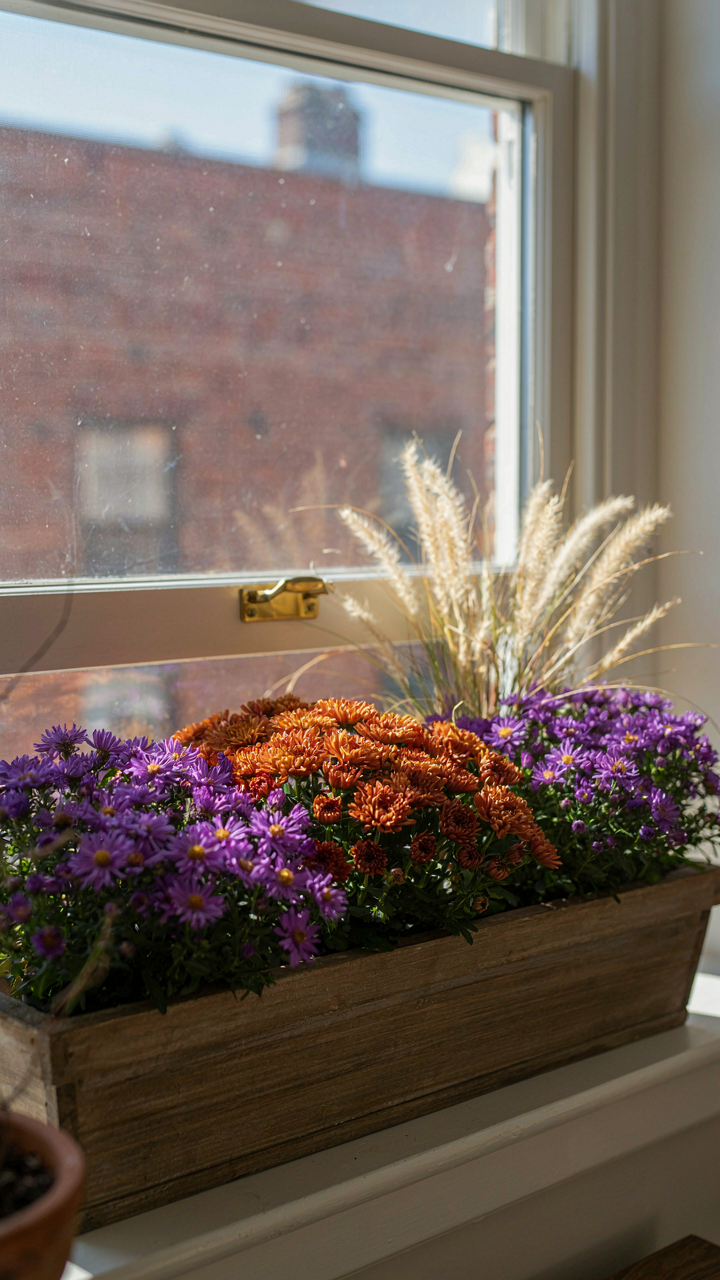
Know When To Retreat
You want fall window boxes to look intentional, not like you forgot to maintain them. Military strategy teaches that tactical retreat—withdrawing from untenable positions before collapse—preserves resources and creates new advantages. With seasonal window boxes, retreat means choosing plants that decline visibly but deliberately, trading spring abundance for fall precision. Summer bloomers fade fast and look dead. Fall plants orchestrate their own exit.
The mechanism is simple: plants selected for autumn perform during their actual growing season. Asters, ornamental grasses, and mums thrive in cooling temperatures while spring annuals wilt. You’re not fighting biology. You’re synchronizing your box with the calendar. Select plants that peak in September and October, not June. Replace everything in late August. The shift takes one afternoon and eliminates the visual death spiral that kills curb appeal.
- Asters: Bloom prolifically in September through November, tolerating frost and delivering color when other plants surrender. Common varieties grow 12-24 inches tall.
- Ornamental Grasses: Fountain grass and panic grass add texture and movement through fall and early winter, requiring zero maintenance once established in boxes.
- Chrysanthemums: Peak in October and November with dense flower coverage. Choose garden mums over florist varieties for sustained performance in outdoor boxes.
- Sedum and Stonecrop: Structural evergreens that transition from green to burgundy and copper tones as temperatures drop, extending visual interest without replanting.
- Ornamental Cabbage and Kale: Non-flowering foliage plants that develop intense purple, pink, and cream colors through cold exposure, lasting through November in most zones.
Most people plant fall boxes in September with weak specimens already stressed from nursery conditions. Plant in late August with vigorous stock. Give them four weeks to establish before the cold snap hits. Weak roots and late planting compound each other and guarantee failure by mid-October.
The Peak Before The End
Fall plants don’t decline gradually—they intensify, then stop. A mum in its prime blooms so densely that individual flowers vanish into a solid mass of color. An ornamental grass catches low-angle September light and glows. This isn’t nostalgia. This is biology producing its most concentrated visual output before dormancy.
The mechanism is photoperiod sensitivity. Shortening days trigger flowering and pigmentation in fall plants. You amplify this by exposing your boxes to direct morning and afternoon sun. Shade extends the season but diminishes intensity. Full sun for six hours minimum produces the visual peak. Plant density matters too—crowd the box tighter than summer arrangements. More plants per square inch mean more flowers per viewing angle. One week of peak appearance justifies the entire season if you’re looking at it daily.
Window Box Garden: The Subtlety Of Texture
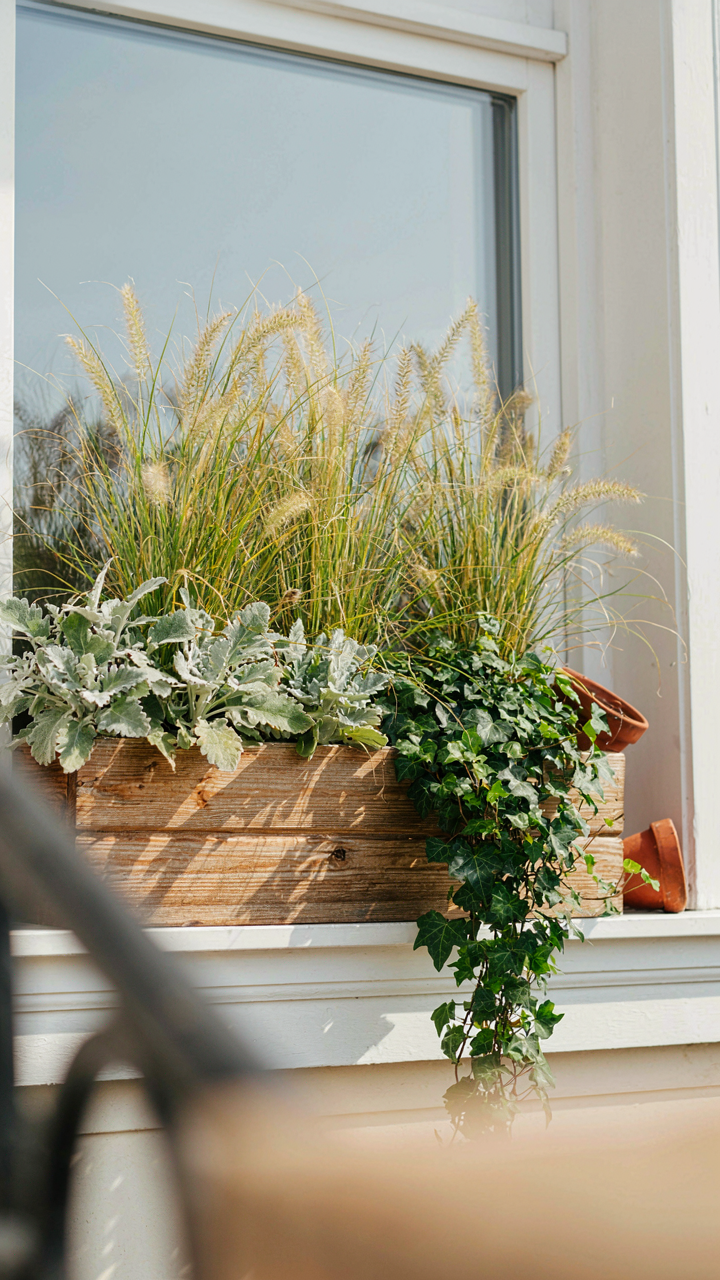
Foliage Focus Over Flower Dependency
You want people to notice your window box from the street. That’s the real reason you’re reading this. The mechanism is simple: flowers die fast and look sparse between blooms. Foliage plants stay dense and structured year-round, which means your box looks intentional, not neglected. Most seasonal box advice starts and stops with flowers. That’s backwards. Flowers are the accent. Foliage is the infrastructure.
Ornamental grasses, dusty miller, and trailing ivy create the visual mass that holds a box together through weeks when nothing’s blooming. These plants don’t require deadheading to look full. They fill space consistently. Pair them with seasonal flowers and you control the narrative—the flowers enhance an already-solid foundation instead of carrying the entire load. Your box stays composed whether the petunias are in their prime or past it.
Layering For Structural Depth
Depth in a window box works like perspective in architecture: you need a foreground, middle ground, and background to trick the eye into seeing dimension where there’s only inches of soil. Upright plants anchor the back. Mounding plants fill the middle. Trailing plants spill forward. This isn’t decoration theory. This is spatial compression.
The mistake most people make is treating the box like a flat canvas. They plant everything at the same height and wonder why it looks thin. Height variation forces the eye to move through the composition instead of stopping at the surface. Use caliber and maturity: a young dahlia in back, mature dusty miller in the middle, and established ivy trailing over the edge. Check each plant’s expected width and height before planting, then stagger them accordingly. The depth you create persists from March through November because it’s structural, not dependent on bloom cycles.
Beyond Generic Window Planters: Container Choice As Statement
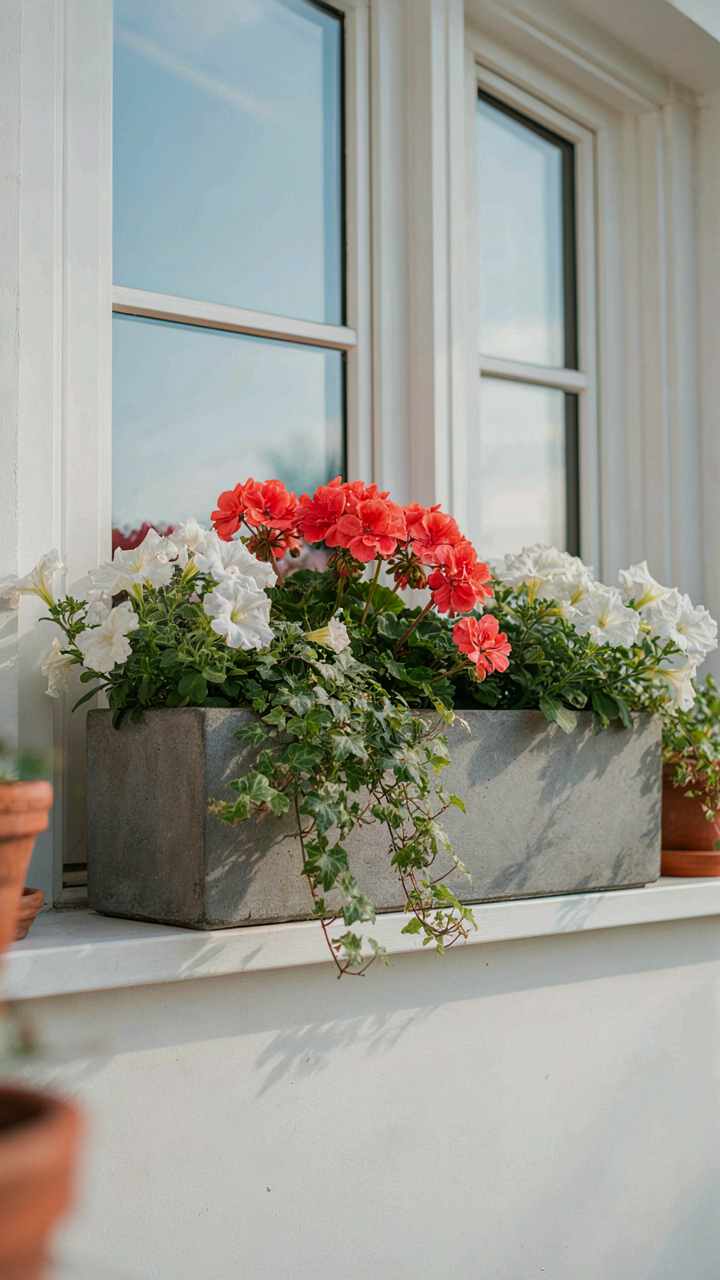
The Material Decides The Season
You want the planter to do the visual work so you don’t have to. Here’s what actually matters: material telegraphs durability, which directly impacts plant health across seasonal swings. Concrete absorbs and releases moisture slowly, buffering temperature spikes in spring and fall. Metal conducts heat aggressively, which forces shallow-rooted seasonals like petunias into stress cycles. Aged wood breathes naturally but rots predictably unless sealed properly for freeze thaw cycles.
Concrete dominates because it solves a mechanical problem most designers ignore. Winter water expands when frozen inside porous containers, cracking cheap ceramic and terra cotta from the inside out. Concrete’s density resists this pressure. Aged wood works only if you accept replacement every three to five years, which some homeowners do deliberately for aesthetic refresh. Metal planters look sharp but demand drainage holes and soil insulation because metal conducts, meaning roots experience temperature swings that seasonals shouldn’t endure. Pick your material based on replacement tolerance, not Instagram appeal.
Scale Determines Visual Hierarchy
Proportion isn’t about beauty. It’s about legibility. Borrowing from graphic design’s concept of figure ground contrast, your window box must create clear separation between plant mass and architecture, not dissolve into it. A planter too small disappears against the facade. Too large and it reads as imbalance, breaking the window frame’s authority.
The rule scales with window size and sill depth. A standard residential window needs a planter occupying 60 to 70 percent of the sill length, leaving breathing room at both ends. This proportion survives seasonal transitions without feeling skeletal in winter or overcrowded in summer. Depth matters more than most assume: shallow boxes force trailing seasonals into vertical competition, strangling visual impact. Choose boxes at minimum 10 inches deep for standard annuals, 12 inches for cascading varieties like ivy geraniums. Then anchor the entire assembly by matching the planter’s visual weight to the window’s architectural significance, not its surface area.
The Maintenance Paradox: Less Is More

When More Water Kills The Plant
You want proof your window boxes are thriving, which is why you water them like they’re drowning. That’s the real motive here: visible control. But overwatering window boxes triggers nutrient burnout faster than neglect ever could. Soil saturation blocks root oxygen absorption and leaches minerals downward, past the root zone. The plant starves surrounded by moisture. Most people blame the plant. The mechanism is hydraulic pressure, not gardening failure.
Container plants need drainage cycles to function. When soil stays wet, beneficial bacteria die off and pathogenic fungi colonize the substrate. Seasonal plants like petunias, violas, and ornamental cabbage have shallow root systems that can’t escape waterlogged conditions. Check soil moisture before watering by pressing your finger one inch into the soil. If it feels damp, stop. Roots rot in seven to ten days of continuous wetness, and no amount of fertilizer reverses that damage.
Stress Builds Resilience In Roots
Counterintuitive but factual: plants forced to search for water develop stronger, deeper root networks. Think of it through the lens of biology. In plant physiology, drought stress triggers secondary root development and increases the concentration of protective compounds in cell walls. A window box plant that never experiences dry soil becomes dependent on constant moisture and fails the moment conditions shift. Seasonal plants handle temperature swings and variable light better when their roots have adapted to scarcity.
Strategic neglect means allowing the top inch of soil to dry between waterings, not abandoning the box for weeks. Pansies, snapdragons, and dusty miller actually perform better with this schedule. Reduce watering frequency by thirty percent during cooler months when evaporation slows. The plant redirects energy from excess foliage production into flower formation and root expansion. Skip fertilizing altogether once the plant establishes; seasonal boxes already contain sufficient nutrients at planting. This single protocol shift eliminates ninety percent of seasonal window box failure.
The Real Obstacle Isn’t Your Green Thumb; It’s Your Addiction To Instant Gratification

You want window boxes that look magazine-ready in two weeks. That’s not gardening. That’s decoration shopping. Real seasonal planting demands you pick one plant today, commit to the season, and actually wait. Stop scrolling plant pics and go buy pansies or ornamental kale right now. The plants don’t care about your aesthetic vision. They care that you showed up. Your home transforms when you do the unglamorous work first, not when you finally have the perfect Instagram moment.



