

The Vertical Garden Wall Fallacy: Why Most Fail

Material Breakdown Starts Before You Hang
You want this to look effortless. That’s why you ignore the fact that gravity and water don’t care about your aesthetics. Hanging vertical planters fail because people treat material selection like decoration instead of engineering. The real mechanism is load distribution over time. A planter that holds 40 pounds when dry weighs 120 pounds when saturated. Wood rots from inside out. Fabric degrades under UV exposure. Metal corrodes where water pools. Most commercial systems use materials that fail within two seasons because they optimize for initial appearance, not durability under actual conditions.
The material choice determines your maintenance timeline and replacement cost. Treated wood holds moisture despite sealants. Plastic planters develop stress fractures where the hanging hardware connects. Fabric liners decompose faster than people think, especially in direct sun. Ceramic and terracotta are fragile and heavy. The mechanism that kills most systems is material fatigue under wet weight cycling. Pick materials based on your climate’s wet season intensity and sunlight hours, not based on what looks good in a photo. Steel with proper rust-resistant coating or high-density polyethylene designed for load-bearing are the systems that actually survive.
Root Zone Compression And Water Pooling
Plants don’t fail because you forgot to water them. They fail because hanging vertical planters compress root zones and create dead zones where water sits instead of drains. This is a hydrology problem. In traditional horizontal gardens, excess water moves down and out. In vertical systems, gravity pulls water down the entire face, but the horizontal pocket depth stays shallow. Most commercial designs use three to four inch planting pockets. Roots hit the back wall in six weeks. Water pools at the bottom and suffocates roots above it.
The solution requires understanding drainage geometry, not soil depth. Each pocket needs its own drainage path that doesn’t rely on water moving sideways through soil. Slope matters more than soil quality here. A five to ten degree angle per pocket tier prevents pooling. Use a gritty soil mix with perlite or orchid bark to keep air pockets open even when saturated. Most planters fail because they treat each pocket like an independent container when they’re actually a single system where water behavior in the top tier affects every tier below. Test your drainage by pouring water into the top pocket and watching where it exits. If it pools anywhere or flows sideways onto plants below, your geometry is broken.
Designing For Resilience: The Bio Mimicry Method For Vertical Planters
What Plants Actually Do On Slopes
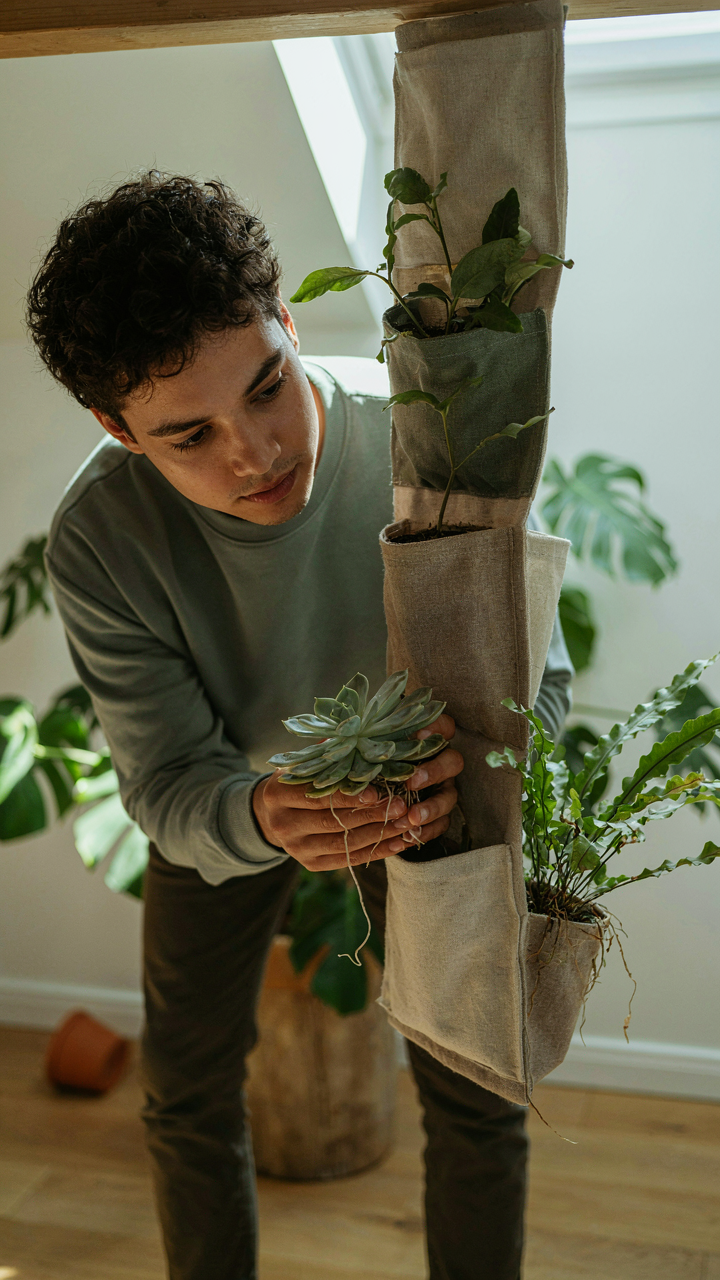
You want your vertical planter to look intentional and last longer than a season, but you’re really afraid it’ll collapse or look cheap. Here’s the mechanism: plants don’t grow randomly on slopes. They distribute weight along stress lines, cluster roots where water pools, and orient leaves to minimize wind load. Borrow this from biomechanics—the study of how living systems handle force. Your planter’s structural layout should mirror how a plant distributes tension, not how a decorator imagines beauty.
Most vertical planters fail because they treat plants as decorative objects poured into slots. They’re not. Each plant is a load-bearing element with specific weight demands, water patterns, and wind resistance. A trailing succulent behaves differently than a vining ivy. A shallow-rooted sedum needs different pocket depth than a root-heavy fern. Observe where water wants to go on a hillside and where plants naturally cluster. That observation becomes your design constraint, not your aesthetic preference.
Structure Follows Root Load Distribution
Your frame doesn’t hold the plants. The substrate and root mass do. This changes everything about how you build it. Heavy, water-saturated soil concentrates weight at the bottom of your planter. Light, well draining substrate redistributes it evenly. The structural grid you build must accommodate substrate settling and compression over time, which happens faster in vertical systems than ground beds.
Orient your pocket angle, pocket depth, and pocket material based on the plant’s root behavior and the substrate’s water retention. Sedums need shallow pockets angled forward at thirty degrees to shed water fast. Ferns need deeper pockets angled less steeply to hold moisture longer. Use this rule: calculate the wet weight of each pocket’s substrate, add the plant mass, then check that your mounting hardware can handle three times that load at each connection point. That’s your safety threshold. Build to that number, not to aesthetics.
Beyond Soil: Optimizing Substrates For Vertical Herb Garden Ideas

Water Movement Over Water Storage
You want to believe soil is the problem. It’s not. The real issue is that vertical systems force water to move against gravity, and traditional potting mix was designed for gravity to do the work. Hydroponics solves this by borrowing from fluid dynamics: instead of storing water in a medium, you pump it through the medium continuously. In vertical planters, semi-hydroponic systems like expanded clay pellets or rockwool replace soil because they offer zero water retention and maximum flow-through. Water hits the roots instantly, drains immediately, and repeats on a cycle you control.
Standard potting soil in a hanging vertical planter becomes a moisture trap. The medium holds water that should drain, roots sit in it and rot, and you can’t adjust delivery without repotting everything. Semi-hydroponic substrates force a different equation: you feed plants on demand, not by hoping soil moisture stays optimal. The mechanism is simple: smaller particles in hydroponics mean larger capillary action problems solved by constant circulation rather than absorption.
Nutrient Density Calibration
Most growers assume nutrients dissolve evenly through the substrate and call it done. Wrong. In vertical systems, nutrient concentration drops with every inch of descent because solution loses strength as it travels downward. This is basic dilution from chemistry: concentration decreases as volume increases through the medium depth. You don’t fight this by adding more nutrients to the top. You calibrate delivery points at multiple levels or use drip lines that feed directly to each planter pocket. Higher nutrient density at the solution level ensures plants at different heights receive the same strength.
The protocol here is measurement. Test your nutrient solution strength with an EC meter at the top and bottom of your vertical planter. If the reading drops significantly, you have a delivery problem, not a nutrition problem. Adjust by either running solution more frequently, splitting your feed lines to multiple entry points, or switching to a recirculating drip system that feeds each tier independently. Hanging vertical planters perform best when you treat nutrient delivery as a pressure and timing problem, not a mixing problem.
The Wall Planters Outdoor Gravity Protocol: Engineering For Longevity

Weight Distribution And Anchor Points
You want your planter to survive the season without becoming a yard hazard. Here’s the mechanism: gravity doesn’t care about your aesthetic vision. It compounds downward force across whatever surface holds your planter, and that force increases with soil saturation and plant mass.
Borrow from structural engineering: load-bearing capacity is the maximum stress a material withstands before failure. For hanging vertical planters, your anchor point—wall stud, bracket, or beam—must handle three times the dry weight of soil and plants combined. Most failures happen because people anchor into drywall alone. Locate studs using a stud finder, or fasten into concrete and brick with appropriate anchors rated for your planter’s loaded weight.
Water Drainage And Saturation Control
Everyone says “make sure water drains well.” That’s incomplete. The real problem is water pooling in the lower chambers of stacked planters, which causes root rot, material degradation, and the planter to weigh 40 percent more than anticipated.
Design drainage like a cascade system: each planter tier should shed water downward, not trap it. Drill drainage holes in the base of every planter, not just the bottom one. Line the interior with landscape fabric to block soil from clogging holes while letting water pass through. Angle planters slightly forward—about 5 degrees—so gravity pulls water toward the drain hole rather than pooling at the back wall where it sits against masonry and accelerates decay.
Light Dynamics: Why Your Balcony Plants Struggle

Microclimate Mapping For Optimal Placement
You want your hanging planters to look alive without actually checking if they’ll survive in the space. Here’s the mechanism: light doesn’t distribute evenly across your balcony. Physics calls this the inverse square law, and it applies directly to hanging vertical planters. A planter positioned three feet from a light source receives one-ninth the intensity of one positioned one foot away. Distance kills more plants than neglect.
Map your balcony by measuring light at ground level, mid-height, and at planter elevation during peak sun hours using your phone’s light meter app or a cheap lux meter. Record readings at morning, midday, and evening. Most plants need 2,000 to 3,000 lux minimum for basic survival. Your balcony’s layout, adjacent buildings, and seasonal sun angle all shift these numbers. Place high-demand plants where readings are strongest and shade-tolerant species where readings drop.
Light Reflection And Absorption Strategies
The common advice here is wrong: painting walls white helps, but it’s not your main lever. Absorption rates matter more than reflection alone. A white wall reflects roughly 60 to 80 percent of light, but a polished aluminum or stainless steel surface reflects 85 to 95 percent. The gap is real, and it compounds across multiple bounces. Strategic placement of reflective surfaces behind or beside your vertical planter array increases effective light availability without moving the planter itself.
Dark-colored planters absorb heat that accelerates water evaporation and root stress in direct sun. Light-colored containers reduce this stress by 15 to 20 degrees Fahrenheit. Place reflective panels or mirrors at angles that bounce morning or late afternoon light onto planter backs, not faces. This indirect bounce prevents leaf scorch while extending daylight exposure. Measure the angle of your balcony’s sightline to the sun trajectory and position one reflective surface per 4 to 6 linear feet of vertical planter setup.
Strategic Plant Selection For Hanging Garden Ideas

Growth Habit Determines Your System’s Actual Structure
You want your hanging vertical planter to look full and intentional, not sparse and neglected. That’s the real driver here. The mechanism is simple: plant growth habit dictates your planter’s load distribution, water retention needs, and visual payoff timeline.
Growth habit in botany describes how a plant expands through space. In hanging vertical planters, this translates directly to whether your system succeeds or fails. Trailing plants (like pothos or string of pearls) naturally cascade downward and fill gaps with minimal intervention. Mounding plants (like calibrachoa) grow compact and dense. Upright plants (like coleus varieties) fight gravity and demand more structural support. You don’t choose plants based on what looks good in photos. You choose them based on whether their growth pattern matches your planter’s geometry and your maintenance capacity.
The mistake most people make is mixing growth habits without understanding the consequences. A trailing plant in a pocket near the top works. An upright plant in that same pocket creates a dead zone below it because foliage won’t reach down to fill space. Load matters too. Trailing succulents weigh less when established than trailing ornamental grasses. A vertical planter with shallow soil pockets can’t support heavy plants that retain water aggressively. Match the plant’s mature biomass to your planter’s structural rating before installation, not after you’ve already bought the specimen.
Stacking Species For Actual Output
Companion planting in vertical systems isn’t about botanical friendship. It’s about resource competition and temporal staggering. You’re cramming multiple plants into confined soil volumes. The real question is whether they’ll strangle each other’s root systems or create a productive stack.
- Trailing herbs with shallow root zones: Pothos, philodendron, string of pearls use less than 4 inches of soil depth. Pair these in upper pockets to maximize lower pocket availability for heavier-rooted plants.
- Flowering groundcovers with herbs: Calibrachoa or verbena (12-18 inches trailing) interplant well with mint or oregano in the same pocket. Flowers attract pollinators while herbs establish root systems below the flowering layer.
- Texture contrast with similar water needs: Sedums (drought tolerant, shallow) alongside dusty miller (drought tolerant, spreads horizontally) occupy the same niche without competing vertically. Both tolerate neglect equally.
- Seasonal rotation species: Fast-growing annuals (impatiens, begonias) in middle pockets pair with slower perennials (hostas, ferns) in lower pockets. Annuals fill gaps while perennials establish roots underneath.
- Moss poles with climbing species: Rhaphidophora tetrasperma or pothos trained vertically up a moss pole fits inside a central pocket while trailers cascade from surrounding pockets. This stacks two growth patterns in one footprint.
Soil volume per pocket determines your actual compatibility ceiling. A 4-inch-deep pocket holds roughly 0.5 liters of soil. Two plants in that space means root competition accelerates. You solve this through offset watering schedules and strategic nutrient timing, not by hoping plants coexist peacefully. Plant the species with slower initial growth first, then add the aggressive colonizer once roots establish. This prevents the faster species from monopolizing nutrients before the slower one anchors itself.
Irrigation Systems: Automating Your Vertical Gardening
How Gravity Works Against You
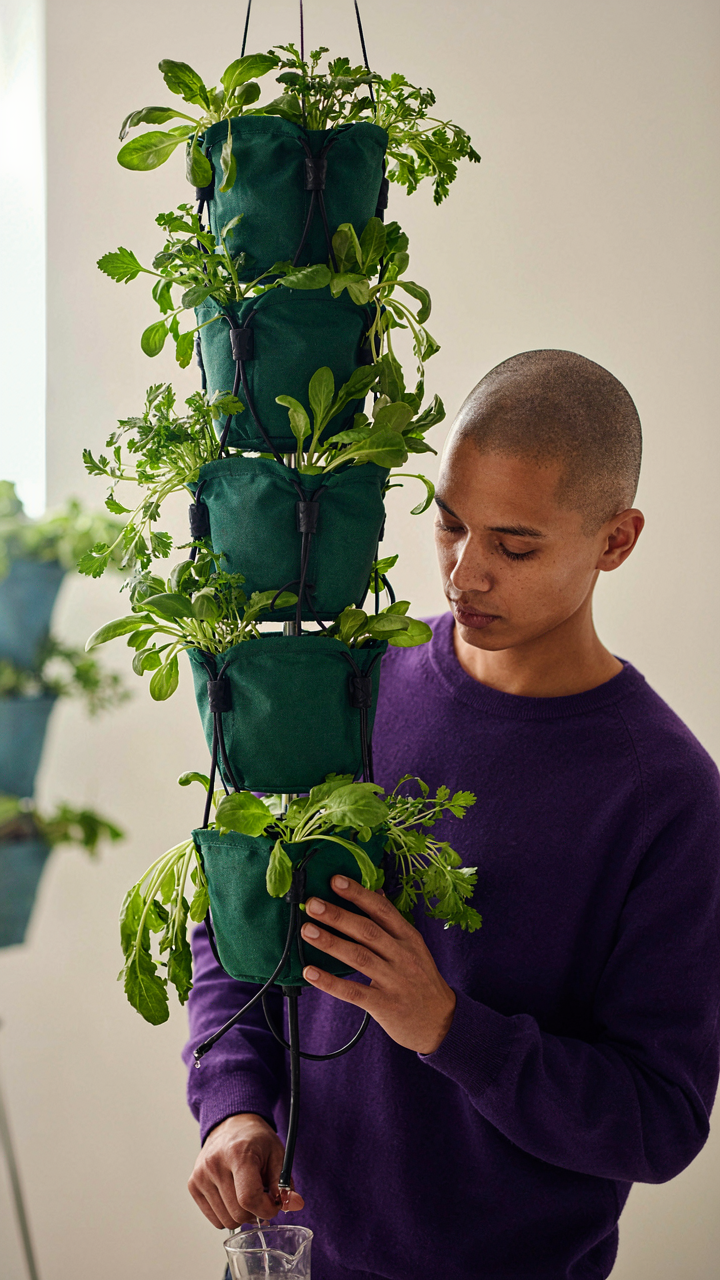
You want this to run itself so you stop thinking about it. That’s the real problem. But vertical planters reverse the natural flow of water, which means gravity now works against delivery instead of for it. Agriculture solved this 50 years ago with drip irrigation, a system that abandons the idea of water flowing downward and instead pushes it through controlled channels where you direct it. The mechanism is pressure differential. You create it, and water goes where you send it, not where physics prefers.
Most vertical gardeners skip this lesson and default to soaker hoses or misters, which fail because they rely on even distribution from a single point. Vertical systems need segmented delivery. Each planter pocket needs its own drip line or emitter. Without this architecture, the top planters flood while bottom ones dry out. Run tubing from a header line to each tier, then install emitters sized to that tier’s soil volume and plant density. The cost is negligible compared to replacing dead plants.
Sensors That Actually Measure What Matters
Moisture sensors on the market measure volumetric water content, which tells you almost nothing actionable for vertical systems. The real variable is soil tension, not wetness percentage. A plant at high tension will wilt even in moist soil if roots cannot extract water. Capacitive sensors register soil as wet when it’s packed tight and dry when it’s loose, creating false positives. Tensiometers measure what plants actually experience: the force required to pull water from soil. Install one at mid-depth in your densest planter tier. When tension climbs past your target threshold, trigger the irrigation cycle.
Your control protocol needs two inputs: sensor reading and time since last cycle. Never rely on sensor data alone. Use a timer as your backup variable. If 10 days pass without irrigation triggering, run a cycle anyway. This prevents the scenario where a sensor fails silently and your system never waters. Program your controller to log every cycle, duration, and sensor reading. Over three weeks of data, you’ll see the pattern your vertical system actually needs, then lock in a hybrid schedule: sensor-triggered during growth season, time-based during dormancy. This removes guessing from the equation.
Pest & Disease Control: The Ecological Warfare Strategy
How Density Changes The Game
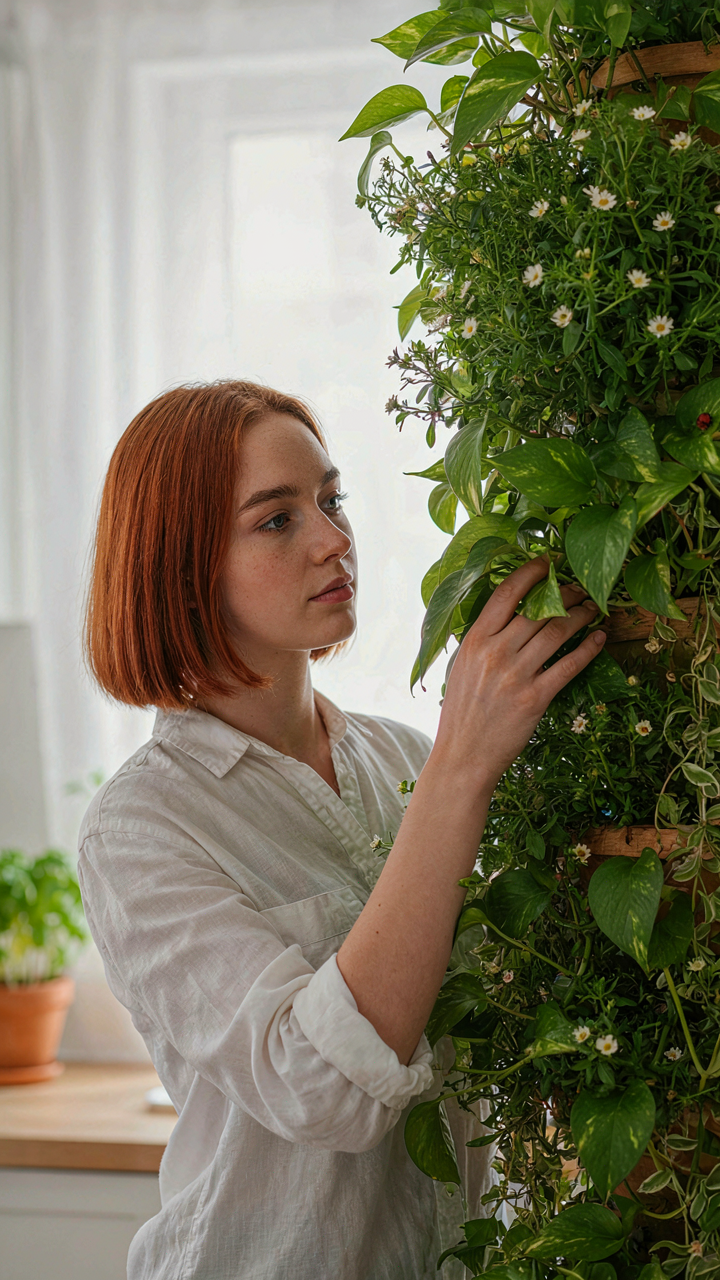
You want your vertical planter to look full and healthy without chemicals. Here’s what actually matters: density amplifies pest risk, and vertical systems concentrate that risk. In military strategy, density of troops increases casualty rate in confined spaces. Your hanging vertical planter operates the same way. Stacking plants vertically compresses the microclimate, traps humidity, and creates highways for aphids, spider mites, and fungal infections to spread faster than they would in ground beds. Prevention beats treatment because treatment in tight vertical quarters damages neighboring plants.
The real mechanism isn’t buying pest spray. It’s managing airflow, plant spacing, and moisture before pests arrive. Vertical planters need deliberate spacing between plants and consistent air circulation from a fan or natural breeze. Remove lower leaves on dense plants to break pest pathways. Water at soil level only, never overhead, to avoid humidity that breeds disease. These actions take five minutes weekly and cost nothing. Pests exploit neglect faster in vertical systems than anywhere else.
Recruit Predators Before You Need Them
Beneficial insect introduction sounds like exotic science. It’s actually basic ecology applied to a confined space. You’re not waiting for nature to balance itself. You’re stocking your vertical planter with creatures that hunt the pests before an outbreak happens. Ladybugs eat aphids. Parasitic wasps target whiteflies and mites. Predatory mites hunt spider mites. These insects work faster in enclosed vertical systems because escape distance is zero.
Introduce beneficials before you see damage, not after. Buy them from reputable suppliers and release them near the base of your planter so they establish territory. Keep pesticides completely out of the system or you’ll kill the predators you introduced. Once established, beneficial insects maintain themselves through regular reproduction as long as their food source exists. Your job is maintaining plant health so pests remain present in low numbers, keeping the predators fed and active in your vertical garden.
Maintenance: The Unsexy Truth About Stunning Hanging Planters Outdoor

Feeding Plants Without Killing Them
You want your hanging planter to look effortless. That’s the real reason you’re reading this. The mechanism is simple: soil has finite nutrients. Container plants burn through them faster than ground plants because water drains out faster, leaching minerals with it. No soil refresh means slow decline disguised as a plateau.
Hanging planters need feeding every two to four weeks during the growing season because they’re closed systems with no natural nutrient cycle. Use a diluted liquid fertilizer or slow-release pellets designed for containers. The concentration matters more than the frequency. Too much burns roots. Too little wastes time. Match your feeding schedule to your plant type: heavy feeders like petunias need monthly doses, while succulents need almost nothing. Soil depletion is the slow killer that makes people think they lack the touch for plants.
When To Cut Back And Why It Matters
The standard advice says prune for shape. That’s incomplete. Pruning removes biomass to trigger hormone shifts. Cutting back hard in late summer or early fall slows growth before dormancy, which means less water demand in winter and easier overwintering for outdoor planters in cold climates. Seasonal rotation isn’t about aesthetics. It’s about aligning plant metabolism with your climate.
Deadheading spent flowers extends bloom cycles because plants stop reproducing once they’ve seeded. Remove diseased or yellowing growth immediately to prevent spread in the contained environment. For trailing plants like petunias or calibrachoa, a hard cut in midsummer forces branching and denser growth. For structural plants like ivy or jasmine, prune after flowering ends. The pruning calendar follows biology, not decoration.
The Real Obstacle Isn’t Your Green Thumb; It’s Your Unwillingness To Treat A Vertical Garden Like A Self-sustaining Organism

Most people build vertical planters and abandon them. They water sporadically. They ignore drainage. They ignore airflow. You’re not creating art. You’re creating a system that either works or fails based on whether you actually designed it to sustain itself. Stop treating your planter like decor you occasionally remember exists. Design the watering, design the light, design the soil composition. Then step back and let it grow without you. Your planter succeeds the moment you stop managing it.



