
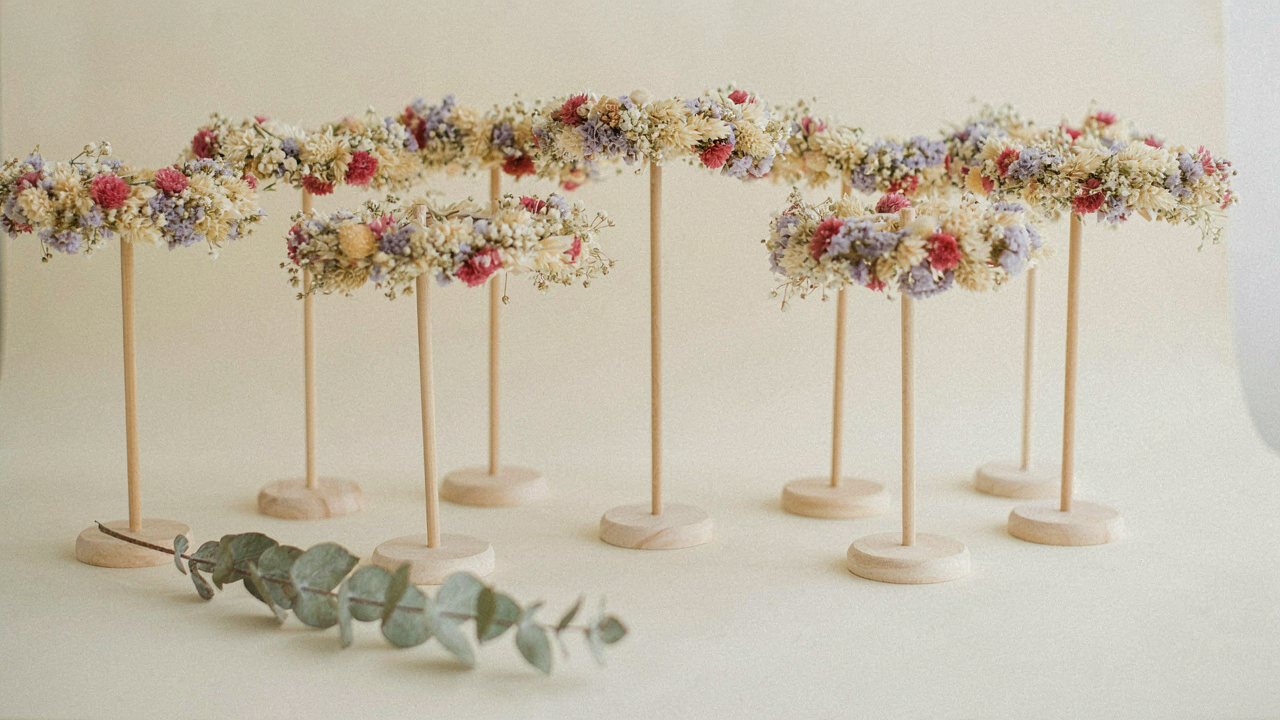
The Faux Fresh Fallacy: Why Dried Flower Crowns Outlast Trends

Dried Flowers Aren’t The Backup Plan
You want the crown to look fresh because you’re afraid guests will judge it as cheap or sad. That’s the real tension. Here’s what actually happens: dried flowers possess superior structural integrity compared to fresh blooms. Fresh petals wilt because cell walls collapse when water evaporates. Dried petals have already surrendered moisture, so they maintain shape indefinitely. The mechanism is simple physics. Dried flowers don’t deteriorate faster than fresh ones do in hours. They outlast fresh flowers by months or years under normal conditions. This flips the entire value proposition. You’re not settling for dried. You’re choosing permanence over fragility.
Fresh flowers demand refrigeration, humidity control, and precise timing. Miss the window by six hours and the crown crumbles before the event ends. Dried flowers ignore these constraints entirely. They perform the same at room temperature, outdoors in wind, under stage lights, or in climate-controlled venues. No special handling required. The perception that dried equals inferior comes from florist marketing that needed to preserve demand for fresh inventory. That narrative has no basis in material reality. Dried flowers are the engineering solution. They’re what you choose when reliability matters more than the lie of freshness.
Permanence Changes What You Design For
In systems design, we call this “designing for failure modes.” With dried flower crowns, the failure mode isn’t decay during the event. It’s relevance after the event ends. Fresh crowns photograph well for four hours then disappear into compost. Dried crowns photograph well on day one and still exist intact six months later. This shifts the entire design calculus. You’re no longer building for a single-use moment. You’re building an artifact that holds value across time.
This changes material selection, color choices, and construction technique. With fresh flowers, bold saturated colors fade within hours, so intensity doesn’t matter. With dried flowers, you choose muted earth tones and pastels because they remain stable and don’t look garish after months of display. You select flowers for their dried appearance, not their fresh appearance. Hydrangea, rice flower, and statice hold color accuracy across the drying process. Roses and ranunculus shift tone significantly. The design principle becomes: build for the final state, not the first state. Measure success not by how the crown looks at minute one, but by whether someone keeps it displayed three years later.
The Alchemist’s Arsenal: Curating Your Dried Flower Crown Palette
Beyond Roses: Unexpected Botanicals For Texture
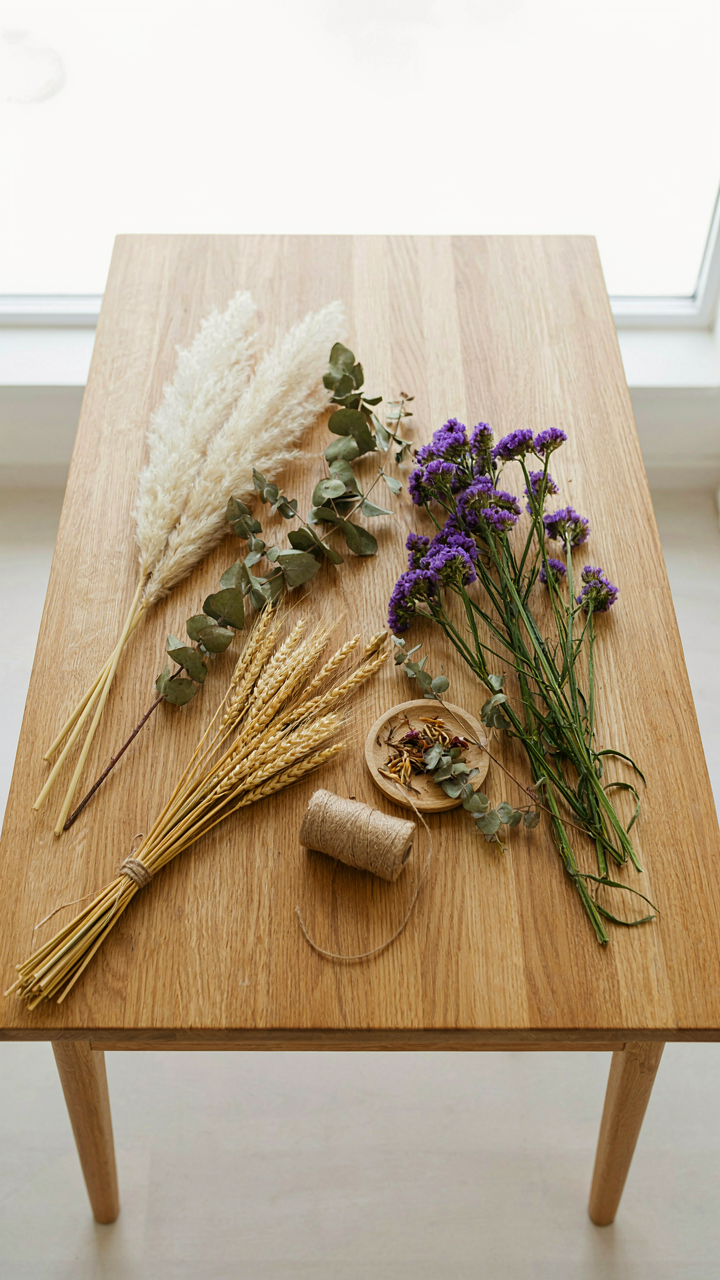
You want this crown to signal taste. Here’s what actually matters: texture creates visual weight and perceived value faster than color does. Most people stack roses and call it done because roses are easy to source and dry predictably. They’re also forgettable. The mechanism that separates a basic crown from one people photograph is contrast in form, not just hue.
Wheat stalks, pampas grass, and eucalyptus pods introduce architectural elements that roses cannot. Statice (limonium) dries into thin, papery clusters that catch light differently than flower heads. Protea and thistle heads have geometric density that reads as intentional rather than assembled. The dried seed heads of allium and delphinium add negative space, letting the eye move through the crown instead of stopping at a wall of petals. Source these from specialty dried flower suppliers rather than generic florists, because generic florists don’t stock them consistently.
Muted Tones, Strategic Pops: The Real Color Rule
Color theory from painting applies directly here: analogous palettes (colors next to each other on the wheel) create harmony, while complementary accents create focus. Most dried flower advice says “use muted tones exclusively” because dried flowers lose saturation naturally. That’s incomplete. Muted doesn’t mean flat. A base of cream, sage, and taupe with a single deep burgundy or mustard accent functions like negative space in design. It makes the viewer’s eye land exactly where you want it.
Dried flowers in cream and blush tones dominate because they’re safe and versatile. But this safety is exactly why they fail to register as distinctive. Introduce one concentrated color—dried red roses, rust-toned wheat, deep purple statice—positioned strategically around the front or one side. This isn’t decoration; it’s contrast management. Without it, the crown reads as texture alone. The accent color is what makes the viewer’s brain classify it as “designed” rather than “assembled.”
The “Everbloom” Protocol: Preserving Your Dried Flower Crown’s Integrity
How Flowers Actually Dry Without Falling Apart
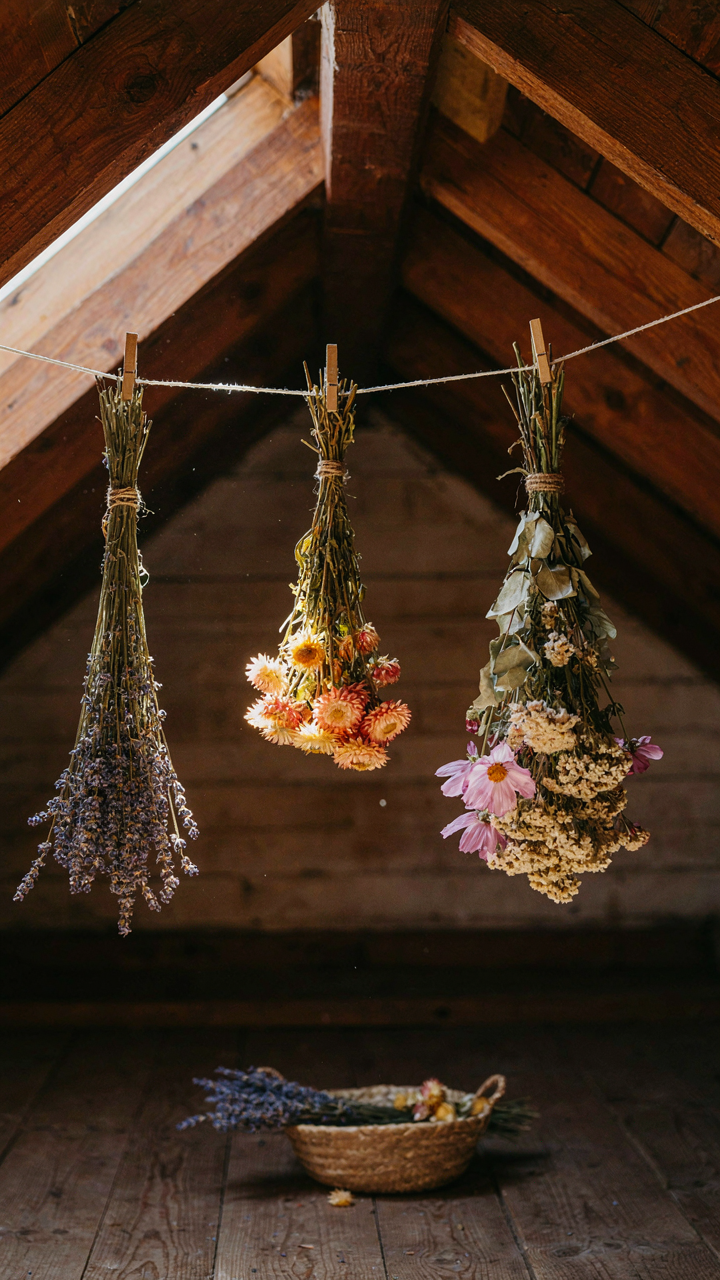
You want your crown to last because you paid for it or spent hours building it, and watching it crumble feels like waste. The mechanism here is moisture removal without structural collapse. Flowers dry through evaporation, but speed matters more than most people realize. Fast drying locks petals in place before they wilt and curl. Slow drying causes petals to contract unevenly, creating weak points where they separate from stems.
Air circulation is the primary variable. Hang flowers upside down in a dark, warm space with consistent airflow. Temperature between 65-75 degrees Fahrenheit with 20-30 percent humidity creates ideal conditions. Direct sunlight bleaches pigment and makes petals brittle. Darkness preserves color while drying happens steadily. Silica gel accelerates the process for delicate blooms but risks over-brittleness if left too long.
Climate Control Determines Crown Lifespan
Storage beats preservation in terms of actual lifespan extension. Think in biological terms: your dried crown is a dormant system vulnerable to three threats. Humidity rehydrates flowers and triggers mold growth. Light fades color and degrades petal structure through oxidation. Pests like beetles and moths eat dried plant material as food.
Store your crown in an airtight container in a cool, dark closet away from exterior walls where humidity accumulates. Silica gel packets inside the container absorb residual moisture continuously. Check the container monthly for signs of pest entry or moisture buildup. Never store near heating vents, windows, or bathrooms. A sealed plastic bin with desiccant packets kept in a temperature-stable interior closet preserves a dried flower crown for 1-2 years with minimal degradation.
Deconstructing The Dried Flower Crown Wedding: Beyond The Aisle
The Crown As Artifact, Not Accessory
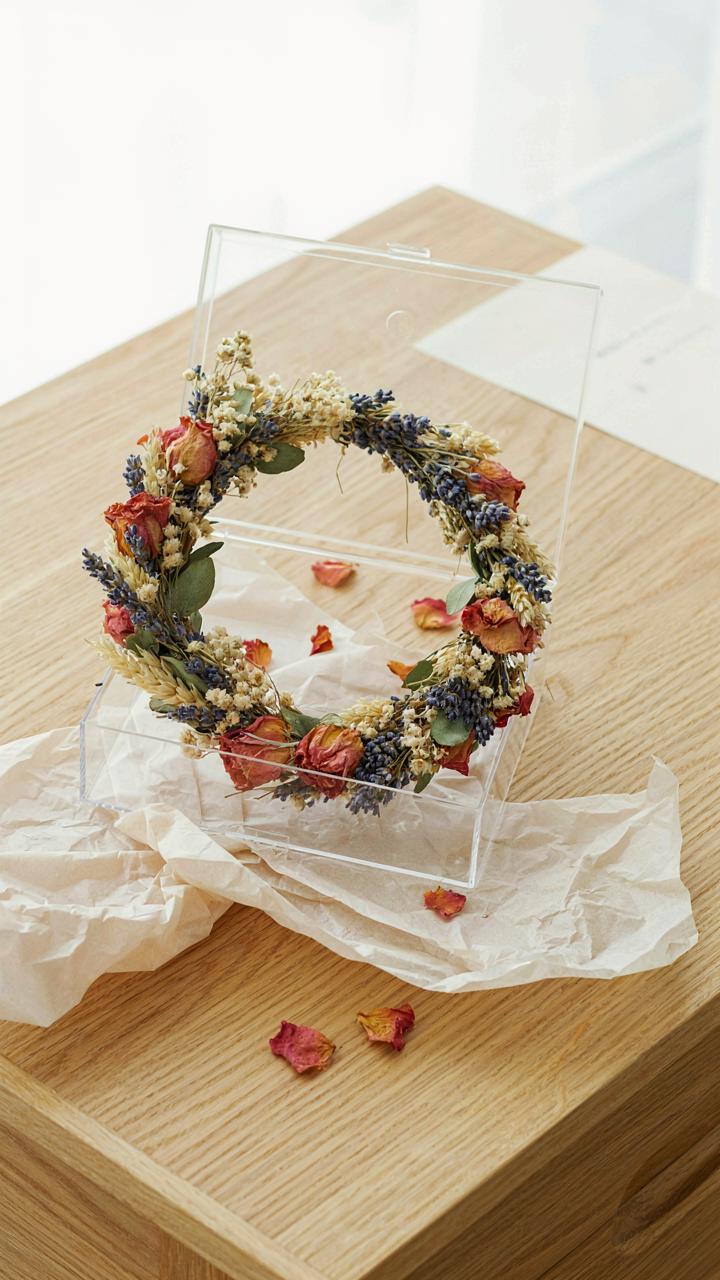
You want proof the day mattered. A dried flower crown sitting on your shelf is that proof. Most wedding advice treats the crown as disposable theater, something to photograph and discard. Wrong. The mechanism here borrows from conservation biology: the idea of “artifact preservation.” A living crown dies in hours. A dried crown becomes an object with durability, capable of holding its form for years if stored correctly. This shifts the crown from consumable to heirloom.
The practical difference is structural. Fresh flowers release moisture and collapse. Dried flowers have already surrendered their water content, so their shape locks into place. You can store a dried flower crown flat in a box with acid-free tissue, kept away from direct sunlight and humidity swings, and retrieve it five years later with minimal deterioration. This is why some couples commission dried crowns specifically for weddings now, rather than ordering fresh and hoping for a photo. The crown becomes the keepsake the bouquet never was.
Display And Repurposed Function
Stop thinking of post-wedding decor as something separate from the crown itself. The crown’s second life starts the moment you decide what wall it lives on. Museums use display cases for a reason: environment control extends object life. But you don’t need a case. You need a space away from heating vents, bathroom moisture, and direct sun. Many couples frame their crown under glass or place it in a shadowbox, which protects it while keeping it visible. This isn’t decoration masquerading as preservation. It’s preservation that doubles as decoration.
Beyond framing, dried flower crowns work as table centerpieces for anniversary dinners, backdrop props for photo shoots, or even elements in other craft projects. Some people carefully disassemble the crown and repurpose individual flower clusters into smaller arrangements or jewelry. The crown doesn’t have a fixed endpoint. It has multiple endpoints depending on when you decide to use or transform it. The only requirement is this: document what you have while it’s intact, with photos and notes on the flowers used, so future decisions about the crown aren’t guesses.
The Structural Integrity System For Dried Flower Crowns
How Nature Engineers Durability
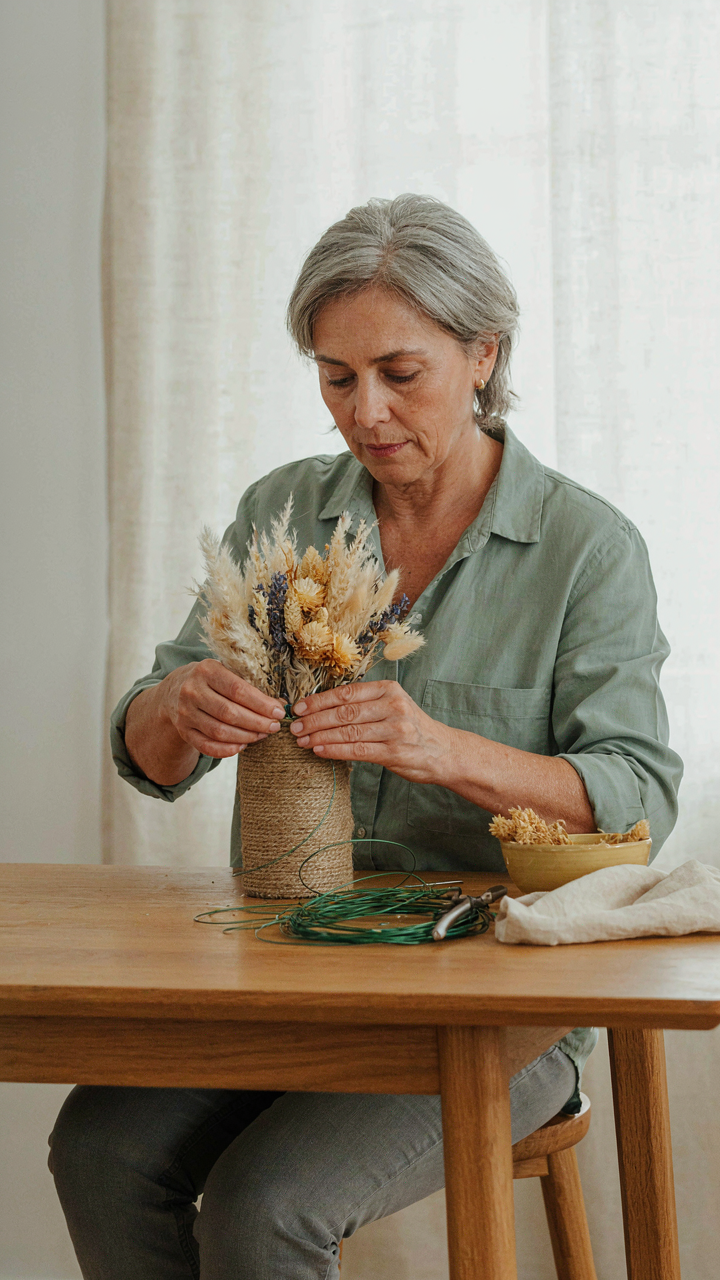
You want your crown to survive the event without falling apart, and that means borrowing from biology. Nature solves the load-bearing problem through distributed stress, not centralized points of failure. A tree doesn’t hang all its weight from one branch. A dried flower crown works the same way: the structure succeeds when you spread tension and compression across multiple anchor points rather than relying on a single wire or base to hold everything up. The moment you load all pressure onto one path, the crown fails.
Look at how a branch network functions. Primary stems connect to secondary stems, which connect to tertiary branches. Each level shares the load. Build your crown base using a graduated approach: start with a thicker, structural wire gauge at the foundation, then step down to thinner wire as you layer flowers away from the center. This mimics how nature distributes force. The base carries weight. The middle sections manage tension. The outer petals handle minimal stress. Your crown survives because nothing is overloaded.
Material Selection Determines Lifespan
Most advice about dried flower crowns ignores material science entirely, and that’s why crowns collapse. The reality is mechanical: wire gauge, adhesive chemistry, and reinforcement type directly control whether a crown lasts three hours or three months. Florist wire comes in gauges 20, 22, 24, and 26. Thinner gauges (26) flex too easily under flower weight. Thicker gauges (18-20) stay rigid but become visible and harder to bend into curves. The sweet spot for most crown work is 22 gauge: strong enough to hold dried stems without buckling, thin enough to wrap without kinking.
Adhesive selection matters more than florists admit. Hot glue bonds fast but fails under humidity and temperature shifts. Floral adhesive (the tacky putty type) holds dried material longer because it cures to a flexible state rather than brittle. For reinforcement, wrap wire-wrapped stems with floral tape before adding glue. The tape seals the stem end, preventing moisture absorption that weakens the connection. Combine these three elements and the crown doesn’t just look good at the ceremony, it survives transport, humidity, and handling without structural collapse.
Fleurs Séchées For The Bold: Statement Dried Flower Headpiece Designs
When Imbalance Becomes The Point
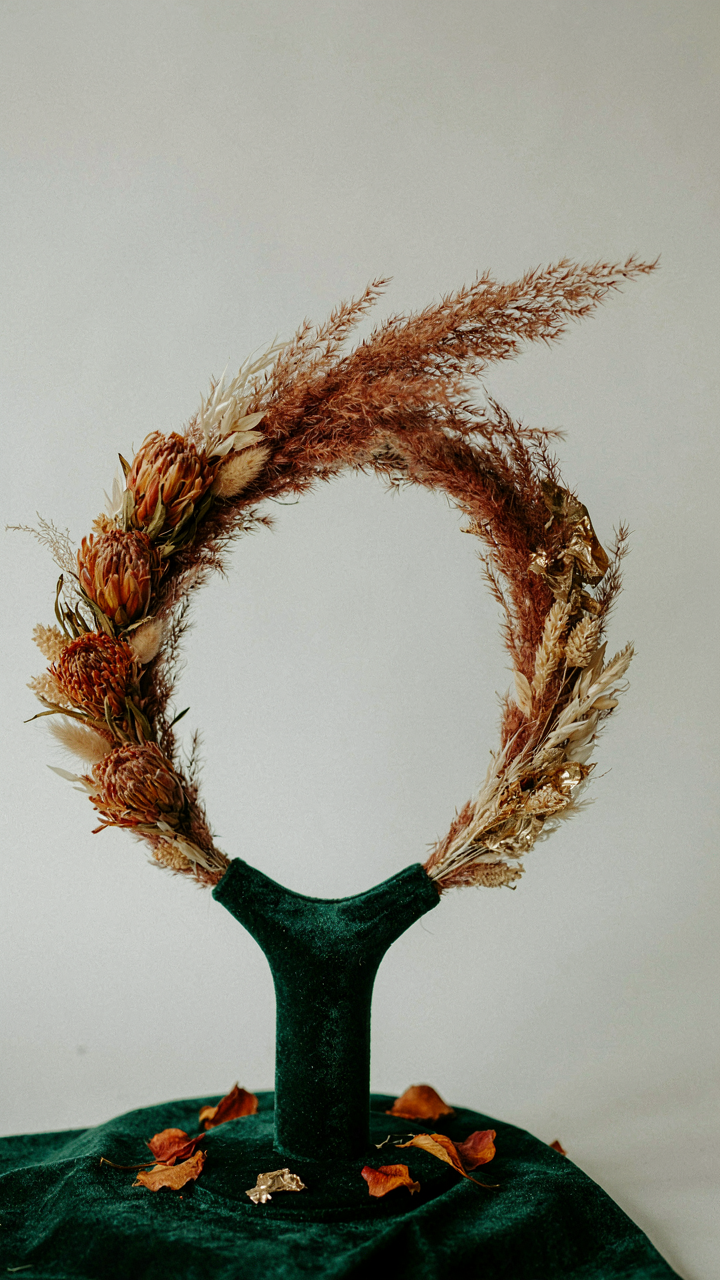
You want people to remember you wore it, not just that you wore flowers. The real mechanism here borrows from visual hierarchy in design: viewers’ eyes move first to the heaviest element. In dried flower crowns, most makers distribute blooms evenly around the head. That’s the consensus move. It’s also invisible. Asymmetry forces the eye to work, which means the crown registers as intentional rather than decorative.
Place your largest, darkest dried blooms on one side—pampas plumes, rust-toned roses, or structural seed pods. Leave the opposite side sparse or build it upward rather than outward. The imbalance makes the piece read as architectural instead of floral. Scale matters alongside placement: a single oversized element (a 4-inch dried hydrangea cluster or a tall thistle stem) commands attention more effectively than ten small blooms scattered evenly. This is contrast working. Your eye knows the difference between “pretty” and “deliberate.”
Metal, Glass, And Texture Breaking
Dried flowers alone create a predictable aesthetic—soft, romantic, historical. Adding metallics or jewels doesn’t soften this; it sharpens it. Gold-plated wire threading through the crown base, copper-wrapped stems, or thin brass elements act as visual breaks. They force dried botanicals into a different category: contemporary rather than nostalgic.
Incorporate jewels by securing them directly to the crown base with florist wire or floral adhesive, not by gluing them to petals. Feathers (real pheasant, ostrich, or peacock) add height without weight, creating depth the flowers alone cannot. These elements work because they contradict expectation: we don’t anticipate metal and glass among dried petals. That contradiction is what makes the crown register as bold rather than safe.
The Flower Crown Hairstyle Paradox: Styling With Dried Flowers
Anchoring The Crown: Securing Dried Blooms Without Damage
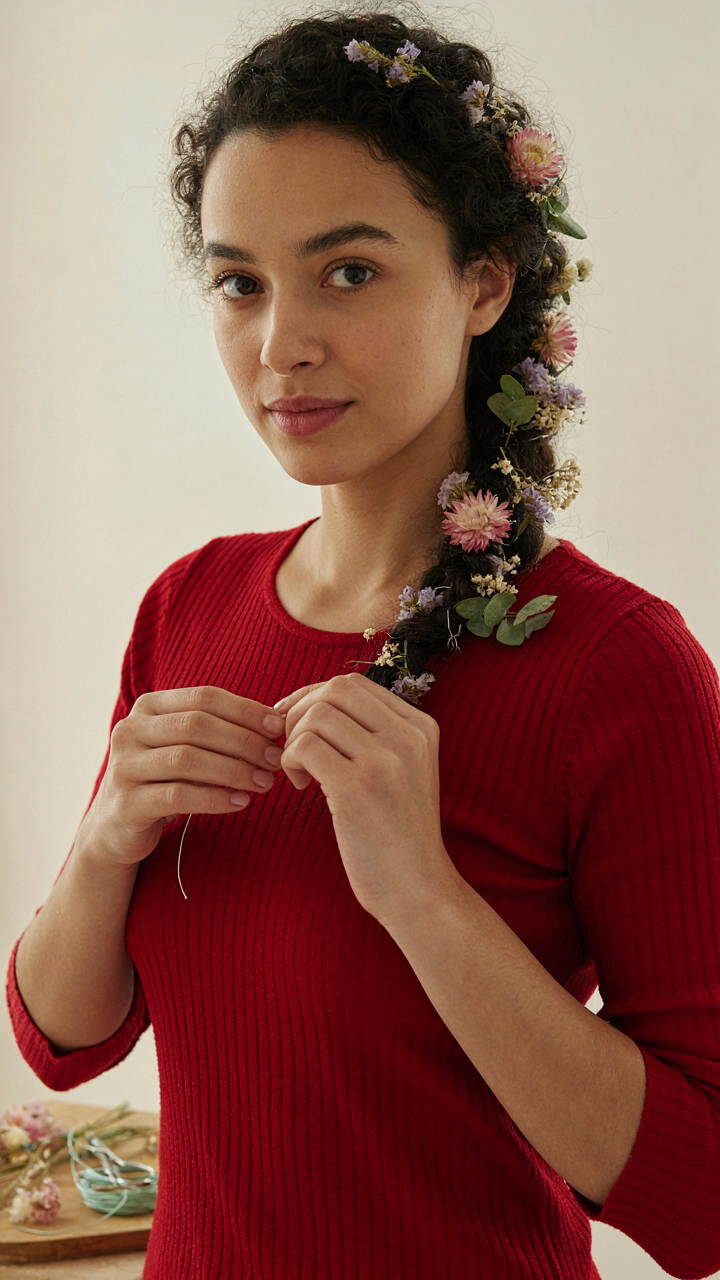
You want the crown to stay put without looking like you’re wearing a helmet. The mechanism everyone misses: dried flowers are brittle because they’ve lost water weight, which means they fracture under tension instead of bending. Treat this like materials engineering, not fashion. The crown’s stability depends on distributing force across multiple anchor points rather than clamping down hard in one spot.
The real move is using floral wire wrapped around your existing braid or twisted sections of hair, then threading individual stems through the wire grid. Never tighten the wire itself. The wire becomes the skeleton. Your hair becomes the shock absorber. Start at the nape with a secure base wire loop, work upward in sections, and test the crown’s weight distribution as you build. If any single bloom carries more than its share of load, it will snap.
Hair Type Texture And Dried Flower Integration
Your hair texture determines how the crown sits, which determines what breaks and what doesn’t. Thick, textured hair grips the wire naturally and distributes weight better. Fine or slick hair requires a different protocol: create texture first with a light texturizing spray or braid the hair before placement so the crown has friction to hold against. Dried flowers don’t care about your aesthetic preference. They care about grip.
Don’t use bobby pins to force flowers into place. That’s the lazy answer and it crushes stems. Instead, weave stems directly through braided sections or use the wire anchoring method and let the hair’s natural texture do the work. For upswept styles, secure the crown’s base wire at the crown of your head, then tuck individual stems into the braided structure as you go. The crown stays because it’s integrated into the braid, not balanced on top of it.
Beyond The Event: The Everyday Dried Flower Crown

Casual Elegance With Dried Blooms
You want permission to wear something beautiful without an occasion, but that feels wasteful or self-indulgent. Here’s the mechanism: dried flowers solve the scarcity problem that keeps people from wearing crowns regularly. Fresh crowns last hours. Dried ones last weeks or months. That changes the math entirely. You’re not buying an event—you’re buying a wearable object that maintains its value.
The practical shift is botanical. Unlike fresh flowers that follow a decay curve, dried botanicals reach equilibrium once moisture content stabilizes. This means daily wear becomes economically rational instead of extravagant. A crown worn twice a week for eight weeks costs pennies per wear. That reframes it from luxury to utility. Most people never make this calculation.
- Minimal Stems For Lightweight Wear: Use dusty miller, baby’s breath, or pampas grass as your base instead of heavy greenery. These maintain structure without the weight that causes neck strain during extended daily use.
- Neutral Color Palettes For Outfit Matching: Earth tones like tan, cream, sage, and taupe pair with most wardrobes. This eliminates the decision friction that keeps crowns in drawers instead of on heads.
- Secured Elastic Systems Over Pins: Elastic adjusts to different head sizes and stays put through movement. Pins shift and require constant repositioning during normal activity.
- Small Scale Blooms Over Statement Pieces: Compact dried flowers like statice, celosia, or small roses create visual interest without overwhelming features during everyday interactions.
- Modular Attachment Points: Design crowns so you can swap individual stems or sections. This lets you refresh the look without replacing the entire structure each season.
The real advantage is psychological ownership. When you wear something daily, you stop thinking of it as special occasion gear. It becomes part of your visual identity. That shift is where the value lives—not in the object itself, but in how it changes your baseline behavior.
Seasonal Transitions And Design Rotation
The mistake people make is building crowns for single seasons, then abandoning them. Dried botanicals don’t follow seasonal growth cycles the way fresh flowers do. You can source the same materials year-round. The actual mechanism is color and material perception—what reads as “summer” is really just our cultural association with certain hues and textures, not botanical availability.
Winter crowns succeed when you use materials that communicate warmth through density and tone, not through bloom type. Deep burgundy celosia, rust-toned protea, and chocolate-colored solidago work November through February without feeling out of place. Spring transitions mean adding lighter materials like bleached pampas or cream-colored baby’s breath. The botanical base stays constant. You’re manipulating psychological cues, not changing materials.
Design rotation happens at the attachment points. A crown built with modular stem pockets lets you swap dried grasses in December for seed pods in March without rebuilding the infrastructure. Store materials in labeled containers sorted by color and texture. When seasons shift, pull three to four new materials and rebuild the crown in thirty minutes. This approach treats dried flower crowns as a system you iterate on, not as disposable objects you rebuild from scratch each quarter.
The Flower Crowns Investment: Value Beyond The Visual
Dried Versus Fresh: The Real Math
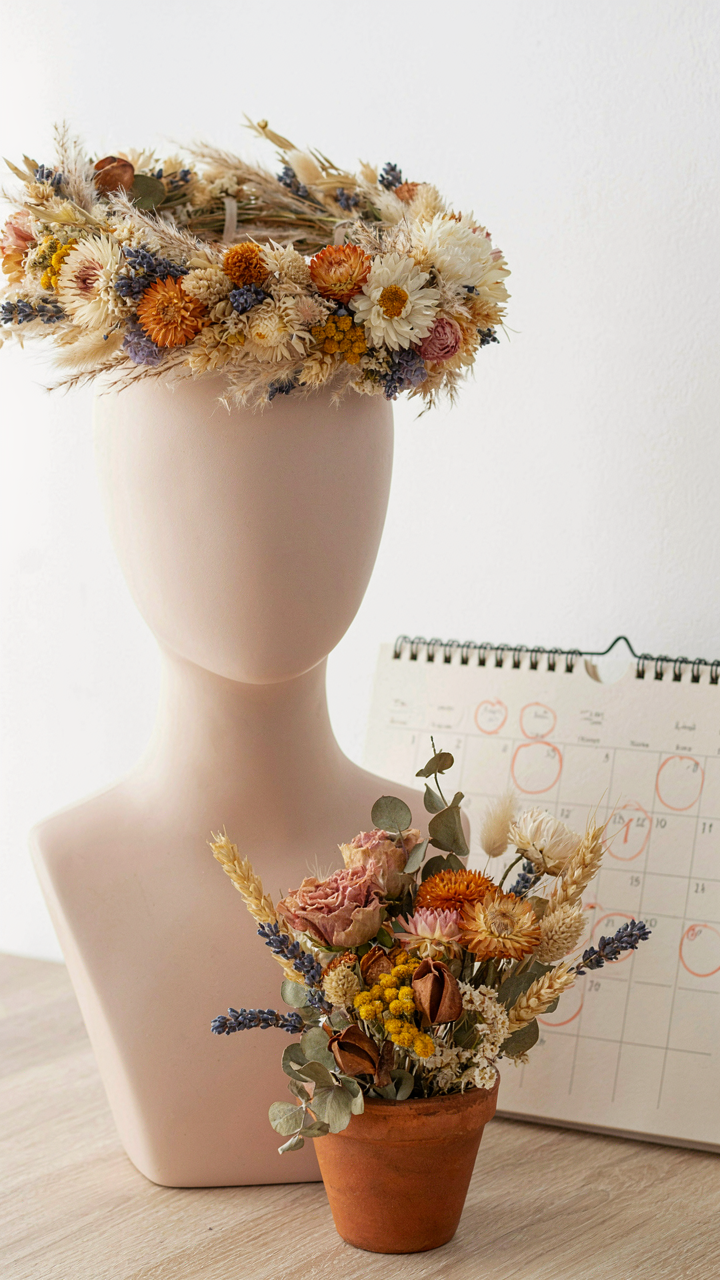
You want to know if a dried flower crown is cheaper so you can feel smart about your purchase decision. Here’s the mechanism: economics calls this the total cost of ownership, and dried crowns win because they compress all expenses into one upfront payment while fresh flowers bleed money across replacement cycles.
A fresh crown costs less initially but dies in three to five days. A dried crown costs thirty to fifty percent more upfront but lasts months or years without degradation. For a wedding, birthday, or photoshoot requiring multiple wears or extended display, dried breaks even within two uses. The math gets worse for fresh when you factor in storage, refrigeration, and the labor of sourcing replacement stems.
The Lasting Piece Calculus
Dried flower crowns hold sentimental value because they don’t disappear. Most people underestimate this: a physical object you can touch and store becomes a reference point for memory in ways a photograph never does. That matters neurologically, not just emotionally.
The mechanism is simple. You wear it, you photograph it, it remains unchanged. Years later you pull it from storage and the crown triggers the full sensory recall of that day because the object itself hasn’t changed. Fresh flowers decompose and vanish, which forces you to rely entirely on photographs. A dried crown becomes a compressed time capsule you can hold in your hands.
The Craft Of The Enduring Dried Flower Crown

Wire Work And Floral Tape Fundamentals
You want this thing to survive the event without collapsing. That’s the real concern underneath the aesthetics. The mechanism is simple: structural integrity depends on how you distribute weight and anchor tension points. Florists treat wire work like engineering treats load paths. Your crown needs a base wire that doesn’t flex under the weight of dried material, and secondary wires that lock each flower stem in place without crushing it.
- 18-gauge floral wire for the base: Rigid enough to hold shape through handling and movement. Bend into a circle slightly larger than the wearer’s head, then overlap and tape the join for redundancy.
- Floral tape application method: Wrap at 45-degree angles around wire and stem joints. This creates mechanical grip, not just adhesion. Overlap each wrap by half the tape width for continuous reinforcement.
- Stem wrapping protocol: Cut dried stems to 1.5 to 2 inches. Wrap each individually with floral tape before inserting into the base. This prevents the dried material from splintering and losing structural contact with the wire.
- Cross-bracing technique: Use 24-gauge wire to create perpendicular supports between base wire segments. This distributes load across multiple points instead of concentrating stress at attachment zones.
- Test tension before assembly: Gently tug each secured stem. It should resist movement without the dried material compressing. If it shifts, re-tape and add a secondary anchor point with finer gauge wire.
The difference between a crown that holds together and one that sheds petals by the second dance is how you treat tape. Most people wrap once and call it done. Proper technique means anchoring the base first, then layering reinforcement at every joint where dried material meets wire. This transforms the crown from a decorative object into a load-bearing structure.
Sealing And Finishing For Longevity
Dried flowers break down under humidity and UV exposure. Sealants slow this process, but the most effective approach involves controlling environment, not just coating material. Matte varnish or floral sealant spray applied in thin layers creates a protective barrier without adding visible shine that contradicts the dried aesthetic. One heavy coat fails because it cracks and peels. Multiple thin applications bond properly to the flower surface.
Apply sealant in a well-ventilated space at room temperature, holding the spray 8 to 10 inches from the crown. Let each layer dry completely before applying the next, typically 2 to 3 hours between coats. Two to three coats provide adequate protection for a single-event crown. For heirloom preservation, add a fourth coat after the crown is fully assembled. This seals the tape joints and wire connections where moisture enters. Store the finished crown in a cool, dry place in a sealed container with silica packets to absorb ambient moisture and extend viability beyond the initial event.
The Real Obstacle Isn’t Finding Creative Dried Flower Crown Ideas; It’s Your Addiction To Novelty Over Lasting Impact

You’ll chase trends forever if you keep treating dried flower crowns like disposable content. Stop scrolling for the next idea. Pick one design that actually matches who you are, commit to mastering it, and use it repeatedly until it becomes your signature. The people who build real recognition aren’t the ones chasing every new aesthetic. They’re the ones who obsess over one thing until it becomes unmistakable. Your dried flower crown doesn’t need to be different every time. It needs to be you every single time.



