

The Environmental Fortification Protocol For Dried Flowers
Control Humidity Before It Controls You
You want dried flowers to last because throwing money away feels worse than admitting you need help with home décor. Here’s the mechanism: humidity rehydrates the plant material, which triggers mold growth and bacterial decay. This is basic thermodynamics—moisture always moves toward equilibrium. Your dried flowers exist in a state of suspended decomposition. Humidity disrupts that suspension.
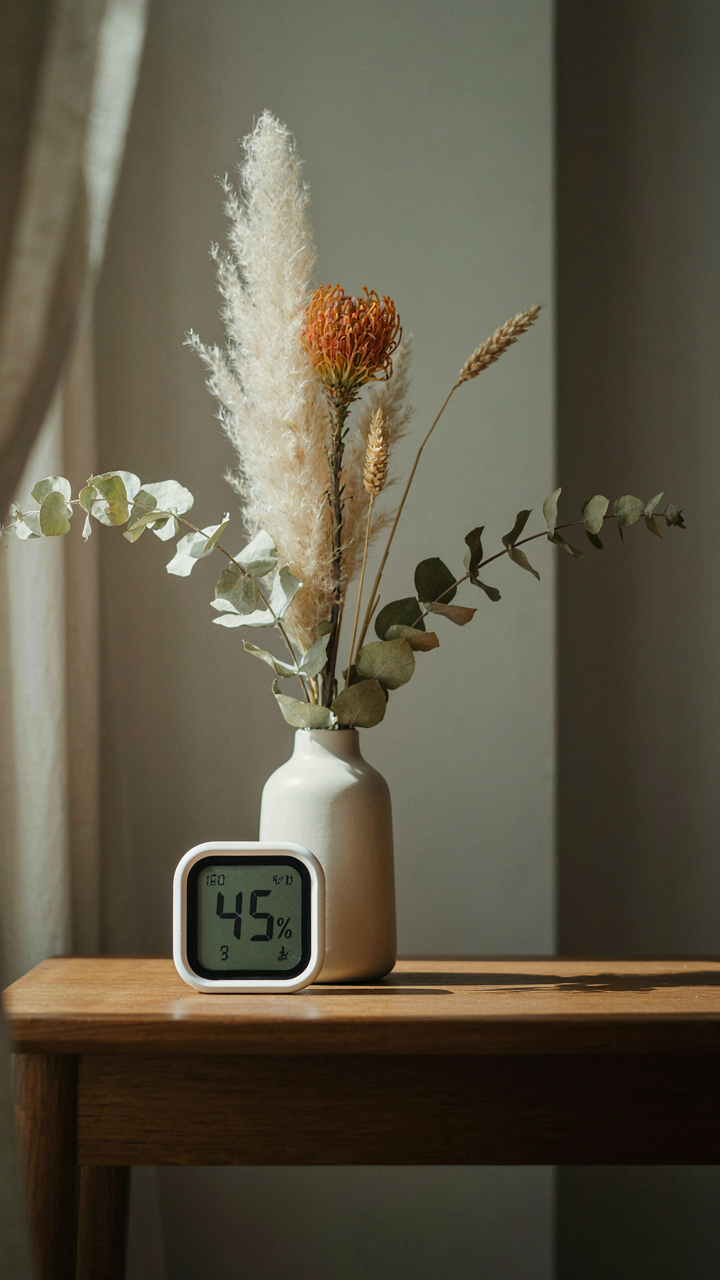
Keep your space below 50% relative humidity. Most homes sit between 40-60%, which means your dried arrangement is already under pressure. A cheap hygrometer costs twelve dollars and tells you the actual number, not your guess. If humidity climbs above 55%, the arrangement degrades faster than you’ll notice until it’s already ruined. Store dried flowers away from bathrooms, kitchens, and humidifiers. These are decay zones masquerading as normal rooms.
Strategic Placement Defeats Light Damage
Sunlight doesn’t just fade dried flowers—it accelerates the brittleness process. UV radiation breaks down the cellulose structure that gives stems their integrity. Think of it like material science: the same wavelengths that bleach your furniture weaken the botanical tissue. Direct sun doesn’t kill dried flowers instantly, but it turns them fragile and colorless over months.
Position your arrangement in a room that gets indirect natural light or stays mostly shaded. East-facing windows work better than south or west-facing ones because morning sun is weaker. If your best display spot catches afternoon light, use a sheer curtain to diffuse it. Avoid heat sources—radiators, vents, and sunny windowsills create temperature fluctuations that crack stems and petals. The goal is stable, dim conditions that preserve structure indefinitely.
Beyond Hangers: True Drying Methods For Dried Floral
Air Drying: The Passive Preservation
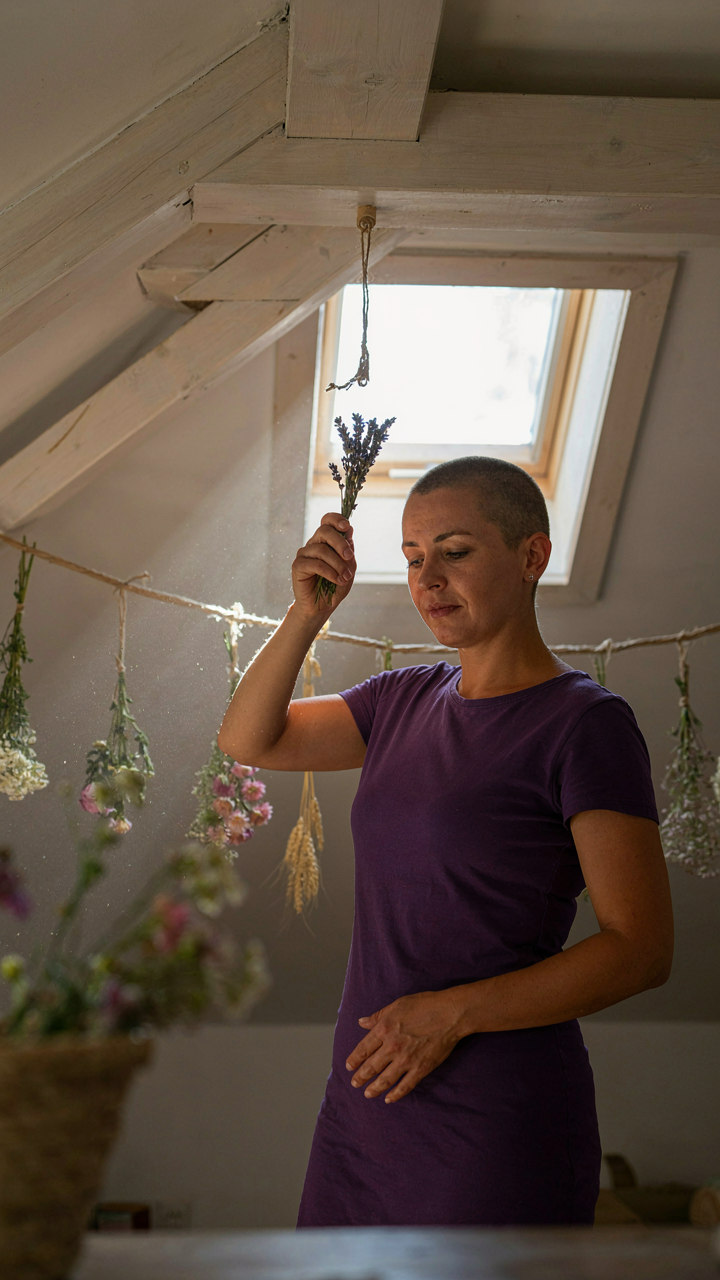
You want dried flowers to look intentional, not like you forgot them in a vase. That’s the real concern here. Air drying works because evaporation is a physics problem. Water moves from the flower into surrounding air through vapor pressure difference. Humidity, airflow, and temperature control this rate. Most people hang flowers upside down and assume that’s the method. It’s not. The hanging position matters far less than the environment itself.
The mechanism requires three non-negotiable conditions: low humidity below 60 percent, consistent airflow without direct sunlight, and stable temperature around 60 to 75 degrees Fahrenheit. Dark spaces preserve color better than light. Group flowers loosely so air reaches all sides, not in tight bunches where moisture gets trapped and rot accelerates. This takes ten to fourteen days depending on stem thickness and petal density. You’re not drying flowers by hanging them. You’re drying them by controlling the air around them.
Silica Gel: Accelerating Preservation, Maintaining Form
Silica gel is a desiccant, meaning it absorbs moisture through physical adsorption. Chemistry borrows this term from material science: adsorption bonds molecules to a surface, not inside it. Silica gel does this aggressively. It pulls water directly from petals and maintains structural integrity that air drying cannot match. The trade-off is cost and reusability. One container of silica gel runs fifteen to thirty dollars but lasts through multiple batches if you regenerate it in an oven.
The process works like this: layer silica gel in an airtight container, place flowers face-up or sideways, cover completely with more gel, seal the lid. Leave it for three to seven days depending on flower size and thickness. Check daily starting day two. Over-drying in silica gel makes petals brittle, so timing precision matters. Once dry, store in an airtight container with fresh silica packets to prevent reabsorption of moisture from the air.
The Dust Aversion Principle For Your Flowers Bouquet
How To Clean Without Destroying Structure
You want your bouquet to look untouched, like you didn’t have to do any work. That’s the real reason you’re reading this. Here’s the mechanism: dried flowers lose structural integrity the moment you apply force. Treat cleaning like museum conservation, not household tidying. The goal is particle removal without contact damage.
A soft-bristled brush or natural horsehair works because the bristles are fine enough to dislodge dust without snapping stems or petals. Move the brush in one direction, following the flower’s natural grain. Never brush against the lay of the petals. A compressed air can works faster but requires distance—hold it six inches away minimum to prevent the pressure from collapsing delicate blooms. Both methods work. Choose based on your bouquet’s fragility.
Creating Physical Barriers Against Particles
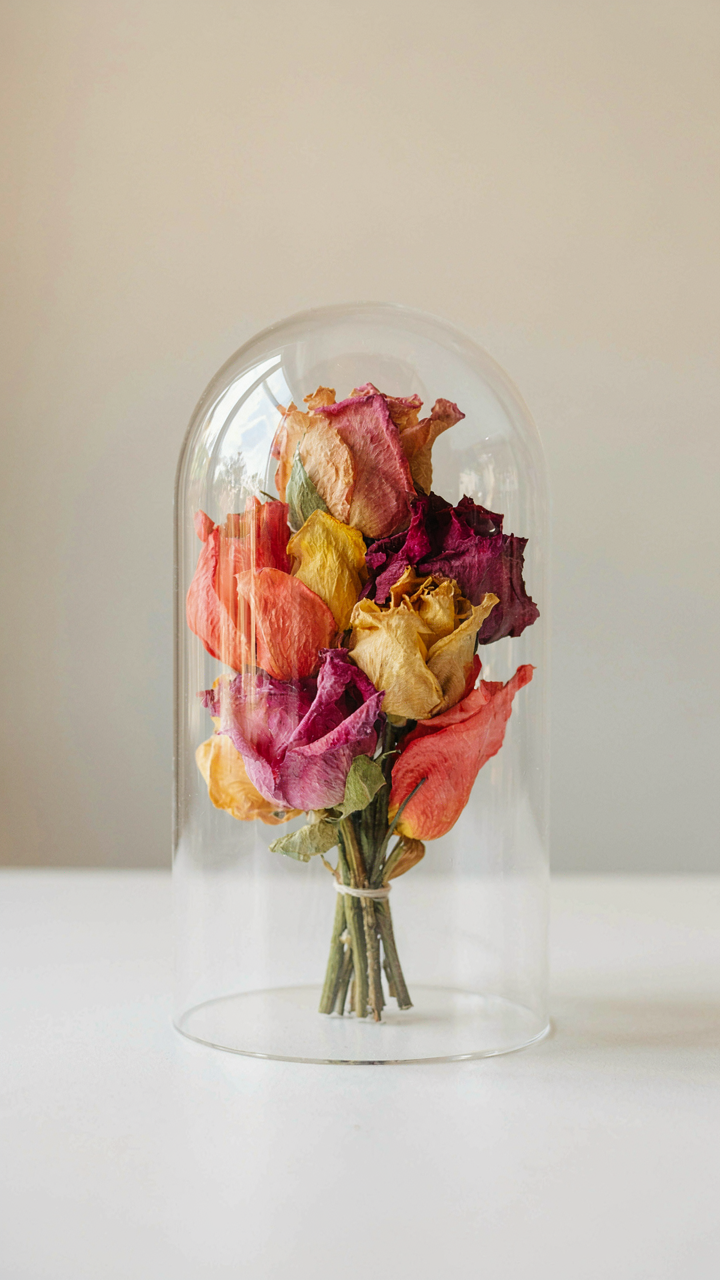
The real problem with dust isn’t that it lands on flowers. It’s that you’ll keep trying to remove it, which causes cumulative damage. Glass display cases eliminate the need for cleaning entirely. They’re not just decorative—they’re preventative infrastructure. A closed case stops dust penetration before it happens, which beats any cleaning protocol.
If a case isn’t practical, use a clear acrylic dome or bell jar. Position the bouquet away from air vents, ceiling fans, and high-traffic areas where air circulation churns up particles. Keep the display at least three feet from open windows. Light-filtering fabric draped nearby can also reduce dust migration without blocking the view. The mechanism is simple: fewer particles reaching the flowers means fewer cleaning cycles, which means your arrangement stays intact longer.
The Structural Integrity Method: How To Preserve Flowers

When Water Leaves, Collapse Begins
You want dried flowers to look like they did fresh. That’s not happening. Physics doesn’t negotiate. When flowers desiccate, they lose cellular water content, and the cell walls that held rigidity cave inward. Think of it like tensile strength in materials engineering: the flower’s structural capacity drops as moisture exits. Fresh flowers maintain shape through turgor pressure. Dried flowers must compensate through reinforcement, not denial.
The drying method you choose determines collapse rate. Air drying works because it’s slow enough that cell walls contract evenly. Silica gel accelerates water removal, which sounds good until petals shatter from the speed differential between interior and exterior layers. Microwave drying is faster still, which is why it’s a shortcut that wrecks delicate specimens. Accept that preservation trades perfection for longevity.
Anchor Points That Actually Hold
Stop wrapping stems in floral tape and calling it protection. That’s cosmetic, not structural. Real reinforcement happens at the three failure zones: the stem base where it bends, the joint where petals attach to the receptacle, and anywhere a branch intersects the main stem. Use floral wire inserted at these points before drying starts, not after. The wire gives the dried tissue something rigid to grip as it shrinks.
The diameter of your wire matters. Too thin and it provides no real support. Too thick and you split the stem during insertion. Gauge 22 or 24 works for most bouquets. Insert the wire straight up through the stem during the drying phase, when tissue is still pliable enough to accept it without crushing. Once fully desiccated, you’re fighting against brittleness and risking breakage. Timing here determines whether your bouquet lasts a year or shatters in six months.
Avoiding The “Trendy” Traps In Dried Flower Bouquet Care

The Spray Myth That Sells
You want a shortcut because maintenance feels like failure. Here’s the mechanism: companies market preservative sprays as essential because they’re profitable, not because dried flowers need them. Dried flowers are already dead plant material. They don’t absorb water or nutrients. A spray doesn’t reverse decay, it masks dust temporarily and creates a false sense of control.
The industry pushes these products hard because they’re consumable. You buy them repeatedly. What actually preserves dried flowers costs nothing: low humidity, indirect light, and stillness. If your environment has moisture creeping in, a spray won’t save you. Fix the environment instead. That’s the real work, and it doesn’t generate recurring revenue.
Handling Causes Most Damage
Every touch is a negotiation with fragility. Think of dried flowers like a supply chain where each handling event is a point of failure risk. The more times a bouquet moves, gets arranged, gets adjusted, or gets shown off, the higher the likelihood that petals separate or stems snap. This isn’t dramatic. It’s physics applied to brittle material.
Stop rearranging your dried bouquets. Place them once and leave them. The bouquets that last years are the ones people admire from a distance, not the ones repeatedly taken apart and reconstructed. If you want the look to evolve, buy a new bouquet. Don’t use the same one as a project. Your hands are the fastest path to damage.
The Long Term Bloom: How To Make A Dried Flower Bouquet Last
Keep Them Out Of The Light
You want your dried flowers to look frozen in time forever. That’s not vanity—it’s the only logical reason to buy them instead of fresh. Here’s what nobody says plainly: light is a decay accelerator, and dried flowers are already chemically stable. UV rays strip pigment from petals and stems faster than anything else will. The mechanism is straightforward photodegradation. Your dried bouquet placed on a sunny windowsill becomes a bleached ghost in weeks.
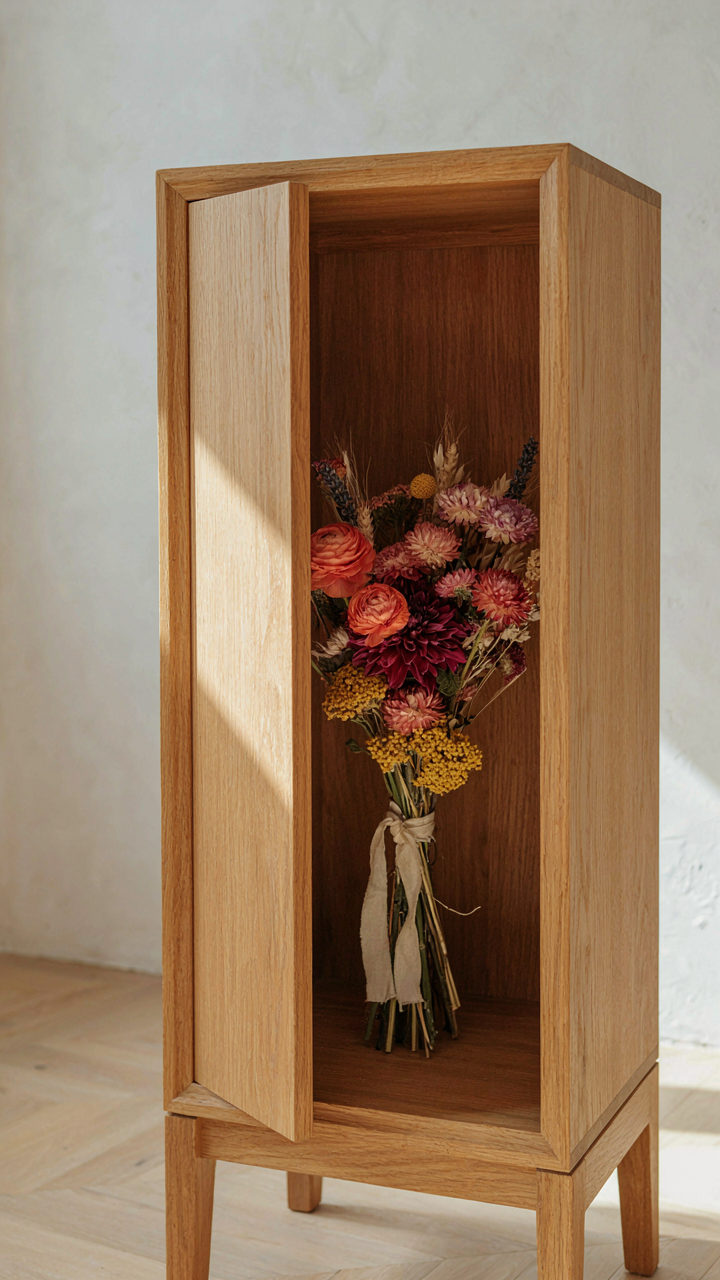
Store dried flowers away from direct sunlight in a cool, dark space between 60 and 75 degrees Fahrenheit. Humidity matters too—aim for 30 to 40 percent. Too dry and stems become brittle. Too humid and mold colonizes the flower heads. A closet, cabinet, or interior shelf works better than any decorative display location. If you want them visible, use a glass case that filters UV light or rotate them into storage after two to three weeks of display.
Break The Static Pattern
The advice to “just leave them alone” is incomplete. Dried flowers decay unevenly when they sit untouched. Gravity pulls moisture downward through the stem, settling it into the lower layers of the arrangement. Dust accumulates on the same surfaces. Parts of the bouquet age faster than others. You need a rotation strategy borrowed from how archivists preserve documents: systematic repositioning prevents localized damage.
Turn the bouquet 180 degrees every two weeks, or move it to a different room to interrupt its exposure pattern. If petals are dusty, use a soft-bristled brush—never water, never compressed air. Check the stems at the vase base for moisture or mold every three weeks. If you spot gray or black spots, remove that flower immediately and increase airflow around the arrangement. A small fan on low speed circulating air nearby extends bloom life significantly and costs nothing.
Curating Your Dried Floral Aesthetic: Beyond Preservation

The Color Trade Off
You want your dried flowers to look like they just dried yesterday, not like they’ve been sitting in your grandmother’s attic since 1987. That’s the real tension. The mechanism is simple: natural drying preserves authentic color through slow moisture loss, while artificial methods like glycerin treatment or dye alter pigment chemically but offer consistency you can’t achieve passively.
Natural drying fades flowers gradually because UV exposure and oxidation break down anthocyanins and carotenoids, the pigment compounds that make color visible. You can’t stop this. What you can do is control the speed by keeping dried arrangements away from direct sunlight and storing them in low-humidity environments. Artificial treatments bypass this entirely by replacing water with glycerin or introducing synthetic dyes pre-drying, which locks color but changes the texture and feel of petals permanently.
Structural Integrity Meets Visual Weight
Dried flowers operate under the same weight distribution principle as architecture: load-bearing elements must support mass without buckling. A top-heavy dried bouquet fails not because flowers are fragile, but because the stem structure can’t anchor the arrangement’s center of gravity. The real work isn’t preserving individual stems—it’s building a framework that balances aesthetic density with structural geometry.
- Stem Conditioning Before Arrangement: Strip lower foliage completely and wire weak stems from the base upward, creating artificial rigidity where natural strength fails.
- Mass Distribution Strategy: Place heavier, denser flower heads lower in the composition and lighter, airier elements toward the perimeter to prevent tipping.
- Support Mechanics: Use floral foam designed for dried flowers, not fresh—it’s denser and holds stems at precise angles without shifting over time.
- Visual Negative Space: Intentional gaps between clusters reduce perceived weight and prevent the arrangement from looking overcrowded or unstable.
- Stem Angle Protocol: Position stems at 45-degree angles rather than vertical; this distributes tension across the support structure instead of concentrating it at one point.
The difference between an arrangement that holds for months and one that collapses after weeks comes down to this: you’re not just placing flowers, you’re engineering a system where every stem serves as both a visual element and a structural component. Build your framework first, then layer aesthetics around it.
Resurrection Tactics: When Your Dried Flowers Need Help

Gluing Broken Stems Back Together
You want to believe your dried arrangement is salvageable because throwing money away feels like failure. Here’s the mechanism: dried plant tissue is brittle because water loss eliminates cellular flexibility. When a stem snaps, you’re not joining living cells—you’re bonding dead wood. Use floral adhesive or a thin line of hot glue applied directly to the fracture point. Press the pieces together for thirty seconds and let cure fully before handling. The joint won’t restore original strength, but it holds for display purposes.
The common advice to “use wire support” misses the real problem. Wire stabilizes a weak joint but doesn’t fix the fracture itself. Apply adhesive first to seal the break, then wire the stem below the repair point if additional support is needed. This two-step approach prevents the glued section from flexing apart. Check the repair after twenty-four hours. If the bond failed, discard that stem rather than chase a problem that won’t hold.
When To Cut Your Losses
Dried flowers degrade in linear fashion, not suddenly. Petals thin and become translucent. Stems weaken beyond repair capacity. Color fades to gray or brown. At a certain threshold, attempting resurrection wastes the arrangement’s visual integrity. The threshold differs by species and storage conditions, but the signal is consistent: if more than thirty percent of the bouquet shows advanced degradation across multiple stems, replacing those elements costs less effort than repair attempts.
Stop repairing when the repair becomes visible. A glued seam, a propped-up stem, reinforcement wire showing through—these announce failure to anyone looking. Accept that dried flowers have a functional lifespan of one to three years depending on humidity and light exposure. When that window closes, discard the arrangement and start fresh rather than maintain a deteriorating display.
Your Real Obstacle Isn’t Dried Flowers; It’s Your Impulse To Overcomplicate Simple Preservation
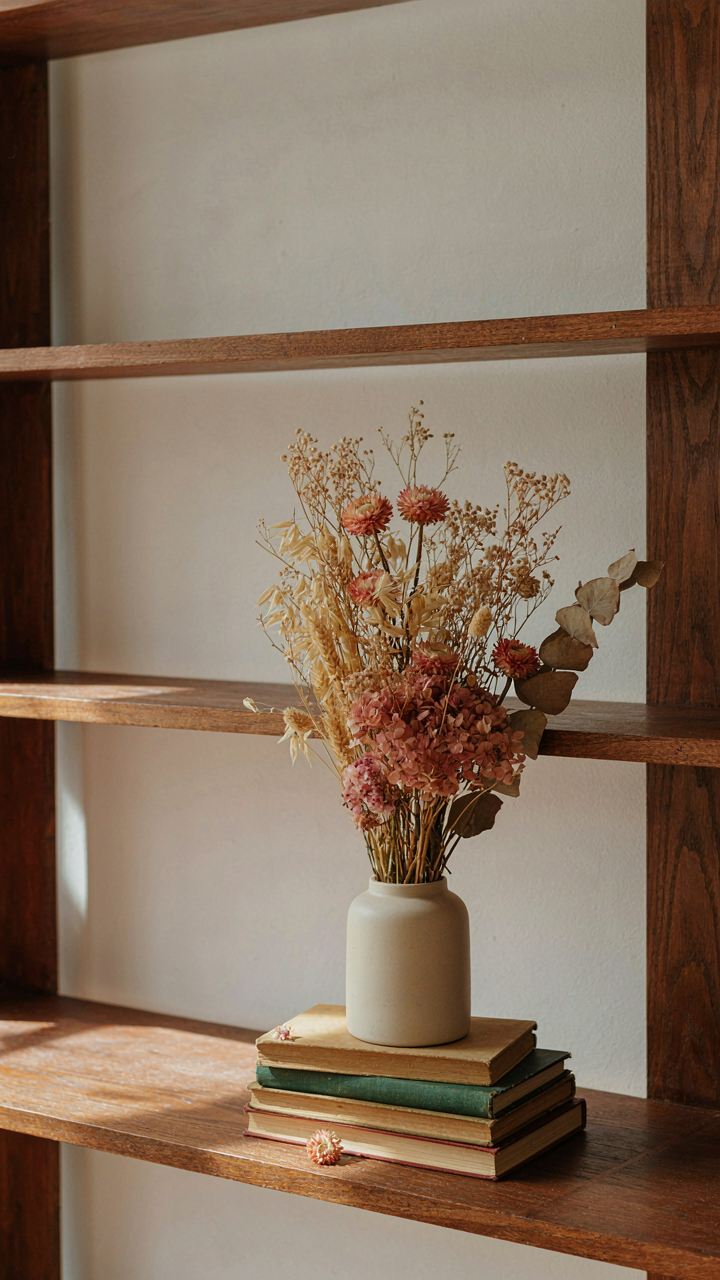
Most people kill their dried bouquets by fussing over them. You don’t need special sprays, humidity controls, or rotating displays. Stop treating preservation like a science project. Pick a dry spot away from direct sun, leave them alone, and check back in six months. The bouquets that last longest belong to people who forget about them. Your next move is simple: find one dark corner in your home today and commit to it. Neglect beats maintenance every single time.



