
The Winter Greenhouse Lie: Why Your Current Approach Fails

You’re Treating Winter Like A Smaller Summer
You want to believe winter growing works like summer growing, just dimmer. It doesn’t. Winter greenhouse gardening operates on different physics entirely. Light behaves differently. Heat retention requires different engineering. Plant metabolism shifts. Most growers chase summer results in winter conditions, then blame the season when crops fail. The real mechanism is this: winter growing demands you reverse your entire operational logic, not dial it down. Your plants aren’t dormant versions of summer plants. They’re adapted to a completely different thermodynamic environment.
Most advice tells you to “just add heat and lights.” That’s incomplete. Winter growing requires understanding photoperiod, thermal mass, and how condensation destroys your margins. You can’t copy a summer schedule onto a winter calendar and expect it to work. The greenhouse envelope matters more in winter than any single input you add to it. Weak insulation kills profitability faster than any light deficiency. Your current approach fails because you’re still thinking in summer terms, applying summer strategies to a season that demands structural and operational redesign from the ground up.
The Heating Cost Trap Nobody Names
Heating economics are inverted in winter greenhouse work compared to what most growers assume. People think the solution is “better insulation” or “more efficient heaters.” That’s backward. The real cost driver is thermal cycling, not total heat loss. Your greenhouse loses steady, predictable heat. Thermal cycling is the silent killer of your budget. When outside temperature swings 40 degrees in 24 hours, your heating system fights those oscillations constantly, burning fuel inefficiently. The mechanism everyone misses: nighttime setback creates the biggest operational cost, not daytime heating. Your heating system works hardest during the worst efficiency window—cold mornings—when you’re trying to raise temperature fast.
Infrared heaters, propane systems, and high-efficiency setups all fail the same way: they respond to swings instead of preventing them. Thermal mass stops those swings. Water barrels, concrete mass beds, and phase-change materials absorb heat during the day and release it at night. This isn’t magic. It’s physics. A greenhouse with proper thermal mass needs 30 to 50 percent less heating energy because it eliminates the cycling penalty. Your heating bill balloons when you rely on equipment to fight temperature swings instead of using materials to prevent them. Install thermal mass before you buy a heater. Everything else is just running your system at half efficiency.
Greenhouse In Winter: The Unconventional Crop Selection Protocol

Beyond Lettuce: High Value Winter Yields
You want to grow something your neighbors can’t, and you’re hoping winter greenhouse gardening gives you that edge. Here’s what actually works: winter crops have zero competition because most growers abandon their greenhouse in November. This creates a pricing and scarcity mechanism that rewards whoever shows up. Lettuce won’t move the needle. Microgreens, however, command 8 to 12 times the per-pound value of full-size greens because restaurants and specialty markets pay premium rates for concentrated flavor and nutrient density.
Asian brassicas like mizuna, tatsoi, and bok choy grow faster than lettuce in cold conditions and store longer after harvest, extending your sales window. Arugula thrives in low light and produces peppery leaves buyers specifically seek. Radishes mature in 30 days and pack themselves into compact spaces. The mechanism is simple: choose crops with existing buyer demand and a margin gap between wholesale and retail. Winter eliminates your competition. Your job is filling the supply vacuum.
Ignoring Conventional Wisdom, Maximizing Output
Everyone tells you to “grow what you love” in winter greenhouses. That’s consensus advice and it’s cost you money. Economics calls this the law of diminishing returns, and winter greenhouse gardening follows it ruthlessly. Growing cilantro because you enjoy it means competing against year-round outdoor production in warm regions. Growing it because restaurants in your region can’t source it in January means you own a market segment nobody else touches.
Track what restaurants, farmers markets, and specialty grocers actually buy in your region during winter. Then grow exactly that. Demand shapes supply in greenhouse work, not the reverse. Don’t diversify across ten crops to “test the market.” Pick three high-demand crops, master the environmental controls for each, and scale output. This concentrates your labor, reduces disease vectors, and makes your operation predictable for buyers who want consistent supply.
The Greenhouse Winter Garden Efficiency Paradox

Thermal Mass Wins Heat Retention
You want a warm greenhouse without running the heater all night because that bill terrifies you. Here’s the physics term that matters: thermal mass is the material’s capacity to absorb and release energy over time. Water, stone, and soil all function as thermal batteries inside your greenhouse. They charge during daylight hours and discharge heat after sunset, flattening the temperature swing that kills tender plants.
The common advice to “add a water barrel” misses the mechanism. You need enough mass to meaningfully shift your heating load, not just a decorative tank. A 55-gallon barrel raises the nighttime temperature by roughly 3-5 degrees Fahrenheit in a small greenhouse, depending on wall exposure and insulation. Calculate backward from your minimum nighttime temperature and add mass until the math works. Black containers absorb more solar radiation than light ones. Position them where direct winter sun hits them for maximum charge.
Photosynthesis Demands Deliberate Light Placement
Winter light is weak and angular. Most growers waste this scarce resource by treating their greenhouse like a symmetrical space instead of a strategic light capture system. Your plants photosynthesize only where usable photons actually land. Growth stops not because it’s cold but because light intensity falls below the compensation point for the species you’re growing.
Reflective surfaces multiply available light without adding equipment cost or complexity. Paint interior north-facing walls with matte white paint to bounce diffuse light back onto plants. South-facing glass needs no treatment. Position plants at angles that maximize exposure to the sun’s lower winter trajectory. This isn’t decoration or optimization at the margins. Light placement determines whether a plant survives dormancy or dies waiting for spring. Track the sun’s path through your greenhouse over one week and place your highest-value crops in the zones that receive the most direct exposure.
Winter Greenhouse Gardening: The Permaculture Integration Model

Design Your Greenhouse Like An Ecosystem
You want permaculture to sound deep because it promises you can garden without fighting nature, which feels intellectually superior to conventional methods. The mechanism is ecology’s concept of “redundancy”—building multiple pathways for energy and nutrients to flow through your system so no single failure kills everything. Your greenhouse isn’t a controlled box you manage. It’s a nested system where waste from one process feeds another, where thermal mass and airflow patterns mirror forest microclimates, and where pest pressure self-regulates through predator populations instead of chemicals.
Most gardeners treat their greenhouse as an isolated chamber. They heat it, light it, control it. Permaculture integration flips this. You design pathways—physical and biological—that let energy enter, cycle, and exit strategically. Thermal mass from water barrels or stone absorbs winter sun and releases heat at night. Perennial plants establish root systems that hold moisture. Beneficial insects overwinter in deliberate refuge areas. The greenhouse becomes a functional edge between indoor cultivation and outdoor ecology, not a sterile escape pod.
Nutrient Loops Replace The Supply Chain
Everyone knows compost recycles waste. That’s the shallow read. The real mechanism is that closed-loop systems eliminate the cost and logistics of external inputs while concentrating nutrient density where you need it. In winter greenhouse gardening, this means you’re capturing every exit point where nitrogen, phosphorus, and potassium leave the system, then redirecting it back.
Plant material stays inside. Fish waste from aquaponics feeds plants directly instead of flowing to treatment facilities. Kitchen scraps compost in a designated area where thermophilic bacteria heat the pile while you extract liquid fertilizer for active crops. Fallen leaves don’t get hauled out—they layer into beds as carbon and slow-release minerals. Worm castings from vermicompost bins become your primary amendment. The protocol is simple: map every nutrient source inside your greenhouse, route it through a processing stage, and apply it back to growing zones. No purchase orders. No delivery dates. No guessing about synthetic ratios.
Winter Greenhouse: Maximizing Space With Vertical Advantage
Tiered Planting Systems
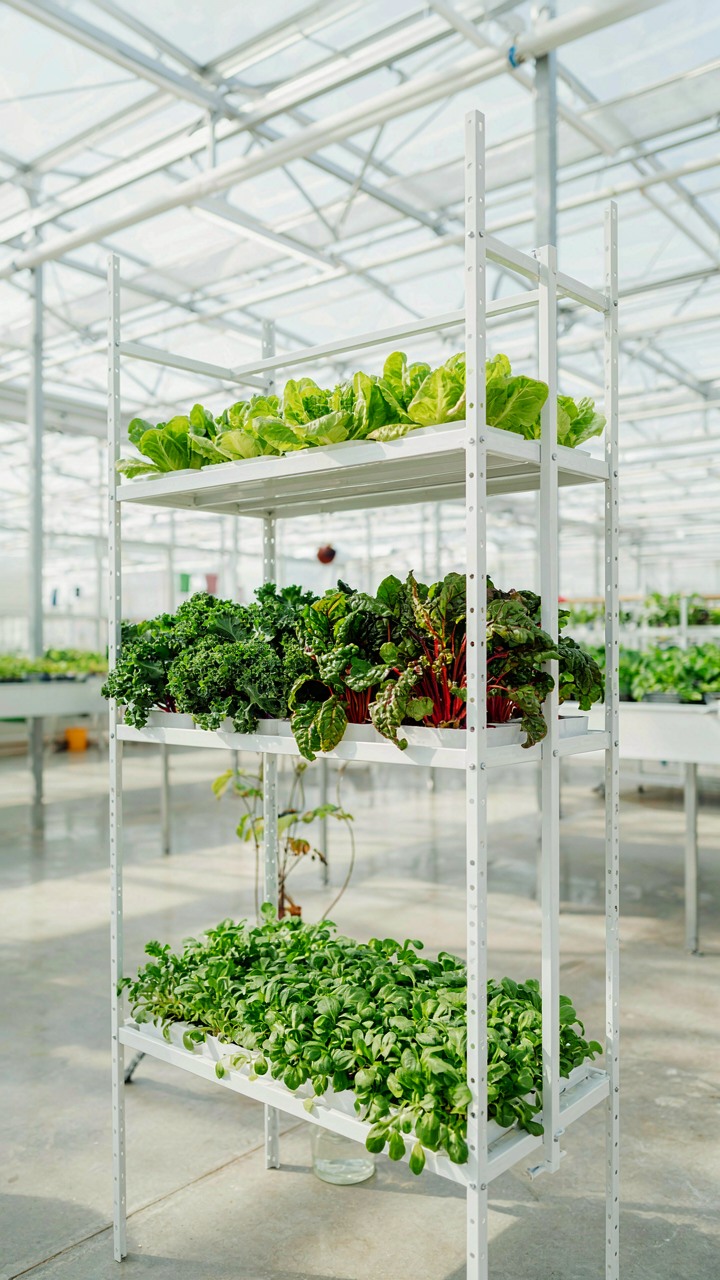
You want to feel like you’re using your greenhouse efficiently without actually doing the math on square footage and yield. Here’s the mechanism: vertical systems force you to move your light source closer to plants while distributing heat more evenly than horizontal layouts. This is basic thermodynamics applied to confined spaces. The air stratifies less aggressively when plants occupy multiple heights, and you eliminate the dead zones where nothing thrives.
Tiered systems work because they compress production into fewer linear feet. A three-tier shelf structure in a 100-square-foot greenhouse gives you roughly 300 usable growing surfaces. You need proper spacing between tiers though—typically 18 to 24 inches—to prevent top plants from shading lower ones and to allow you to move through the rows without breaking stems.
- Adjustable aluminum shelving: Modular frames let you alter heights seasonally. Winter crops like lettuces and microgreens need different clearances than spring seedlings.
- Wooden A-frame structures: Inexpensive and durable. Position plants on both sloped sides to capture light reflection from greenhouse walls.
- PVC pipe racks: Budget option that handles moisture well. Assemble quickly and move between growing cycles without tools.
- Staggered bench placement: Offset each tier so lower plants receive adequate light. Prevents complete shadow zones beneath upper shelves.
- Hanging baskets above benches: Utilizes air space without occupying shelf real estate. Works especially well for trailing herbs and strawberries.
The real constraint isn’t the structure itself—it’s light distribution. You either add supplemental LED strips between tiers or orient your greenhouse to maximize winter sun angles on vertical surfaces. Most people ignore this and wonder why lower plants thin out by February.
Hydroponics And Aquaponics For Density
Water culture systems sound technical until you recognize what they actually do: eliminate soil and root competition for nutrients, which means you pack plants closer together without starving them. This is pure resource allocation from agricultural economics. You’re trading complexity for density.
Hydroponic setups produce more biomass per cubic foot than soil-based methods because roots don’t spread laterally searching for moisture and minerals—they’re suspended directly in a nutrient solution. You control feed rates precisely, which matters in winter when plant metabolism slows. Aquaponics adds fish waste as the nutrient source, which stabilizes pH and requires less chemical monitoring than standalone hydro systems.
The practical trade-off is operational load. You manage water temperature, dissolved oxygen, pH, and electrical conductivity instead of just watering occasionally. Algae grows faster in the reduced light of winter months, clogging lines and filters. A simple drip hydro system with lettuce and herbs handles maintenance easily. Full aquaponic integration with tilapia or goldfish demands consistent attention. Pick the system that matches your actual discipline, not the one that sounds impressive.
Greenhouse Growing: The Intelligent Automation Blueprint

Climate Control Through Sensor Strategy
You want automation because you’re afraid of losing your crop to a temperature swing you didn’t catch. That fear is the only honest reason, and it’s valid. The mechanism is feedback loops: sensors detect deviations, controls respond before problems compound.
Temperature and humidity sensors placed at plant level, not near vents or heat sources, give you actual growing conditions. Install them where air naturally stalls. Soil moisture sensors tell you when to water, not when you think you should. Both feed into a controller that triggers heating, cooling, or ventilation on thresholds you set once and verify weekly.
Most growers buy sensors and ignore calibration. Dead sensor readings produce worse decisions than no sensors at all. Calibrate temperature probes against a thermometer you trust. Test soil moisture sensors in your actual soil mix before installing them. The system works only if the data entering it matches reality.
A basic setup needs three zones: upper canopy temperature, lower root zone temperature, and humidity. Each zone runs independent because a heating system that warms air for tomatoes will kill lettuce seedlings nearby. Run checks every five days, not daily. Obsessive monitoring creates phantom problems.
Remote Monitoring From Off Site
You already check your phone constantly. Why not have your greenhouse data there instead of wondering if the heater failed? Remote monitoring trades your anxiety for actual decision points.
A connected controller sends temperature, humidity, and watering status to your phone or computer through your home WiFi or a cellular connection. You see real time numbers, not guesses. When something breaks, you know before damage happens. More important: you stop obsessing because you have facts instead of theories.
The actual work is deciding on thresholds and alert ranges before you go remote. Set your system to notify you only on genuine problems, not every tiny fluctuation. A one-degree drift shouldn’t trigger an alert. A five-degree swing at 3 AM should. Define these once, then trust the system. Remote monitoring fails when people treat every notification like a crisis and adjust settings constantly, which creates instability.
The cheapest entry point is a WiFi enabled thermostat paired with a basic camera. More sophisticated systems add soil sensors and automated watering data. Whatever you choose, ensure the company still operates the platform in five years. Dead platforms turn smart systems into dumb ones. Write down your setup in a document you can reference if the app goes down.
The Unseen Threats To Your Winter Garden Success

Pests And Diseases Thrive In Your Blind Spot
You’re worried about freeze damage when the real threat is already inside your greenhouse. Winter pest and disease pressure exists because you’re creating a controlled environment while pests operate on pure opportunism. Indoor conditions remove natural predators and weather cycles that would normally suppress populations. Aphids, whiteflies, and spider mites reproduce faster in stable greenhouse heat than they do outdoors. One missed infestation becomes exponential before spring arrives.
The mechanism is ecological collapse disguised as control. Prevention beats treatment because greenhouse containment means nowhere for pests to escape. Scout leaf undersides weekly, not monthly. Remove infected material immediately and never compost it on-site. Isolate new plants for two weeks before introducing them to your main crop. This is non-negotiable if you want to avoid burning a season on chemical cycles.
Humidity Creates The Perfect Incubator
Borrowed from microbiology, your greenhouse operates like an agar plate, and humidity is the growth medium. Most winter gardeners get humidity control backwards: they assume adding moisture prevents problems. High humidity without air movement breeds fungal diseases faster than any pest infestation ever could. Powdery mildew, botrytis, and damping off exploit stagnant air pockets and leaf wetness. These diseases spread silently and kill seedlings before you notice symptoms.
The solution isn’t reducing humidity entirely, it’s managing air circulation as your primary control variable. Install a small circulation fan that runs continuously on low speed. Never mist leaves in late afternoon or evening, only early morning when evaporation can happen. Vent your greenhouse on warm days even in winter to exchange stale air. Space plants far enough apart that air flows around every leaf surface.
Greenhouse Gardening In Winter: The Financial Leverage Framework

The Arbitrage Window Nobody Talks About
You want permission to spend money on a greenhouse without feeling guilty about it. Here’s the mechanism: Economics calls this seasonal price arbitrage, and winter greenhouse gardening is textbook arbitrage. When tomatoes cost four dollars per pound in January, your greenhouse produces them for pennies. The gap between market price and production cost is the lever. You’re not growing food for hobby. You’re capturing the spread that exists only because most people quit gardening when it gets cold.
The real play happens with crops that have genuine winter demand and genuine winter scarcity. Leafy greens, herbs, and microgreens move fast at farmers markets and restaurants in winter because supply contracts hard. Your production cost stays flat. Their willingness to pay climbs. That ratio compounds across a five-month season. One mature greenhouse producing saleable volume shifts from expense category to cash machine faster than most people realize.
Long Term Yield Beats Annual Cycle Thinking
The mistake everyone makes is treating a greenhouse like an annual garden. You spend money, grow for six months, tear it down, repeat. That’s expense thinking. Real yield thinking means a greenhouse operates on a twelve-month cycle from year one. Winter production funds spring seedlings. Spring sales fund summer irrigation upgrades. Summer surplus builds your soil profile for fall yields. You’re not asking “Did I break even this year?” You’re asking “What’s my compound production per square foot across thirty-six months?”
A quality greenhouse structure lasts fifteen to twenty years with minimal maintenance. The infrastructure investment amortizes into near-nothing per season after year three. Your actual cost to operate drops year over year while your efficiency climbs. Calculate total yield per dollar invested across a full decade, not a single season, and the ROI flips from defensive to dominant. Most growers quit before the curve bends because they measure wrong. You measure in cumulative output, not quarterly returns.
Your Winter Greenhouse Isn’t A Hobby; It’s A Strategic Asset. The Real Obstacle Isn’t The Cold, It’s Your Limited Imagination

Most people build a winter greenhouse and grow the same three vegetables they could buy at any grocery store. You won’t. Pick one crop that matters to you, one that you’d actually buy or one that solves a real problem in your life. Then grow it obsessively through the cold months. Document what works. Sell the excess if you want. The greenhouse compounds. Your competitive advantage isn’t the structure itself, it’s the willingness to think differently inside it. Stop gardening like everyone else and start gardening like someone with a plan.



