

The Illusion Of Abundance: Why More Plants Means Less “Stunning”

When Space Becomes Density
You want to cram the basket full because empty space feels like failure. But that’s where the mechanism breaks. Think in terms of biology: each trailing plant occupies a zone of resource extraction. Soil volume stays constant. Water distributes across more root systems. Nutrients deplete faster across competing feeders. The basket doesn’t scale. At some point, adding another plant doesn’t create abundance. It creates scarcity disguised as fullness. Most people miss this until their baskets flatten into tangled mats with weak trailing stems.
The visual payoff of “stunning” requires each plant to reach its genetic potential for length, leaf density, and color saturation. Overcrowded baskets stunt this. Stems stay shorter. Foliage thins. You end up with a dense knot instead of elegant cascades. The remedy is brutal: plant fewer specimens and space them to their mature spread. A basket with three thriving trailing plants outperforms one with eight struggling ones every time.
Resources Get Split Four Ways
Competition for resources works like military logistics: supply lines stretch thin when you multiply units in fixed territory. Light hits the canopy unevenly. Inner foliage starves. Water applied to the surface reaches deeper root zones slower in dense root mats. Nutrient uptake becomes inefficient because plants compete for bioavailable forms in shrinking soil reserves. This isn’t opinion. It’s root physiology. Dense planting creates micro-droughts and nutrient lockup even when you water and feed on schedule.
The common advice says “water more and feed more frequently.” That’s incomplete. More inputs can’t fix a structural problem. The real fix: reduce plant count so individual root systems access consistent moisture and nutrient concentration throughout the growing medium. Space trailing plants so outer stems hang freely without competing for light penetration. Feed on a standard schedule, not a panic schedule. This approach produces fuller baskets because each plant dedicates energy to growth instead of survival scavenging.
The Root Foundation: Unseen Mechanics Of Cascading Plants For Hanging Baskets

Soil Structure And Drainage Architecture
You want the basket to look full without doing the work to understand why plants die in hanging containers. The mechanism is simple: gravity pulls water down, but poor soil structure traps it, suffocating roots before it drains. Trailing plants need soil that moves water through quickly while holding enough moisture for nutrient uptake. This isn’t about buying premium potting mix. It’s about understanding pore space.
Use a base of quality potting soil mixed with perlite or coarse bark at a 3:1 ratio. This ratio creates air pockets that water moves through instead of pooling around. The drainage hole matters less than soil composition. Even a basket with perfect drainage fails if the soil itself compacts and holds water like clay. Compact soil is dead soil for trailing plants.
Root Architecture Determines Cascade Potential
Root systems behave like a military supply chain: shallow, fibrous roots forage near the surface while deeper anchors stabilize the structure. Trailing hanging basket plants don’t develop deep roots because the container doesn’t allow it. They instead create dense, horizontal root networks that spread sideways along the soil surface. This matters because shallow root systems need consistent moisture and frequent feeding. They can’t access reserves deeper in the medium.
Trailing plants with aggressive horizontal root systems like trailing petunia and dichondra will fill a basket faster but demand more frequent watering. Plants with less aggressive root architecture like string of pearls establish slower but tolerate neglect better. Your watering schedule and feeding frequency must match the root behavior of the species you choose, not the other way around. The root system dictates the maintenance load.
The “Silver Falls” Protocol: Strategic Plant Selection For Trailing Hanging Basket Plants

Match Growth Rates, Not Just Aesthetics
You want your basket to look intentional instead of like things happened to it. The real mechanism is growth rate synchronization. Plants with wildly different maturation speeds create visual hierarchy problems—fast growers choke out slow ones, or slow growers get buried under aggressive foliage. Think of it like team building: incompatible pacing creates friction and waste.
Pick plants that reach mature trailing length within the same seasonal window. Pothos and Philodendron reach 3 to 4 feet in a single growing season. String of Pearls and Senecio rowleyanus take longer and stay more compact. Pair Pothos with Tradescantia, not with String of Pearls. Mismatched timelines mean constant pruning or a basket that never looks balanced.
Build Around The Anchor Plant
Most advice says “mix textures and colors.” Wrong. You’re solving a structural problem, not decorating. Pick one trailing plant as your anchor—the one that handles neglect and defines the basket’s shape. This is your primary load-bearer. Everything else serves its function, not the other way around.
- Pothos: Tolerates low light, inconsistent watering, and temperature swings. Grows 3 to 4 feet trailing. Works as primary anchor in 80 percent of indoor setups.
- Tradescantia (Wandering Jew): Needs bright indirect light and consistent moisture. Trails 2 to 3 feet. Use as anchor only if you can guarantee stable conditions.
- Philodendron Hederaceum: Slower growing than Pothos but equally forgiving. Trails 2 to 3 feet. Better choice when you want deliberate, controlled growth.
- String of Pearls: Low water tolerance and high light demand. Trails 2 feet maximum. Anchor only if your environment is genuinely dry and bright—don’t guess.
- Dischidia Nummularia (String of Nickels): Moderate growth, drought tolerant, compact trailing form. Reaches 1.5 feet. Works for small baskets or as filler, not primary anchor.
Your anchor plant should handle 70 percent of the basket’s visual weight and require the least intervention. Secondary plants fill gaps and add variety without demanding extra conditions. Plant the anchor first, let it establish, then layer in supporting players that match or exceed its resilience threshold.
The Energy Budget: Optimizing Nutrients For Sustained Hanging Basket Plants Outdoor Display

How Plants Deplete Soil Faster Than You Think
You want your baskets to look full and healthy all season without constant work. Here’s what actually happens: hanging baskets are constrained containers with limited soil volume, so nutrient depletion accelerates compared to ground beds. Every watering leaches soluble nutrients through the drainage holes. Every rain event does the same. The soil doesn’t replenish itself like outdoor earth does. You’re managing a closed system that runs a deficit by design.
Container plants consume nitrogen, phosphorus, and potassium at predictable rates tied to growth phase and light exposure. Early season growth demands high nitrogen. Flowering and fruiting phases shift toward phosphorus and potassium. Trailing varieties like petunias, verbena, and dichondra exhaust nitrogen faster because they’re building biomass continuously. The mechanism is biological: nutrient uptake happens through root absorption, and high-output trailing plants pull reserves consistently until the soil hits depletion and growth stalls.
Fuel Your Plants Like A System, Not A Ritual
Common advice says “fertilize every two weeks with half-strength.” That’s incomplete. It treats fertilization as a calendar event instead of a response to actual plant demand. The real strategy is managing nutrient availability relative to growth stage and environmental conditions. Temperature, light intensity, and water frequency all shift how fast plants burn through nutrients. A basket in full sun with daily watering needs more nitrogen than one in partial shade watered twice weekly.
Use a controlled-release fertilizer as your baseline. Osmocote or similar products release nutrients over 8-12 weeks at rates tied to soil temperature and moisture. This eliminates the guesswork of weekly feeding schedules. Layer in liquid fertilizer during peak growth or heavy flowering to spike specific nutrients when plants demand them most. Liquid feeds act fast, addressing deficiency symptoms within days. The protocol: start with controlled-release at planting, switch to liquid feeds every 10 days during peak season, drop to every 14-21 days as growth slows in late summer.
The Microclimate Myth: Tailoring Environment, Not Just Watering Hanging Baskets

Sun Exposure, Wind, And Humidity Control Plant Stress
You want your baskets to look effortless, which means you’re hoping environment doesn’t matter much. It does. Borrow from microclimatology: your hanging basket exists in a localized atmospheric zone that differs from surrounding conditions. Sun intensity, wind velocity, and moisture saturation create a stress gradient. Plants don’t fail from neglect alone, they fail from conflicting signals about light and water availability.
Direct sun exposure accelerates evapotranspiration. A basket receiving six hours of unfiltered afternoon sun loses soil moisture faster than one in dappled light. Wind amplifies this effect dramatically. Humidity buffers the stress. A basket on an exposed patio loses water 40 percent faster than one against a sheltered wall. The plant adapts by restricting growth or dropping foliage. You then blame watering frequency when the real culprit is environment mismatch.
Placement Determines Long Term Plant Performance
Don’t overthink placement. Match plant species to the specific microclimate first, then position accordingly. Scaevola and diascia tolerate full sun and wind. Bacopa and tradescantia deteriorate in both. Most trailing annuals prefer morning sun with afternoon protection in hot climates. This isn’t preference, it’s photosynthetic efficiency hitting a ceiling where heat stress outpaces carbon fixation.
Place high-traffic, wind-exposed locations only with proven hardy species. Sheltered corners work for delicate trailers. Eaves and pergolas filter harsh afternoon rays while maintaining air circulation. Humidity-loving plants like string of pearls perform better near water features or against building walls where air stagnates slightly. Position each basket as if you’re managing stress, not decoration.
The Pruning Paradox: How Less Growth Equals More Vigorous Trailing Plants

Deadheading And Shaping For Sustained Bloom Cycles
You want your basket to look full without doing the work yourself. The mechanism is simple: spent flowers signal the plant its reproductive job is done. Remove them before seeds form, and the plant redirects energy back into flowering instead of seed production. This isn’t cosmetic. It’s resource allocation.
Most people deadhead randomly or skip it entirely. The real move is consistency. Pinch faded blooms every three to four days on heavy bloomers like petunias and calibrachoa. For plants like ivy or string of pearls that don’t flower prolifically, focus cuts on stems growing inward or crossing over each other. Shape while you deadhead. Both actions compete for the plant’s attention, so combine them into one weekly pass through the basket.
Redirecting Plant Energy Through Strategic Cuts
Biology teaches resource distribution: energy flows where demand exists. In trailing plants, the terminal bud dominates growth. Cut it off, and you force the plant to activate dormant lateral buds lower down the stem. More branches mean denser coverage and more trailing points. Weak pruning produces weak results.
The timing matters. Make cuts in early morning when the plant is hydrated and cell pressure is highest. Cut just above a leaf node at a 45-degree angle. Remove no more than one-third of total stem length per cut, or you’ll shock the plant into recovery mode instead of growth mode. On mature baskets, this single protocol creates the branching density that separates full baskets from sparse ones.
The Container Gardening Design Language: Beyond Basic Hanging Basket Plants
Material Selection Determines Root Environment
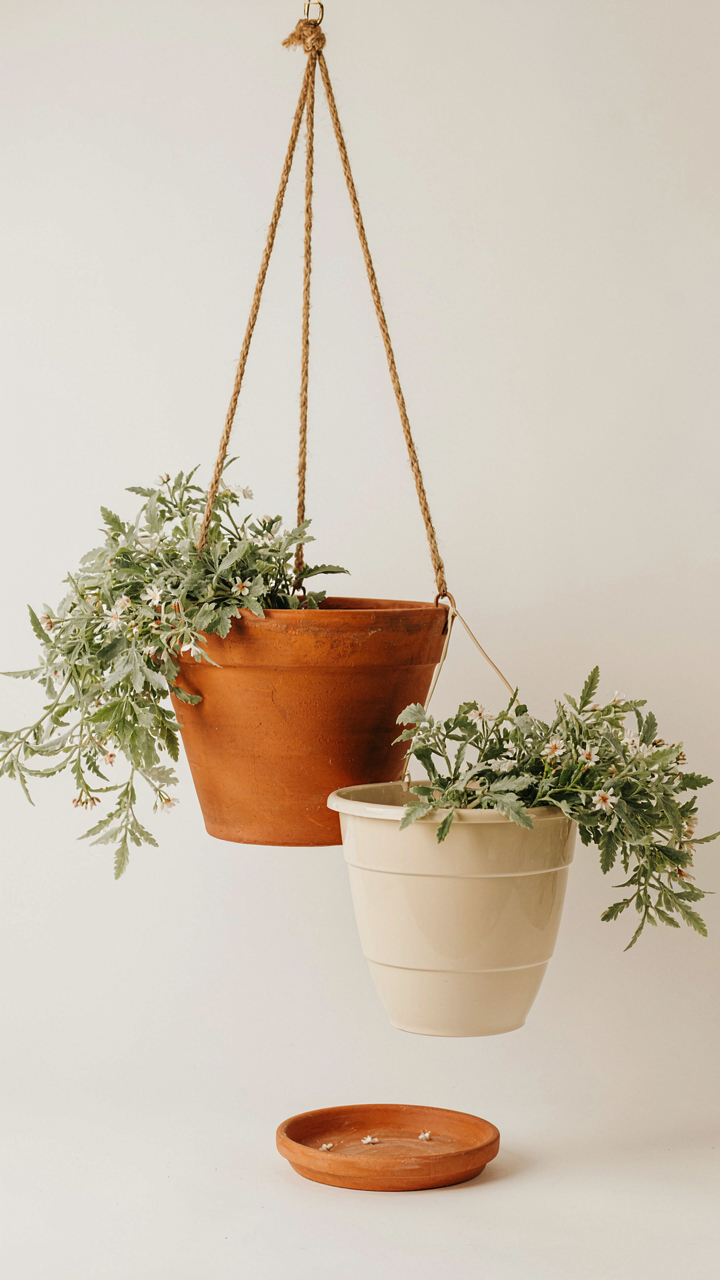
You want your basket to look intentional, which means you’re really asking whether the container itself does work for you or against you. Thermal dynamics—borrowed from physics—govern how fast your soil heats and cools. A terracotta basket acts like a heat sink, pulling moisture from soil and cooling roots faster than plastic or resin. Ceramic and wood moderate temperature swings but retain more water. Metal baskets conduct heat directly to roots on hot days. Choose based on your climate and watering consistency, not aesthetics alone.
The soil temperature inside a container fluctuates 15 to 25 degrees more than ground soil because the basket exposes soil to air on all sides. Trailing plants like pothos and string of pearls tolerate this variance, but succulents and ferns don’t. Thicker walls (terracotta at half-inch minimum, resin at quarter-inch) slow temperature swings by two to four hours. Drainage holes matter more than material—they prevent root rot, which kills trailing plants faster than any other single factor. Drill or punch holes if your chosen basket lacks them.
Negative Space Creates Visual Tension
Most people stuff baskets because empty space feels like failure. In design theory, negative space is the area around objects that defines their shape and gives your eye rest. A trailing basket packed to capacity reads as chaotic; one with deliberate gaps around focal plants creates hierarchy. The empty space isn’t wasted—it’s the reason the full areas read as intentional instead of overgrown.
Balance doesn’t mean symmetry. A basket with three trailing stems on the left and one on the right, with visible soil or basket rim between them, creates more visual interest than a perfectly filled sphere. The contrast between void and form makes each plant more visible. Start with 40 percent of your basket left unplanted. Let the trails fill that space as they grow over four to six weeks. This pacing forces you to choose plants that complement each other instead of compete.
The Gravity Tax: Engineering Support For Good Plants For Hanging Baskets
Stem Strength And Weight Distribution
You want your basket to look full without collapsing because a dead cascade looks worse than sparse growth. Here’s what actually matters: trailing plants distribute weight through their stem architecture, not magic. Thin-stemmed varieties like string of pearls fail under their own biomass once they exceed 12-18 inches of trailing length. Thicker-stemmed trailers like pothos handle 24-36 inches before stem failure becomes visible.
The real mechanism is cellular density. Succulent trailers store water in their tissues, which adds dead weight that weak stems cannot support. Non-succulent trailers like ivy allocate their biomass to structural lignin, not water storage, so they distribute load more efficiently across longer distances. Choose your trailing plant based on how much actual mass it accumulates per inch of length, not on appearance alone.
The Suspension Frame
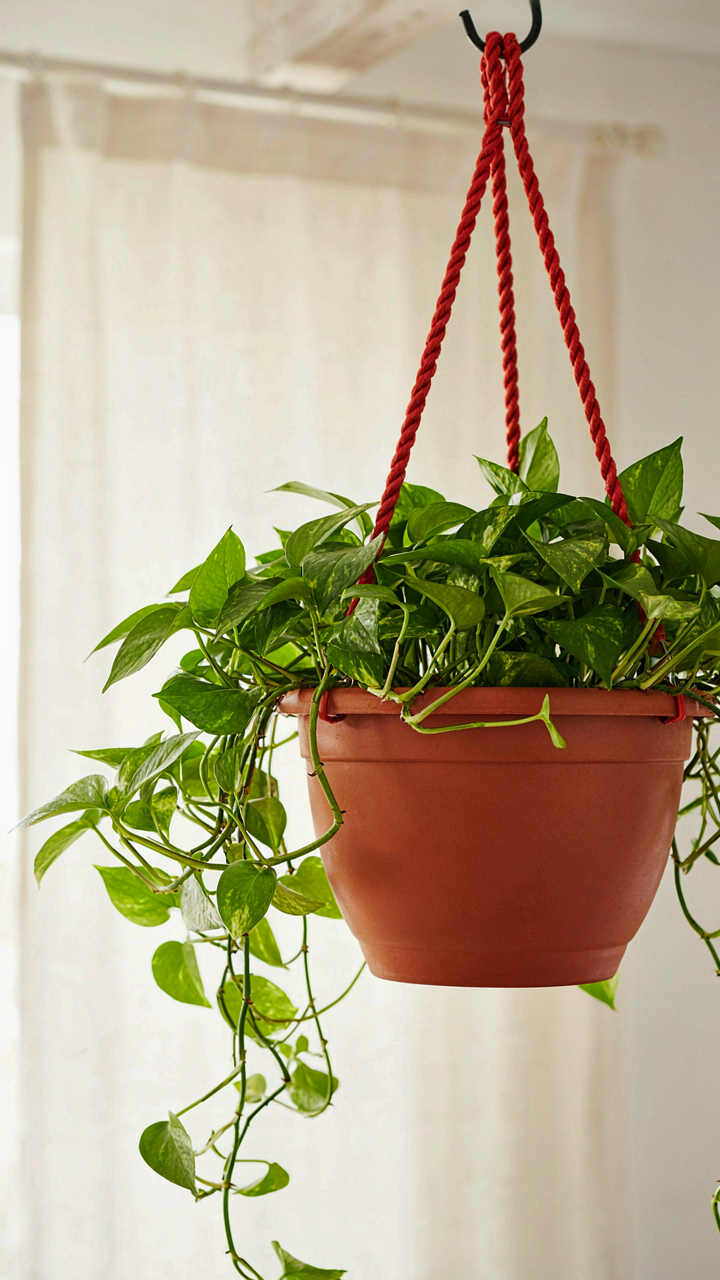
Think of this as load-bearing architecture from structural engineering: your hanging basket system is a beam under distributed load. A single hook centered on a weak chain fails because it creates a stress point, just like a beam snapping at its weakest attachment. The real fix is triangulation. Use three or four suspension points anchored to the basket rim instead of one, spreading force across multiple vectors so no single attachment carries full load.
Material choice is not cosmetic. Twisted wire or thin string breaks at specific tensile limits and provides zero safety margin as the plant grows. Braided nylon or steel cable withstands 5-10x the load of equivalent diameter alternatives because the braid distributes stress across multiple fibers instead of concentrating it. Anchor your suspension system to structural ceiling elements, not drywall or plaster. Then verify the basket rim itself won’t deform under load by selecting containers with reinforced rims, not thin plastic designed for lightweight potting soil only.
The Watering Wisdom: Precision Hydration, Not Drowning, For Gardening Tips

Know Your Species Before You Water
You want your baskets to look effortless, which means you’re actually afraid of killing them through neglect or overwatering. The real mechanism is this: different trailing plants have wildly different water needs, and soil composition in a hanging basket dries faster than ground soil, so you can’t just copy what works for garden beds. Petunias tolerate dry spells. Impatiens wilt if the soil surface dries out completely. Succulents like sedums rot if kept constantly wet. Fuchsias need consistent moisture but hate standing water. The only way forward is matching watering frequency to the specific plant species you’re growing, then adjusting for weather conditions like heat, humidity, and rainfall.
Check soil moisture by pressing your thumb one inch into the soil. If it feels dry at that depth, water thoroughly until drainage exits the basket’s holes. In hot weather, hanging baskets may need daily watering because they heat up and dry rapidly. During cool, cloudy periods or rain, skip watering entirely. The common advice to “water when the top inch is dry” is incomplete because it ignores that hanging baskets lose water from all sides, not just the top.
Holding Water Where It Matters
Moisture retention isn’t about keeping soil wet forever—it’s about extending the interval between waterings so the plant’s root system stays accessible to available water. Think of it like hydrology: retention infrastructure slows water movement through a system. In hanging baskets, coir fiber and quality potting mix with compost hold more water than cheap bark-heavy mixes. Water-absorbing crystals can hold up to 300 times their weight in water, releasing it slowly as soil dries, but they only work in mixes that also contain organic matter for the roots to access.
Apply a thin layer of mulch—coconut coir or shredded bark, about half an inch—to the soil surface inside the basket to reduce evaporation. This cuts water loss by roughly 25 to 40 percent depending on heat exposure. Water crystals work best mixed into the potting soil at planting time rather than added later. Check the soil temperature before deciding on mulch thickness in direct sun baskets, as thick mulch can trap heat and damage shallow roots. The protocol is simple: amend soil at planting with either quality coir-based mix plus crystals, or mulch existing baskets, but not both unless you’re managing extreme heat conditions.
The “Resilience Cycle”: Sustaining Your Stunning Trailing Baskets

Rotation And Rejuvenation Through The Seasons
You want your baskets to look perfect year-round without admitting they’ll eventually decline. That’s the real problem here. The mechanism is simple: trailing plants enter dormancy or decline based on light duration and temperature, not your care alone. Rotation moves baskets from high-stress zones to recovery zones. Spring baskets move to partial shade by July. Fall plantings move indoors before hard frost. Winter bloomers rotate to protected south-facing positions. This isn’t decoration advice. This is logistics. You’re matching plant physiology to environmental pressure, then rotating that pressure to different baskets.
Most growers abandon baskets mid-season instead of rotating them. The plant didn’t fail. You stopped reading its signals. A trailing petunia in full summer heat wants afternoon shade by June. A trailing ivy in winter indoors wants cool nights, not heated living rooms. Rotation extends the visual lifespan of each basket by 4-6 weeks because you’re not fighting biology, you’re choreographing it. The protocol: mark seasonal rotation dates on your calendar now. Move baskets every 4-6 weeks. Document which plants thrive in which zones. Next year, you have a system. This year, you have data.
Long Term Health Over The Short Win
Biology doesn’t reward extraction. Growth in trailing basket plants follows the same principle as asset depletion: rapid withdrawal collapses the system faster. Pinching new growth weekly for density feels productive. Removing every faded flower feels attentive. Both accelerate burn-out. The plant exhausts its nutrient reserves before establishing deep root structure. You get 6 weeks of density, then collapse. The alternative requires patience that feels like laziness. Feed on a 10-14 day cycle with half-strength fertilizer instead of biweekly full strength. This keeps nutrient availability steady without shocking the roots. Prune conservatively. Remove only dead material and crossing stems. Let the plant’s natural form emerge. Dense, stretched baskets fail faster than well-structured sparse ones.
The difference between a basket that peaks at week eight and one that sustains for sixteen weeks is this single decision: stop optimizing for now. A trailing basket’s real lifespan depends on root health, not branch count. Roots need oxygen, consistent moisture, and slow nutrient availability. Aggressive feeding and constant pruning compact soil and encourage shallow root systems. Those baskets collapse under their own weight by mid-summer. Sustained baskets receive gentle handling, consistent watering to soil moisture (not saturation), and fertilizer every 10-14 days at half the recommended dose. Measure success by week twelve, not week four.
Your Wilting Basket Proves You Prioritized Speed Over An Actual System. Stop Chasing Trends, Master Plant Physics

Most people kill their trailing hanging basket plants because they treat watering like a habit instead of a response. You don’t water on Tuesday. You water when the soil tells you it’s ready. Check the weight of your basket daily. Learn how your specific plant drinks. This one shift from guessing to observing changes everything. Master the physics of drainage and light before you worry about which trendy species to buy. The basket that thrives wasn’t chosen for Instagram. It was chosen because you actually understand how it grows.



