

The Illusion Of Easy Hanging Basket Flower Combinations

Why Most Advice Misses The Point
You want a hanging basket that looks magazine-worthy without thinking about it. That’s the real ask. The problem isn’t that conventional advice is wrong—it’s that it treats hanging baskets like a static design problem when they’re actually a system problem. Every recommendation you’ll read focuses on color matching and plant size while ignoring the one variable that determines success: water retention mechanics. A basket that dries out in three days will kill your combination no matter how perfectly you paired the petunias with the ivy.
The consensus says “mix trailing, mounding, and upright plants.” True, but incomplete. This framework comes from landscape design, where spatial hierarchy matters. In hanging baskets, though, you need to reverse-engineer from the container’s water-holding capacity first. A shallow plastic basket with poor drainage demands drought-tolerant plants like sedums and calibrachoa. A deeper, lined wire basket tolerates thirstier specimens like impatiens and begonias. Start with the container type, not the color scheme.
The Cost Of Following Templates
Generic combinations fail because they ignore your climate, your watering habits, and your actual light conditions. You’ll invest in a pre-made combo or follow a blog’s suggestion, watch it wilt by July, and blame yourself. The real culprit is that most templates assume temperate regions with moderate humidity and afternoon shade. If you live in dry heat or full sun exposure, a combination designed for Scottish growing conditions will collapse within weeks. Nobody says this directly because it complicates the sale.
The hidden cost runs deeper than dead plants. Each failed basket teaches you nothing actionable because you don’t know which variable failed: drainage, water frequency, light exposure, or plant incompatibility. This loop locks you into buying replacements. The mechanism that breaks the cycle is diagnostic: before designing your combination, audit three things—your basket’s drainage capacity, your actual daily watering schedule, and your light hours. Only then select plants that match those constraints, not the other way around.
Beyond Aesthetics: Engineering Your Hanging Basket Ecosystem

Water And Light Demand Alignment
You want your basket to look effortless. That’s the real reason you’re reading this section. The mechanism that actually determines success isn’t color theory or plant height. It’s whether every plant in the container receives the same water and light intensity. Physiology operates on a zero-sum principle: a shade-loving plant in full sun will transpire faster than its root system can absorb water, while a sun-demanding plant in partial shade stays perpetually undersaturated. The basket fails not because plants clash aesthetically but because their biological thresholds conflict.
The standard advice says “mix foliage plants with bloomers for texture.” That misses the real constraint. You need plants whose stomatal response patterns converge on the same watering frequency and light band. A vinca and a verbena both demand full sun and accept dry-down cycles between waterings. An impatiens and a dusty miller do not occupy compatible ecological niches in the same container. Test this by checking each plant’s published light range and soil moisture preferences against the basket’s actual microclimate before combining anything.
Root Competition And Nutrient Partitioning
Plants don’t fail in baskets because they fight for space. They fail because they compete for the same nutrient pools in an environment with zero recovery time. Ecology provides the framework: niche differentiation. In hanging baskets, this means selecting plants with different root depths and feeding schedules so they’re not extracting nitrogen from identical soil layers simultaneously. Shallow-rooted trailing calibrachoa and deep-rooted upright coleus occupy different vertical zones within the same medium and draw nutrients from separate profiles.
Balanced basket design requires deliberate root architecture planning, not random aesthetic pairing. Measure the effective rooting depth of each candidate plant. Combine shallow feeders with medium-depth root systems and one deeper anchor plant. Feed on a split schedule: lighter doses every seven days rather than heavy feeding once monthly. This prevents the nutrient depletion spike that crashes baskets by mid-summer. The specific action is to assign each plant a root-depth category before planting, then space feed applications to match the shallowest plant’s uptake rate.
The Microclimate Manipulation Protocol For Flowering Hanging Baskets
Heat Absorption And Dissipation Control
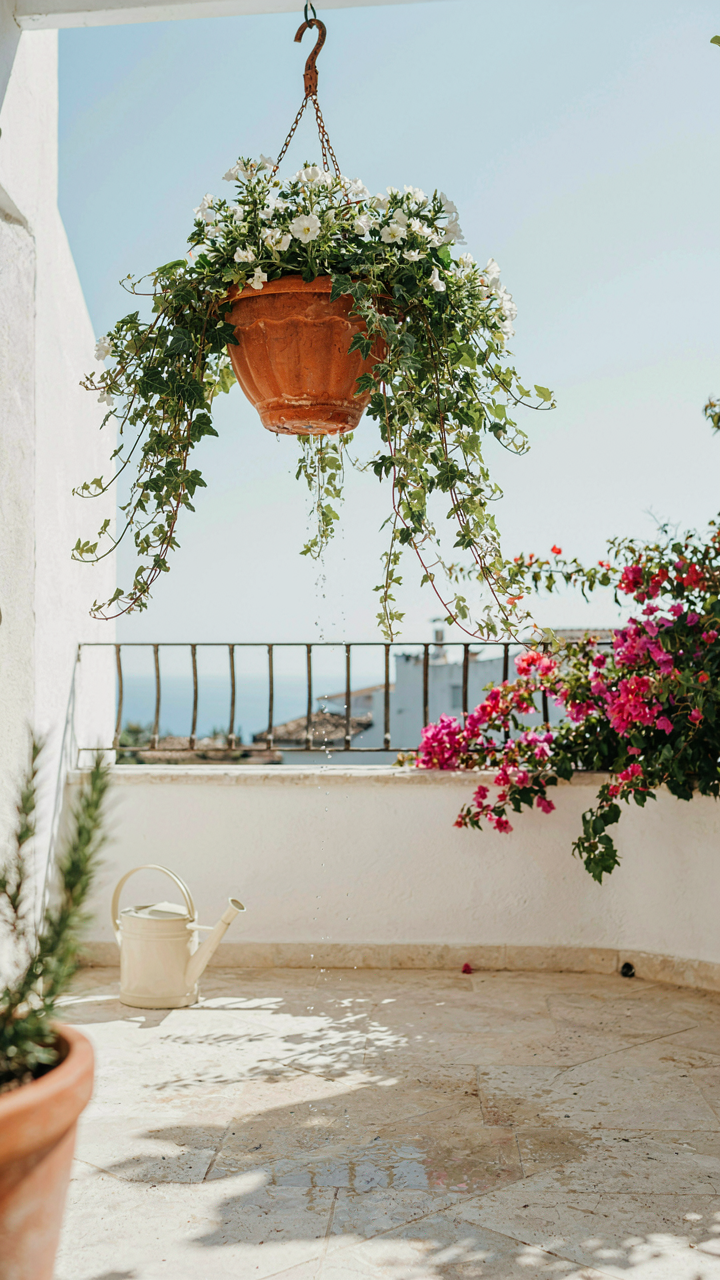
You want your baskets to look effortless. They won’t. The real reason you’re reading this is you’re tired of watching flowers wilt after two weeks while your neighbor’s thrive. Here’s what nobody tells you: thermodynamics governs container gardening the same way it governs industrial cooling systems. Your hanging basket is a thermal mass problem. Dark containers absorb solar radiation and trap heat. Light containers reflect it. The soil temperature inside that basket can swing 15 to 20 degrees Fahrenheit between morning shade and afternoon direct sun, and your flowers respond by stress-closing their stomata and halting growth.
Basket material and color are your primary lever. Terracotta breathes and allows evaporative cooling but dries fast in heat. Plastic holds moisture longer but heats up quicker. Resin and composite materials fall between. Position baskets where afternoon sun hits them sideways, not head-on. Move them into dappled shade during peak summer heat, especially if you’re growing petunias, impatiens, or begonias. These species have thin leaf tissue and dehydrate rapidly under sustained high temperatures. The thermodynamic rule: manage container temperature first, plant selection second.
Water Movement And Retention Architecture
People say “don’t overwater.” Useless advice. You need to understand what drainage actually does. Fluid dynamics teaches us that the flow rate of water through soil depends on soil porosity, particle size, and gravitational gradient. A hanging basket with poor drainage doesn’t just retain water. It creates anaerobic zones where roots rot. One with excessive drainage starves roots between waterings. The mechanism is pore space saturation and capillary action working against you simultaneously.
Construct your basket substrate in layers. Bottom layer gets perlite or coarse bark for rapid drainage. Middle layer gets a moisture-retaining mix: peat moss or coco coir blended with compost. Top layer goes back to lighter material so water penetrates evenly instead of running down basket sides and out. Use a hanging basket liner that breathes but doesn’t compress over time. Coconut fiber works better than plastic because it maintains air pockets through the season. Check moisture by weight, not appearance. A saturated basket feels noticeably heavier. Water until it drips from the bottom, then wait until the top inch dries before watering again. This cycle prevents both root rot and drought stress.
The Three Tiered Design For Optimal Hanging Basket Trailing Plants
Why The Thriller Filler Spiller Framework Fails You
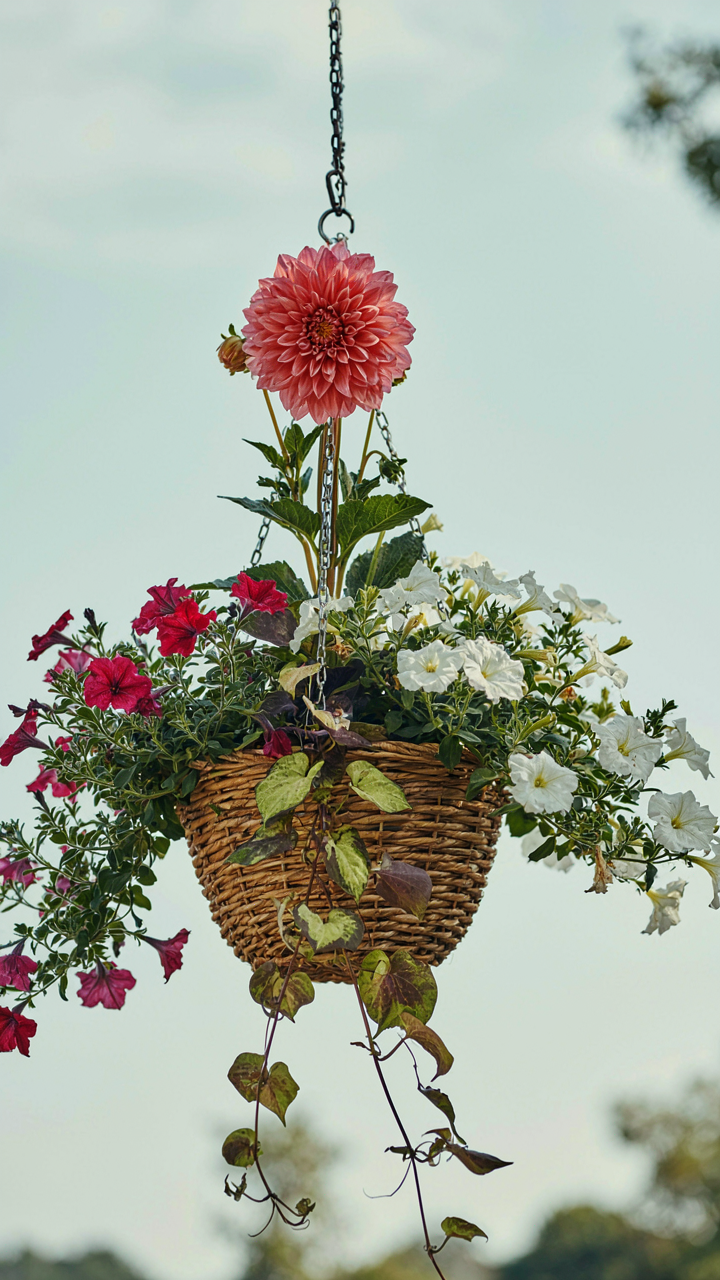
You want a formula because formulas feel safe. They promise control. Here’s what actually happens: the thriller-filler-spiller model treats a hanging basket like a static display instead of a living system with different watering needs, root competition, and light demands. The mechanism nobody states is that this framework prioritizes aesthetics over survival. A tall focal plant in the center of a hanging basket dries faster than trailing plants on the perimeter because it sits higher and catches more wind and sun. Meanwhile, fillers and spillers below it compete for the same soil volume and nutrients, creating a resource bottleneck.
The real problem is mixing plants with incompatible microhabitats in one basket. A dahlia needs consistent moisture and prefers afternoon shade. Trailing petunias and sweet potato vine need sharp drainage and full sun. You can’t achieve both in six inches of soil. Stop treating the basket as one zone and start treating it as three distinct growing chambers with different conditions.
Layering That Accounts For Real Growing Conditions
In horticulture, the concept of stratification refers to how plants occupy different vertical layers in their ecosystem. Your hanging basket isn’t one environment, it’s three: the exposed upper perimeter where sun and wind assault plants, the shaded mid-section where the basket rim blocks light, and the inner core where root density peaks and moisture lingers longest. This shifts your plant selection entirely.
- Upper Perimeter Plants: Trailing varieties that tolerate exposure. Sweet potato vine, diascia, and bacopa handle heat and wind without wilting by midday. They dry out predictably, so you can time waterings to their rhythm.
- Mid Section Fillers: Shade tolerant densifiers that don’t compete aggressively. Impatiens, begonias, or torenia thrive in the dappled light the basket rim creates. They buffer moisture loss from the outer layer.
- Central Core Plants: Deep rooting or moisture lovers that anchor stability. Ivy geraniums or trailing fuchsias root deep enough to access retained moisture without choking out neighbors.
- Soil Density Variation: Use coarser mix on the perimeter, standard mix in the middle, and moisture retentive mix in the core. This prevents the outer plants from drying the center to dust.
- Watering Protocol: Water from the inside out. Saturate the core first, let it draw moisture to mid section, then surface water the perimeter last. This creates a moisture gradient instead of uniform saturation that kills trailing plants.
The mechanics are simple. You’re not fighting a basket’s physics anymore, you’re exploiting them. The basket’s shape creates three distinct microclimates whether you acknowledge it or not. You choose: fight it with a one size fits all approach, or layer plants according to the conditions each zone actually provides.
Plants For Hanging Baskets: Unconventional Choices For Superior Results

Water Demand Misalignment Kills Baskets Faster Than Neglect
You want a basket that looks effortless. That’s the real motive here. But effortless requires brutal honesty about water physics. Hanging baskets have surface area exposure on all sides, meaning they dry three to four times faster than ground soil. This isn’t opinion. This is evaporation. Most gardeners pair drought-tolerant plants with high-water feeders in the same basket, then blame themselves when one thrives and one dies. That’s not failure. That’s incompatible demand meeting finite resource.
The mechanism is simple: isolate your water classes. Drought-tolerant species like sedums, dichondra, and calibrachoa handle irregular watering and air exposure without stress. High-water plants like impatiens, fuchsia, and begonias require consistent moisture and shade to prevent transpiration loss. Don’t mix them. Stack drought-tolerant plants at the basket’s outer edges where wind exposure peaks. Put water-hungry species in the center where air movement slows and soil moisture stabilizes longer. Water once, serve both groups without compromise.
Mutualism Over Aesthetics In Plant Selection
Ecology teaches us that organisms survive through resource exchange, not competition. Hanging basket combinations work the same way. You’re not arranging plants for Instagram. You’re building a microclimate where each species reduces stress on the other. Most advice ignores this entirely and focuses on color contrast alone. That’s incomplete thinking.
Pair shallow-rooted trailers like sweet potato vine with deeper-rooted upright plants like pentunia. The vine draws moisture from surface soil; the pentunia’s roots access deeper reserves. Neither compete for the same resource layer. Combine fine-textured foliage plants like asparagus fern with bold-textured flowers like marigolds. The fern’s light canopy lets air and water penetrate to lower soil zones while the denser flowers shade roots and reduce evaporation. Test this pairing strategy by monitoring soil moisture at three different depths over two weeks, adjusting plant ratios based on which layer stays driest longest.
Soil Science For Hanging Basket Flower Ideas: It’s Not Just Dirt
The Permeability Problem
You want your baskets to look full and lush without rotting out in two weeks, but nobody tells you the actual mechanism at work here. Drainage and aeration operate on the same principle as soil infiltration in civil engineering: water moves through soil by gravitational pull and capillary action. A hanging basket fails when the medium compacts, sealing off air pockets. The soil becomes a barrier instead of a filter. Most people dump potting soil in and wonder why roots suffocate.
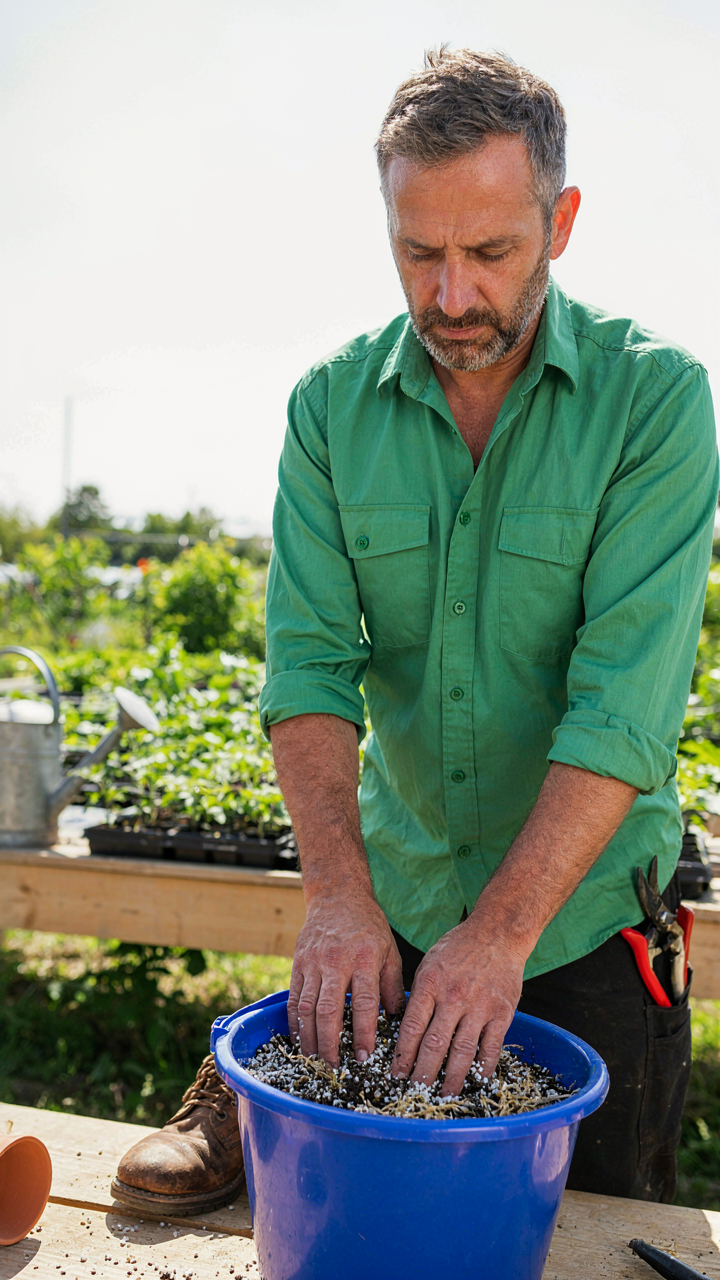
The fix is structural, not chemical. Use a base layer of horticultural bark or coarse perlite—roughly 15 to 20 percent of your total medium—to create permanent air channels. These don’t collapse under water pressure. Add sphagnum moss to the upper layers for water retention without compression. The goal is a medium that drains within 15 minutes after watering while still holding enough moisture for root uptake. Compress nothing. Stack materials by density: heaviest at bottom, lightest at top.
Feeding Without Drowning The System
Nutrient release in containers works against you because confined soil volumes amplify salt concentration. Bacteria and fungi break down organic matter into plant-available nitrogen, phosphorus, and potassium, but in a basket this happens fast and uncontrolled. Most advice says “use slow-release fertilizer,” but that’s incomplete. Slow-release pellets work only if your drainage is correct. Poor drainage traps salts. Good drainage flushes them out too quickly.
The real protocol uses layered nutrient timing. Mix a balanced granular organic fertilizer into your base layer only—about one tablespoon per gallon of soil. This feeds early growth. Apply liquid fertilizer every 10 to 14 days during the bloom cycle, but reduce concentration by 25 percent compared to ground beds. Your basket dries faster, so plants uptake nutrients quicker and leach salts harder. Weekly flushing with plain water after feeding prevents salt burn. This is the mechanism that keeps combinations blooming consistently without toxicity buildup.
The Watering Regimen: Precision Hydration For Container Gardening Flowers

What Actually Kills Your Hanging Baskets
You want your basket to look effortless. That’s why you kill it with water. Most growers either drown their containers daily or let them dry out completely, then panic-water when plants wilt. The mechanism here is simple: hanging baskets have zero water storage. Soil in a basket dries faster than in-ground soil because air circulates underneath and around the sides. You can’t water on a schedule. You water by soil condition, which changes based on heat, humidity, wind, and pot size. This is not negotiable.
The real variable most people miss is substrate composition. Use a soil blend with perlite or bark chunks, not dense potting mix meant for indoor pots. Dense soil stays wet too long in a basket and causes root rot. Light, amended soil drains fast but holds just enough moisture for roots to access between waterings. Test soil moisture two inches down before you water anything. Wet soil means wait. Crumbly, slightly dry soil means water until it drains from the bottom. This becomes automatic after two weeks.
Root Stress And Saturation Points
Plant biology uses the term “anaerobic threshold.” That’s when roots stop breathing because water occupies all air pockets in soil. In hanging baskets, you hit this threshold faster than anywhere else because drainage is aggressive. Wet roots sitting in standing water for more than a few hours triggers root rot bacteria and fungal growth. The plant wilts not from lack of water, but from dead roots that can’t uptake it.
Dehydration shows as wilting, leaf curl, and browning at edges first. Over-saturation shows as wilting too, but the soil stays wet and smells sour or musty. You distinguish between them by touch: squeeze moist soil gently and it should crumble, not clump or stay soggy. If soil clumps, you’ve saturated. If it’s powder-dry and plants wilt, you’re under-watering. The protocol is this: water deeply until drainage runs from the bottom, then do not water again until soil dries to the two-inch mark. Check daily during heat waves, every other day during mild weather.
Fertilization: Fueling Peak Performance In Hanging Basket Ideas

What Your Plants Actually Need
You want hanging basket combinations to look magazine-ready without doing the work. That’s the real motive. But here’s the mechanism: container plants live in a closed system. Soil breaks down fast. Rain and watering leach nutrients out. Unlike ground soil that cycles nutrients naturally, your basket needs constant replenishment. Nitrogen, phosphorus, and potassium form the base—but magnesium, iron, and calcium matter too. Deficiencies show up as yellowing leaves, weak stems, and dead flowers. Most growers miss this because they think fertilizer is optional maintenance when it’s actually the fuel replacing what the system can’t generate.
Micronutrients do the invisible work. Iron makes chlorophyll. Magnesium activates photosynthesis. Calcium strengthens cell walls and prevents blossom-end rot in some species. You can’t see these at work, but their absence appears suddenly. Hanging baskets with petunias, verbena, and calibrachoa demand constant feeding from May through frost because blooming drains the soil faster than ground plants. Start measuring fertilizer concentration by parts per million, not guesswork. Most hanging basket combinations need 150 to 200 ppm nitrogen during peak bloom season. Your feeding schedule determines whether you get one month of flowers or four.
Feeding Strategy That Actually Works
Conventional advice splits into two camps: slow-release pellets versus weekly liquid feeding. Both work. Neither is complete. Think of this in agricultural terms—slow-release is like crop rotation, liquid feeding is like precision irrigation. Slow-release granules release nutrients over 4 to 8 weeks depending on temperature and moisture. They handle base nutrition passively. Liquid fertilizers hit immediately and flush out in days. The real play combines both. Start hanging basket combinations with slow-release mixed into potting soil at planting. Then layer in liquid feeding every 7 to 10 days once blooms appear.
- Slow-release pellets (osmocote, miracle-gro): Mix into soil at planting for 6 to 8 week baseline coverage. Temperature-dependent release means slower feeding in spring, faster in heat. Prevents early deficiencies.
- Weekly liquid concentrate (20-20-20 or higher phosphorus): Applied every 7 to 10 days during bloom season. Delivers quick nutrient hits when petunias and impatiens demand heavy feeding. Dilute to label strength or slightly lower to prevent salt burn.
- Foliar spray (diluted liquid fertilizer on leaves): Apply early morning or late evening on calm days. Leaves absorb nutrients faster than roots, useful for emergency micronutrient correction when yellowing appears mid-season.
- Organic alternatives (fish emulsion, kelp extract): Release nutrients slower than synthetic fertilizers but build soil biology over time. Better for gardeners prioritizing soil health over peak performance consistency.
- Specialty formulas (higher potassium for blooms): Switch to 10-52-10 or similar once flower buds set. Phosphorus and potassium trigger and sustain flowering. Standard balanced fertilizer produces foliage over blooms.
Start with slow-release at planting, then switch to liquid feeding once the first flower buds appear. This two-phase approach prevents early nutrient waste while matching peak feeding to peak demand. Most hanging basket combinations fail not from neglect but from feeding at the wrong time to the wrong formula. Adjust liquid feeding frequency based on rainfall. Heavy rain flushes the pot, requiring feeding every 5 days. Dry spells mean every 10 days works. Check soil moisture before each application. Wet soil doesn’t absorb more fertilizer—it dilutes it.
Pest And Disease Management For Hanging Baskets Flowers: Proactive Defense

What Actually Threatens Your Basket
You want your hanging baskets to look untouched by nature’s chaos, but pests don’t care about aesthetics. The real mechanism: enclosed baskets trap humidity, creating ideal conditions for spider mites, aphids, and powdery mildew. These organisms exploit density. When you pack petunias, calibrachoa, or verbena tight for that full look, you’ve engineered the perfect breeding ground. Inspect leaf undersides and soil surface every three days. Early detection stops exponential spread.
Common threats show themselves in specific ways. Spider mites leave fine webbing and stippled yellowing leaves. Aphids cluster on new growth and excrete sticky residue. Powdery mildew appears as white coating on foliage. Fungal gnats hover near soil. Whiteflies flutter when disturbed. You won’t catch these by glancing at your basket from the patio. Get close. Touch leaves. Check both sides. This habit saves weeks of damage control.
Environment Over Chemicals
Borrowed from agricultural epidemiology, the principle of “host susceptibility” applies directly to hanging baskets. Weakened plants attract pests at higher rates than vigorous ones. Poor airflow, overwatering, and nutrient imbalance create susceptible hosts. Stop treating pest problems as external invasions requiring immediate chemical response. The real work happens before infection spreads. Space plants within baskets to allow air movement. Water at soil level only, never overhead. Provide consistent feeding throughout the growing season.
Physical barriers and habitat management work faster than most gardeners realize. Remove infected leaves immediately and discard in sealed bags, not compost. Prune lower foliage to increase airflow. Reduce watering frequency if soil stays damp. Use neem oil or insecticidal soap only after confirming pest presence, not as preventive spray. Repeat applications every seven to ten days for two weeks. This protocol stops the cycle without chemical dependency. Document what you find and when you found it. Data beats guessing.
The Real Obstacle Isn’t Your Green Thumb, But Your Failure To Master Ecological Principles. Stop Decorating, Start Designing

Most people buy flowers and shove them in baskets. You need to think like an ecosystem instead. Water retention, root competition, light availability, nutrient cycling. These aren’t boring details. They’re the difference between a basket that thrives for months and one that dies in weeks. Stop asking what looks pretty. Start asking what actually works together. Today, pick one basket and map its conditions: sun hours, wind exposure, moisture patterns. Design around reality, not Instagram. Your flowers don’t care how beautiful your vision is. They care if you understand them.



